Showing posts with label Sean-T. Show all posts

20070528

Holdin' the weight of the Bay -- Mistah F.A.B.

By Garrett Caples
San Franciso Bay Guardian May23, 2007

The rapper all rapers want on their album, and the first pure product of the hyphy movement. Mistah FAB works around Atlantic's delay of his major-label debut, walks out the independent Da Baydestrian...

Still looks like slavery

But it's the black legacy

--Mistah FAB, "100 Bars"

One night last September, I hitch a ride with G-Stack of the Delinquents and Dotrix of Tha Mekanix to Dem Hoodstarz's album release party in San Francisco. As we park outside the club, Mistah FAB rolls up with a modest posse. In contrast to his usual iced-out Technicolor clubwear, the man also known as Fabby Davis Jr. is low-key, dressed all in black, a pair of designer stunna shades supplying the main clue to his identity. He hops in Stack's car to hear a newly laid track for the latter's upcoming Purple Hood, then we set out for the club, a less than half block journey whose distance is lengthened interminably by a series of well-wishers and business consultations. It's like following two CEOs across the floor of the stock exchange: Stack is on two cell phones, trying to shake hands with someone. FAB, meanwhile, handles minor transactions, poses for a photo, and takes a call, all while briefing me on the deal he had just signed with Atlantic Records for Da Yellow Bus Rydah, the much-anticipated follow-up to his 2005 disc, Son of a Pimp (Thizz Ent.).

Near the door, a man takes FAB aside. "FAB, you gotta do something about the violence," he says, meaning specifically the 141 homicides in Oakland in 2006 under former mayor and present attorney general Jerry Brown. FAB nods at what is clearly an unreasonable request, albeit one that reflects the disproportionate political burden borne by black entertainers in America. No one would turn to, say, Justin Timberlake to stop violence. Then again, I imagine no one asks Keak Da Sneak either. FAB's position, in other words, is unique.

Though he made his early reputation as a freestyle battle rhymer and owes his success to hyphy hits like "Super Sic Wit It," FAB's lyrics seldom stray into gangsta or pimp terrain — the title of his last album is simply literal. Yet he can get down on a track with the most thugged-out MCs. Aside from the giants Too Short and E-40 and on par with the perpetually hot Keak, FAB is the rapper all Bay Area rappers want on their albums, because he has the biggest buzz on the radio and in the streets. His popularity gives him influence, but FAB commands respect in the hood because he's from the hood: his compass-based hit "N.E.W. Oakland" was the first major rap recognition of his native North Oakland as a hood. This rapport with the alienated and isolated ghetto youth who constitute hyphy's core audience separates him from the vast majority of MCs to whom the label "conscious" may be applied.

"You go up to someone in the hood and be, like, 'Dick Cheney had a heart attack,' they be, like, 'Who the fuck is Dick Cheney?'" FAB says later. "But you tell him, 'Jay-Z donated a million dollars to improve water in Africa,' they be, like, 'For real?' That's something of their world. Being a Bay Area artist, I'm of their world. So you have the opportunity to teach without them knowing."

"People who have influence," FAB continues, "have an obligation to tell people, 'Preserve life. Save lives. Help lives.' But it's hard to reach people if you're not giving them something they relate to. The hyphy movement is something they relate to. Hyphy gets you in the door, to open their ears to what I'm saying. It's up to them to digest it."

That night at the club, FAB exerts his influence. When things get salty between security and Dem Hoodstarz's East Palo Alto associates, the group calls FAB to the stage to perform their collaboration "Ugh." Things chill out. FAB issues an impromptu plea against violence and murders. These are problems no single person can solve, but FAB is doing his part. Yet by the show's finale — the "Getz Ya Grown Man On" remix, on which he has a verse — Fabby Davis has left the building. Being Mistah FAB, I realize, can be exhausting.

FOLLOW THE YELLOW BUS ROAD

Mistah FAB's deal with Atlantic is a landmark in a scene long neglected by the majors. Along with Clyde Carson's signing with Capitol, FAB's arrangement — including distribution for his Faeva Afta Entertainment — is the first serious acknowledgment of the renaissance Bay Area rap has undergone in the past three years. Unlike E-40, a regional star who'd already achieved platinum sales on Jive before his push last year by Warner Bros., FAB's an unknown quantity outside the Bay. And in contrast to Frontline or the Federation — whose deals came through the respective backing of nationally known producers E-A-Ski and Rick Rock — FAB is the first evidence for a new generation of local rappers that enough talent and dedication can get you signed. It's another weight on the shoulders of the man born Stanley Cox Jr.

"Lots of people are putting their hopes into the album," he acknowledges. "They're, like, 'I hope FAB do it, because it'll kick in the door for all of us.' I realized when I was creating this album it's not just something I want to do. It's something my whole region depends on."

Da Yellow Bus Rydah's journey has been anything but smooth, however. Bottom line: Atlantic has postponed the album's tentatively scheduled spring release, due to controversy surrounding the Ghostbusters-themed advance single, "Ghost Ride It." A tribute to the hood-invented practice of throwing your car in neutral as you walk alongside and steer, "Ghost Ride It" was generating a buzz through its a video on YouTube and the minor-league MTVs when a Dec. 29, 2006, Associated Press story ("Hip-Hop Car Stunt Leaves 2 Dead") linked the song with a pair of unrelated deaths: Davender Gulley, 18, of Stockton, who "died after his head slammed into a parked car while he was hanging out the window of an SUV," and an unnamed "36-year-old man dancing on top of a moving car [who] fell off, hit his head and died in what authorities said was Canada's first ghost riding fatality." While the scant details obscure whether these incidents stemmed from ghost riding or more traditional automotive horseplay, Fox News's Hannity and Colmes found the trend alarming enough to call FAB on the carpet in January.

"You understand that a lot of kids look up to you?" Sean Hannity accused rather than asked FAB. "They sing your songs. They dress like you. They talk like you — they wanna be you!" Aside from displaying an oversimplified sense of the relationship between artist and audience, Hannity's remark reveals a comic lack of familiarity with hip-hop and their guest in particular: what part of "Super Sic Wit It" do you sing? Moreover, while rap fans undoubtedly draw from the same well of slang, the idea that they all talk the same — or even like FAB, for that matter — is a stereotype.

"I don't think they expected me to be so articulate," FAB recalls with a laugh. Yet among MCs, FAB is singular interview subject. While he has a clear sense of his talent and importance, he's more apt to discuss his personal relationship with God or how his lonely childhood as a latchkey kid inspired him to create rather than brag about how real he is. His power to articulate the struggle of urban youth — to explain the rage that motivates, say, ghost riding — is the very reason he's often labeled the spokesperson for a hyphy movement otherwise devoted to "going dumb."

Hannity treated FAB like he's dumb, but FAB turned the tables. Hannity's denunciation of his effect on the "kids" prompted the rapper to question whether his influence rightly extends to a Canadian 11 years his senior, which Hannity countered by accusing FAB of wanting as much "money and controversy" as he can get. When FAB speculated on the influence of turning on the TV and seeing 3,000 soldiers die in Iraq, Alan Colmes was sent in as a balm, ending the segment.

"Both those people were adults," FAB says later of the ghost-riding deaths. "I feel bad for the families, but at the end of the day, an adult has to take responsibility for his actions."

GHOSTBUSTED

The next pothole for Yellow Bus was a late March cease and desist letter from Columbia Pictures for copyright infringement in the "Ghost Ride It" video — just as it was about to debut on MTV's 106 and Park. "We had permission [to use the Ghostbusters van] from the man who built it and owns it," FAB explains. "But Columbia owns the logo." The video was immediately pulled from all media outlets, impairing Atlantic's ability to market the single nationally. As a result, the Yellow Bus has been parked. The official explanation, from Atlantic VP Mike Carin, is that the label is focusing on FAB's "artistic development." Despite the inevitable rumor that the rapper was dropped, Carin confirms that "the deal is still in place."

Still, such delays have silenced many MCs' buzz: witness how the delay of Raekwon's album on Aftermath has converted excitement into skepticism, or how the Team's World Premiere (Moedoe/Koch, 2006) dropped too long after its singles had peaked, leading to lower-than-expected sales. Fortunately, the structure of FAB's distribution deal allows him an unusual degree of freedom.

"They were willing to sacrifice certain things," he says of his initial decision to sign with Atlantic among competing offers. "They allowed me to do what I want to do — if I want to drop an independent album, I can."

ENTER DA BAYDESTRIAN

This flexibility has allowed the prolific FAB to immediately walk out another new album, Da Baydestrian, on May 15, through SMC/Fontana. Although, according to SMC cofounder Will Bronson, Atlantic has options to include as many as five of its songs on Yellow Bus, Baydestrian is an otherwise distinct project intended to satisfy the demand for a follow-up to Son of a Pimp. FAB's also preparing a series of summer releases, including a second installment of the all-freestyle Tonite Show with DJ Fresh. (Fresh, incidentally, edited FAB's 2005 DVD, The Freestyle King, now packaged with Baydestrian as a bonus.) With Beeda Weeda and J-Stalin, representing the East and West respectively, FAB's formed the multihood group N.E.W. Oakland, whose mixtape is nearing completion. Prince of Da Bay (In Yo Face/Hooker Boy Filmz), a documentary on FAB by local hip-hop director Dame Hooker, should be out by press time, while FAB's next DVD, Shoobalaboobie TV, is in the works.

"You do what you have to do to keep the buzz going," FAB says. "Also sales — on the independent level, your numbers are what's important [to major labels]." Da Baydestrian thus has Atlantic's blessing, but its commercial success will determine the fate of his deal.

Yet the need to appeal to the marketplace hasn't inhibited FAB's creativity, and Da Baydestrian refuses to play it safe. Rather than exploit the hyphy sound he helped establish, FAB only sprinkles it in, most obviously on the remix of the Traxamillion-produced "Sideshow" and the opening title track, one of six bangers produced by FAB protégé Rob-E. The young Martinez-born producer proves his versatility on tracks like the triumphant "Get This Together" and the melancholy "Life on Track," featuring Faeva Afta vocalist J-Nash, whose Hyphy Love drops in August. Another four productions by Son of a Pimp collaborator Genessee contribute to Baydestrian's in-house feel even as the family breaks new ground: "Can't Wait," say, evokes Andre 3000's explorations of go-go, filtered through FAB's hyphy sensibility, while "Shorty Tryin' 2 Get By" is a contemporary "Keep Ya Head Up" spiced with Bay Area R&B. The album is refreshingly free of skits, and guest stars are kept to a minimum, but Too Short blesses the disc three times, an unambiguous stamp of approval from Bay rap's founder.

What makes Da Baydestrian one of the most extraordinary albums since hyphy's inception, however, is its social consciousness. "Deepest Thoughts," for example, hits out at President George W. Bush, but even more pointedly at Gov. Arnold Schwarzenegger for expanding the prison system instead of aiding the poor. The Sean T–produced "Crack Baby Anthem" addresses teen dope dealers, seeking to uplift without castigating or glorifying their activities — for the nonghetto audience, the song connects the dots between poverty, crime, and the present political climate. FAB describes his approach as "hip-hyphy," presenting an alternative to hip-hop fans who consider hyphy juvenile or incomprehensible. Granted, the disc's school bus and helmet imagery — referring to the hyphy concept of acting "retarded" — is hardly p.c. Nonetheless, FAB's lunchbox-wielding Baydestrian is a welcome change from the exaltation of guns and dope adorning your average rap album.

"In no way am I trying to say I'm like Martin Luther King or Malcolm X," FAB explains. "But I realized I could create nonsense and seem to support ignorance, or I can get people to start looking at the reality of it, and the reality of it is that young blacks are dying, not only in the Bay; they're dying everywhere. We've been raised in a warlike civilization. We've been brainwashed to accept war as the proper thing to do when things don't go right."

"Tupac [Shakur] said it himself," FAB concludes. "He said, 'I'm not going to be the one to change the world. But I guarantee I'll plant a seed in the mind of someone who does.' We're all the Tupac generation. Pac was hyphy."

While I don't think it's my place to declare FAB the next Tupac, I can't fail to be struck by his invocation of the Bay Area icon. On a superficial level, of course, with all his non-thugged-out, cartoonish imagery, FAB is nothing like Pac, just as the hyphy movement differs from the Bay's mid-'90s sound. Yet locally, if not nationally, the two rappers occupy the same position on the map of hip-hop: like Pac, FAB has cred with nearly everyone, he has a positive message within an utterly street aesthetic, and he makes tunes everyone wants to hear.

No rapper has embodied all three attributes since Pac, and that combination makes FAB extraordinary.

www.myspace.com/mistahfab


Read More...

20061202

The 'Moe Show -- San Quinn, Messy Marv, Big Rich, Will Hen leading out from the Fillmore

by Garrett Caples
San Franciso Bay Guardian November 22, 2006


If you don't know about the Filthy ’Moe

It's time I let real game unfold....

Messy Marv, "True to the Game"

I meet Big Rich on the corner of Laguna and Grove streets, near the heart of the Fillmore District according to its traditional boundaries of Van Ness and Fillmore, although the hood actually extends as far west as Divisadero. "Me personally," the 24-year-old rapper and lifelong ’Moe resident confesses, "I don't be sticking my head out too much. But I make sure I bring every photo session or interview right here."

At the moment he's taping a segment for an upcoming DVD by the Demolition Men, who released his mixtape Block Tested Hood Approved in April. Since then, the former member of the San Quinn–affiliated group Fully Loaded has created a major buzz thanks in part to the snazzy video for "That's the Business," his E-A-Ski- and CMT-produced single. It was the Jam of the Week in August on MTV2 and added to straight-up MTV in time for the Oct. 3 release of the Koch full-length Block Tested Hood Approved. (Originally titled Fillmore Rich, the album was renamed to capitalize on the mixtape-generated hype.)

Presented by E-40 and featuring Rich's dope in-house producer Mal Amazin in addition to heavyweights such as Sean-T, Rick Rock, and Droop-E, BTHA is a deep contribution to the rising tide of Bay Area hip-hop. While Big Rich's gruff baritone delivery and gritty street tales make his music more mobster than hyphy, the album is not unaffected by the latter style's up-tempo bounce, helping the movement hold national attention during this season of anticipation before Mistah FAB's major-label debut on Atlantic. "I don't necessarily make hyphy music," Rich says. "But I definitely condone it. As long as the spotlight is on the Bay, I'm cool with it." Coming near the end of a year that has seen landmark albums from San Quinn, Messy Marv, Will Hen, and fellow Fully Loaded member Bailey — not to mention JT the Bigga Figga's high-profile tour with Snoop Dogg, which has taken hyphy all the way to Africa — Rich's solo debut is one more indication of the historic district's importance to the vitality of local hip-hop and Bay Area culture in general.

THE EDGE OF PACIFIC HEIGHTS

The Fillmore is a community under siege, facing external and internal pressures. On the one hand, gentrification — in the form of high-end shops and restaurants serving tourists, Pacific Heights residents, and an increasingly affluent demographic creeping into the area — continues to erode the neighborhood's edges. "If you grew up in the Fillmore, you can see Pacific Heights has crept down the hill, closer to the ghetto," says Hen, who as a member of multiregional group the Product (assembled by Houston legend Scarface) moved more than 60,000 copies of its recent "thug conscious" debut, One Hunid (Koch). "Ten years ago there were more boundaries. But the Fillmore's prime location, and I'm not asleep to this fact. We're five minutes away from everything in the city. That has to play a role in the way the district is represented in a city that makes so much off tourism. You might not want your city portrayed as gangsta, even though it is."

Hen has a point. The notion of San Francisco as gangsta is somewhat at odds with the way the city perceives itself. As an Oakland writer, I can attest to this, for even in San Francisco's progressive artistic and intellectual circles, Oakland is usually understood to be beyond the pale in terms of danger and violence. Yet none of the Oakland rappers I've met talk about their hoods in quite the same way Fillmore rappers do, at least when it comes to their personal safety. As Big Rich films his section of the DVD, for example, he remarks on the continual stream of police cruisers circling the block.

"They slowed it down," he says. "Now they only come every 90 seconds. Right around here is murder central — people be shooting each other every night. By 7 o'clock, we all gotta disperse, unless you want to get caught in the cross fire." He waves his hands in mock terror. "I ain't trying to die tonight!"

“BUSTING HEADS”

Though Rich is clowning, his statement is perfectly serious — indiscriminate gunfire among gang members, often in their early teens, makes nocturnal loitering a risky proposition at best. As of September, according to the San Francisco Police Department's Web site, the Northern Police District, which includes the Fillmore, had the city's second highest number of murders this year, 11, ceding first place only to the much larger Bayview's 22. For overall criminal incidents, the Northern District led the city, at more than 10,000 so far.

Though Fillmore rappers might be given to stressing the danger of their hood, insofar as such themes constitute much of hip-hop's subject matter and they feel the need to refute the city's nongangsta image, no one I spoke to seemed to be boasting. They sounded sad. Hen, for example, reported that he'd been to three funerals in October, saying, "You hardly have time to mourn for one person before you have to mourn for the next person." While the SFPD's Public Affairs Office didn't return phone calls seeking corroboration, both Rich and Hen indicate the neighborhood is suffering from an alarming amount of black-on-black violence.

"Basically, it's genocide. We're going to destroy each other," Hen says. "It used to be crosstown rivalries rather than in your backyard. Now there's more of that going on. If you get into it at age 15, the funk is already there. Whoever your crew is funking with, you're in on it." The ongoing cycle of drug-related violence — the Fillmore's chief internal pressure — has only ramped up under the Bush administration's regressive economic policies. It's a fact not lost on these rappers: as Rich puts it succinctly on BTHA, "Bush don't give a fuck about a nigga from the hood."

"Everybody's broke. That's why everybody's busting each other's heads," explains Rich, who lost his older brother to gun violence several years ago. "If you don't know where your next dollar's coming from ..."

To be sure, the rappers give back to the Fillmore. They support large crews of often otherwise unemployable youth, and Messy Marv, for example, has been known to hand out turkeys for Thanksgiving and bikes for Christmas. But Bay Area rap is only just getting back on its feet, and while the rappers can ameliorate life in the Fillmore's housing projects, they don't have the means to dispel the climate of desperation in a hood surrounded by one of the most expensive cities on earth. Moreover, they are acutely aware of the disconnect between their community and the rest of the city, which trades on its cultural cachet.

"It's like two different worlds," Hen muses. "You have people sitting outside drinking coffee right in the middle of the killing fields. They're totally safe, but if I walk over there, I might get shot at. But the neighborhood is too proud for us to be dying at the hands of each other."

HOOD PRIDE

The neighborhood pride Will Hen invokes is palpable among Fillmore rappers. "I get a warm feeling when I'm here," Messy Marv says. "The killing, you can't just say that's Fillmore. That's everywhere. When you talk about Fillmore, you got to go back to the roots. Fillmore was a warm, jazzy African American place where you could come and dance, drink, have fun, and be you."

Mess is right on all counts. Lest anyone think I misrepresent Oaktown: the citywide number of murders in Oakland has already topped 120 this year. But my concern here is with the perceived lack of continuity Mess suggests between the culture of the Fillmore then and now. By the early 1940s, the Fillmore had developed into a multicultural neighborhood including the then-largest Japanese population in the United States. In 1942, when FDR sent West Coast citizens of Japanese origin to internment camps, their vacated homes were largely filled by African Americans from the South, attracted by work in the shipyards. While the district had its first black nightclub by 1933, the wartime boom transformed the Fillmore into a major music center.

"In less than a decade, San Francisco's African American population went from under 5,000 to almost 50,000," according to Elizabeth Pepin, coauthor of the recent history of Fillmore jazz Harlem of the West (Chronicle). "The sheer increase in number of African Americans in the neighborhood made the music scene explode."

Though known as a black neighborhood, Pepin says, the Fillmore "was still pretty diverse" and even now retains vestiges of its multicultural history. Japantown persists, though much diminished, and Big Rich himself is half Chinese, making him the second Chinese American rapper of note. "My mother's parents couldn't speak a lick of English," he says. "But she was real urban, real street. I wasn't brought up in a traditional Chinese family, but I embrace it and I get along with my other side." Nonetheless, Pepin notes, the massive urban renewal project that destroyed the Fillmore's iconic jazz scene by the late ’60s effectively curtailed its diversity, as did the introduction of barrackslike public housing projects.

The postwar jazz scene, of course, is the main source of nostalgia tapped by the Fillmore Merchants Association (FMA). Talk of a musical revival refers solely to the establishment of upscale clubs — Yoshi's, for example, is scheduled to open next year at Fillmore and Eddy — offering music that arguably is no longer organically connected to the neighborhood. In a brief phone interview, Gus Harput, president of the FMA's Jazz Preservation District, insisted the organization would "love" to open a hip-hop venue, although he sidestepped further inquiries. (Known for its hip-hop shows, Justice League at 628 Divisadero closed around 2003 following a 2001 shooting death at a San Quinn performance and was later replaced by the Independent, which occasionally books rap.) The hood's hip-hop activity might be too recent and fall outside the bounds of jazz, yet nowhere in the organization's online Fillmore history (fillmorestreetsf.com) is there an acknowledgement of the MTV-level rap scene down the street.

Yet the raucous 1949 Fillmore that Jack Kerouac depicts in his 1957 book, On the Road — replete with protohyphy blues shouters like Lampshade bellowing such advice as “Don’t die to go to heaven, start in on Doctor Pepper and end up on whisky!” — sounds less like the area's simulated jazz revival and more like the community’s present-day hip-hop descendants.

How could it be otherwise? The aesthetics have changed, but the Fillmore’s musical genius has clearly resided in rap since Rappin’ 4Tay debuted on Too $hort’s Life Is ... Too $hort (Jive, 1989), producer-MC JT the Bigga Figga brought out the Get Low Playaz, and a teenage San Quinn dropped his classic debut, Don’t Cross Me (Get Low, 1993). While there may not be one definitive Fillmore hip-hop style, given that successful rappers tend to work with successful producers across the Bay regardless of hood, Messy Marv asserts the ’Moe was crucial to the development of the hyphy movement: “JT the Bigga Figga was the first dude who came with the high-energy sound. He was ahead of his time. I’m not taking nothing away from Oakland, Vallejo, or Richmond. I’m just letting you know what I know.”

In many ways the don of the ’Moe, San Quinn — reaffirming his status earlier this year with The Rock (SMC), featuring his own Ski- and CMT-produced smash, “Hell Ya” — could be said to typify a specifically Fillmore rap style, in which the flow is disguised as a strident holler reminiscent of blues shouting. While both Messy Marv and Big Rich share affinities with this delivery, Will Hen, for instance, and Quinn’s brother Bailey — whose Champ Bailey (City Boyz, 2006) yielded the MTV and radio success “U C It” — favor a smoother, more rapid-fire patter.

What is most striking here is that, with the exception of fellow traveler Messy Marv (see sidebar), all of these artists, as well as recent signee to the Game’s Black Wall Street label, Ya Boy, came up in the ’90s on San Quinn’s influential Done Deal Entertainment. Until roughly two years ago, they were all one crew. While working on his upcoming eighth solo album, From a Boy to a Man, for his revamped imprint, Done Deal, Quinn paused for a moment to take justifiable pride in his protégés, who now constitute the Fillmore’s hottest acts.

“I create monsters, know what I’m saying?” Quinn says. “Done Deal feeds off each other; that’s why I’m so proud of Bailey and Rich. We all come out the same house. There’s a real level of excellence, and the world has yet to see it. Right now it seems like we’re separate, but we’re not. We’re just pulling from different angles for the same common goal.”

“We all one,” Quinn concludes, in a statement that could serve as a motto for neighborhood unity. “Fillmoe business is Fillmoe business.”

myspace.com/bigrich

myspace.com/williehen

myspace.com/sanquinn


Making Messy Marv

One of the most extraordinary products of recent Fillmore history is Messy Marv, a rapper whose life reflects the neighborhood's struggle with a half century of urban renewal and the ’80s-era introduction of crack into America's ghettos. In 1996, when he was still in 10th grade, he released his first album, Messy Situations (Ammo). Though it sold around 15,000 units, Mess admits he didn't take music seriously at first.

"I dropped out of high school due to family issues," he says. "I had to grow up real fast and do the man thing, but I started doin' the street thing."

Nonetheless, Mess's rap reputation grew, and in 1997 he hooked up with San Quinn to record Explosive Mode (Presidential, 1998), which has sold more than 50,000 copies. "There was a lot of hype around the hood about how he was better than me or I was better than him," Mess says. "We decided to come together, and we made a classic."

"At that time, I was really on the street, living outta cars, doing real bad things," he recalls. "So Quinn and his mom took me in."

Despite his success when few in the Bay were moving many units, Mess was unable to leave the dope game, partly due to his own addiction. "I inherited a cocaine habit," the rapper says. "I been clean for a while, but I had a really bad habit. All I can say is 'Say no to drugs.’” Though he won't go into details, Mess confirms his triple life as rapper, dealer, and user came to a head one night at an out-of-state show in 2001, when he was forced to jump out a fourth-floor window. "I broke both of my legs, crushed my left foot, lost a lot of blood," Mess says. "I was in a wheelchair for six months. The doctors said I'd never walk again."

"It gave me a whole new respect for handicapped people. I was doing shows in my wheelchair, and I rocked the whole crowd. It was a hell of a feeling that they still accepted me," he says. "That gave me the strength to get up and walk. I learned how to walk all over again, by myself, in four months. After that I decided it was time to go somewhere else with my life."

As if to atone for time lost, Messy Marv has since pursued his talent with a vengeance, recording a slew of projects for his own label, Scalen LLC, and labels such as Frisco Street Show, which released a reunion with Quinn, Explosive Mode 2: "Back in Business" (2006), and just dropped Explosive Mode 3 with Husalah and Jacka. In 2004, Mess inked a distribution deal for Scalen through Universal/Fontana, helping him move more than 20,000 copies each of Disobayish (2004) and Bandannas, Tattoos and Tongue Rings (2005). While he spent much of 2005 in county jail on a weapons violation, he still managed to score one of the big radio hits of the hyphy movement, "Get on My Hype," produced by Droop-E. Most recently, he's been on MTV and other airwaves with the E-A-Ski- and CMT-produced "So Hood," from The Infrastructure (SMC), his album with Hunters Point rapper Guce, released under the name Bullys Wit Fullys. A self-conscious bid to end hood rivalry between the ’Moe and HP, the Infrastructure project shows Mess's awareness of the power of his position as a role model even as he continues to spit with the most defiant swagger of any rapper in the Bay.

While Mess admits he has major deals on the table and plans to release the first of a two-volume opus titled What You Know about Me? in December, he also intends to retire thereafter in a nonbinding Jay-Z sort of way in order to concentrate on the younger acts on his label. This intention seems characteristic of the true spirit of the Fillmore as well as an acknowledgment that despite his youth, Messy Marv has already written a chapter in the district's history.

myspace.com/messymarvonline


Read More...

20061022

Nation of Thizzlam: The Rebirth of Thizz Entertainment

by Garrett Caples
San Francisco Bay Guardian November 16, 2005

The real legacy of Mac Dre is not his criminal record but rather the music he made and the label he started as Romp Records after his release from prison in 1996. In a characteristically generous move, Dre’s first project was a Rompalation featuring the new generation of Crestside rappers who’d begun to establish themselves in his absence. In 2001, continuing friction with the Vallejo Police convinced Dre to relocate to Sacramento and rename his company Thizz Entertainment, downplaying the association with “Romper Room Gang” (see main article). Originally slang for an ecstasy high, “thizzin’” grew to be an extremely elastic concept in Dre’s hands, encompassing a wide range of hedonistic associations.

While Thizz long boasted an impressive roster of largely Crestside-bred talent, the death of its charismatic leader and best-seller obviously threatened the company’s existence. But Thizz wouldn’t die. Dre’s business partners, Miami Tha Most and Kilo Curt, instead brought in Crestside native Mac Mall as co-owner, flagship artist, and public face of the organization. Though Mall and Dre had fallen out in the mid-’90s, they’d recently reunited to record Da U.S. Open (Thizz 2005), the last project Dre completed, down to its tennis-themed cover art.

“We started doing a lot of shows on the road and bonded our friendship first,” Mall recalls. “Then that record was the easiest I ever made in my life. It was so organic. Me and Dre was getting ready to take over the world, doing projects together and then solos, along with the rest of Thizz. So we already had this in mind.”

“When dude passed, I made a vow; I’m not gonna let this story end. I gotta step up and keep Crestside music alive.”

Thizz has done more than keep alive. The period since Dre passed has been one of the hottest times for Bay Area rap in years, and no label has brought more heat than Thizz. In addition to maintaining Dre’s own vast catalogue, Thizz has dropped one underground banger after another, releasing new albums from its established core of Crestside artists like PSD (The Guru), Little Bruce (Base Rocks & Pimp Socks), and J-Diggs (California Livin’, Part 2), as well as more recent affiliates like former Steady Mobbin’ member BavGate (The InstaGator) and North Oakland’s Mistah F.A.B. (Son of a Pimp), whose Droop-E-produced single, “Super Sic Wid It” featuring Turf Talk and E-40, cracked the top 5 on KMEL, making it the label’s biggest radio success. (Dre’s own Sean-T-produced “Fellin’ Myself,” from his 2004 album Ronald Dregan, continues to play in heavy rotation.) Mob Figaz member Rydah J. Klyde, a friend of Dre from his Sacramento days, already had two big albums on Thizz this year—The Best of the Mob Figaz and a duo album, as Money Gang, with Johnny Cash of Da Hoodfellas, called Bang Fo’ Bread—when he dropped two more: one solo, What’s Really Thizzin?, one duo, with Freako, El Pueblo Children. This doesn’t even exhaust the list, which also includes four Thizz Nation compilations. Taken as a whole, it’s an unprecedented single-year output for a Bay Area independent hip hop label.

Dreganomics

The sheer volume of Thizz releases over the past year has been made possible by an increased level of collaboration within Bay Area hip hop’s notoriously cutthroat business environment. Dre’s goodwill extended far beyond Crestside, and the tragic circumstances of his death provided a sudden common ground on which a divided scene could unite.

“Thizz Nation, that’s everybody all put together, because that’s what Dre always wanted,” PSD says. “The Bay Area didn’t know how to come together. But with Thizz it’s starting to happen. A lot of neighborhoods that had problems squashed those problems in the name of Mac Dre and Thizz.”

“We’re trying to carry on what Dre had going on, to put the shine back on the Bay,” he continues. “This is a fire he started. It’s up to us to keep it lit. It’d not only be disrespectful not to; we’d be idiots.”

“Thizz isn’t just a label; it’s a movement,” says Mistah F.A.B. “Of course we want to do ourselves as our artists but really we want to keep Mac Dre’s legacy alive. He started a lot of things that’s taking place right now. We want to put the Bay Area back out front.”

This new spirit of cooperation involves more than just pooling creative resources, though this helps; in F.A.B.’s case he recorded his entire album, including guest shots and producers, for free. More radically, however, has been Thizz’s adaptation of the co-branding principle to local hip hop on an unprecedented scale, teaming with rappers like F.A.B. or BavGate, who often have their own labels and put their own albums together. “We do albums and we bring them to Kilo, who is the C.E.O.,” F.A.B. explains. “Each artist has their own different ways of completing his album. But if it’s an album Thizz feels is worth putting out, putting their stamp on, they’re gonna put it out.” In exchange for a cut of the profits, Thizz lends logistical support and promotional dollars, as well as the “Mac Dre Presents” logo. Ultimately such independent dollars only go so far; as is increasingly the case even with major labels, it’s ultimately the artist’s responsibility to break the record. But Thizz lends the power, infrastructure, and name-recognition of a corporation to artists who otherwise might not be able to push a record without it; it also exposes them to potential new fans through association with other Thizz artists.

“There comes a point of saturation,” F.A.B. admits. “You don’t want people to burn out on the whole movement before it even gets a chance to expand.” What is striking, however, is the sheer quality of the Thizz releases thus far. Obviously Dre’s death has lent an incredible urgency to this music. The effect might best be gauged by comparing PSD’s current The Guru to his 2003 U Ain’t Heard of Me???, both co-released by Thizz and his own Gateway Entertainment. While the earlier disc is an impressive if overpacked collection of a top-notch rapper, The Guru is a true masterpiece of an album, bluesy and soulful, tinged throughout with PSD’s Mississippi roots.

With the addition of Keak Da Sneak, who confirmed his much awaited upcoming album will be a Thizz co-release with his own AllNDaDoe label, Thizz continues to gain momentum. The one hold out thus far is Dre’s fellow Cutthroat Committee member Dubee. While he willingly helped PSD finish the group’s second album, Money Iz Motive, among the final projects Dre worked on, Dubee doesn’t feel ready to drop another album yet. “I put my game on pause,” he says, “out of respect for the cuddie.” While he may not agree, PSD understands his friend’s position; no one wants to exploit Dre even as they want to further his work.

“We could have used more songs with Dre,” PSD says, “But we were like no, save it for his kids. We have to eventually let go; we can’t just keep giving you Dre songs like Dre alive.”

Read More...

20061019

Rick Rock Changes the Game

by Garrett Caples
July 2005

After a prolonged eclipse following its mid-’90s commercial peak, Bay Area hip hop is once again starting to shine. Major labels long leery of the Bay’s reputation for violence off wax as well as on have begun to sign acts, from new groups like The Team (Universal) and The Frontline (Penalty/Ryko) to veterans like Sean T (Interscope) and E-A-Ski (Penalty/Ryko). Anticipation of E-40’s new album for Lil Jon’s Warner-distributed BME has only added fuel to the fire. But the man who perhaps sparked this major label flame is, appropriately enough, a Rock: Rick Rock, the innovative producer who laid the foundation for the Bay Area sound known as “hyphy.”

If the word “hyphy” means anything to you then you’re probably familiar with the Bay’s homegrown alternative to crunk: aggressively uptempo beats serving as vehicles for frenetic flows whose contrast to the more leisurely enunciations of the Dirty South’s chief export could hardly be more apparent. In the amount of time an Eastside Boy will spend stretching a single phoneme beyond recognition, a Bay rapper like Keak Da Sneak will deliver a brief dissertation on the fine art of ballin’. While the influence of crunk had been creeping into Bay Area club music for quite some time, it was the single “Hyphy” by the Fairfield, CA-based trio Federation, featuring a guest spot by 40 himself, that formalized the tendency. Produced by Rock and released on his own Southwest Federation label, “Hyphy” generated sufficient noise both in the club and on the radio to attract the attention of Virgin/EMI, who signed Rock’s label in time to release Federation’s 2004 debut, The Album. Emboldened by this example, or for fear of being left behind, other companies began to follow suit, leading to the present flurry of Bay Area deals.

Tucked away in a semi-rural corner of Sacramento, in a housing tract of relatively recent vintage, the home Rick Rock shares with his wife and baby daughter is a picture of domestic bliss, albeit one decorated with gold and platinum plaques. In person, Rock presents a marked contrast to the behavior suggested by Federation songs like “Go Dumb” and “Mayhem.” Laid back, soft spoken, able to disarm his toddler of a deafening musical Elmo toy without spoiling her sunny disposition, Rock displays throughout our interview an unfailing politeness more evocative of southern hospitality than elbow-throwing in the club.

“I was born in Montgomary, Alabama,” Rock says, “but raised in Suisun and Fairfield, California. Doonie Baby [of Federation] I met in Alabama. He was born in Mississippi. That’s how we came with the name Southwest Federation, because we’re a combination of both. I moved here when I was 15, then I moved back to Alabama until I was 25. Goldie Gold, he’s from Vallejo. And Stres is from Fairfield.”

“When I came here from Alabama,” he continues, “I was really doing East Coast music. SB-1200. I went into a store down there called the Fonkey Chicken, and my friend there said, ‘The type of music you’re doing, they’re not gonna feel it here;. you gotta switch up.’ And I was like, ‘I’m going to do me and have the game switch to me.’ And it’s weird because he brings that up, after what’s happened, and I listen to the radio, and now everyone’s trying to do me.”

Naturally such a change didn’t occur overnight, but rather resulted from patient toil and sacrifice; at this point, Rock has put a solid 10 years into the game.

“I began producing in 1995 with Conscious Daughters, a female group Paris had. Then I did one for 2pac. Most of these records were under the radar and I was just lucky to be on them at the time. I actually got on E-40’s Hall of Game (Jive, 1996). I did ‘Record Haters’ and ‘Circumstances.’ I didn’t charge money because at the time I didn’t have nowhere to live. I was sleeping on the floor, just trying to get my name out. That was two songs; his last three albums I did something like 9 songs on each.”

Though working with E-40 definitely put Rock in radar range, the Bay itself was just entering its lengthy turn-of-the-century drought, a time when many deserving artists languished without major label support or access to the airwaves. What saved Rock from a similar fate was a summons from Jay-Z to produce 4 songs for his Roc-A-Fella family album The Dynasty (2000), including the hit single “Change the Game.”

“When I did Jay-Z, things started heating up for me. Calls start coming in, ‘Who’s this guy? He’s got a different sound. West Coast-type of beat but not your typical West Coast beat, with East Coast rhyming on it.’ That’s when Fabolous came around.” Unlike Jay-Z, a proven star who could score a hit over polka, Fabolous was an unknown quantity, but the resulting single, “Can’t Deny It,” had no small role in making the rookie rapper a mispelled household word in 2001. “It just snowballed from there,” Rock says, continuing his winning streak over the next couple of years with hits like “Make it Clap” (Busta Rhymes), “Automatic” (E-40 and Fabolous), and “I Know What You Want” (Busta Rhymes and Mariah Carey), for which he won an ASCAP pop award.

While extensive collaborations with East Coast artists gave him a level of exposure he couldn’t have achieved in the Bay Area—including airplay on the region’s main hip hop station, Clear Channel-owned 106.1FM KMEL—Rock never abandoned his base in Sacramento. Indeed, his nationwide status as an A-list producer became a source of pride for the local hip hop community at a time when it desperately needed one.

“I love what I’m doing for the Bay Area,” Rock confirms, “for Northern Cali period, because there’s been a drought out here and I’ve been able to work with a lot of people and still represent Northern Cali. It gives people a hope, and me too. Working with different people from different places, like New York, or Atlanta, gives you another perspective and it translates into your music when you come home.” Nonetheless, he admits, being classed among elite hitmakers like Dre, Timbaland, and the Neptunes is “a different type of stress.”

“When you’re not on the radar, it’s cool; you’re getting a few dollars, you’re on the grind. The minute you got a couple of hits, you’re on the clock. Because then it’s like, when’s the next one? Right now, I got 2 or 3 singles in the pipe, and I can’t wait for them to come because my last record was ‘Breathe Stretch Shake’ [Mase featuring P.Diddy] and that’s like 6 months old now. If not longer. You get kinda nervous. And it’s something that new producers, they never feel that pressure.”

In the meantime, Rock hasn’t stood idle, throwing his energies into his own roster of artists. In addition to producing an album by Oakland group Kinsmoke, Rock has accumulated 18 tracks towards the next Federation album. “I’ve already started mixing the record,” he says with evident enthusiasm. What remains in question, however, is whether either album will be released through Virgin. In a textbook case of industry irony, the man who began the Bay’s new round of major label deals can’t wait to get out of his. For Rock was dissatisfied with Virgin’s handling of Federation’s The Album.

“It didn’t do well,” he sighs, like the ace pitcher whose team can’t score any runs for him. “It’s a classic Bay Area album. But what we did I can do independent and make way more.” Among his particular frustrations was Virgin’s decision not to make a video for “Hyphy,” cutting off one of the most likely routes for a regional hit to go national. “I really wanted to make these dudes stars, not just independent, around here stars. There was nothing out here and I wanted to make everything seem bigger than it is.”

“When I signed with Virgin, I was at Mister Chow’s in LA,” he continues, conjuring an image of the elite environment in which superproducers dwell. “Pharrell was there. He was complaining about how Virgin did N.E.R.D. and how they did Lenny Kravitz. And I’m sitting there listening, and it was just crazy that I ended up signing with Virgin.”

“I have to do a few more records for them unless they say we’re cool. They decide. We can’t drop them. I’m supposed to know what they want to do in a minute; hopefully they’ll be like, ‘We should sever ties,” because I’d really like to open another door.”

Fortunately, while Virgin makes up its mind, Rock is by no means in limbo; as a producer, he’s still a free agent. “I knew I couldn’t cross my production with Virgin because more than likely, we’d be off the label soon. I understood going into this that more times than not it doesn’t work.” Among his latest projects: splitting production chores with Lil Jon for the new E-40 album, proving that crunk and hyphy aren’t rivals but more like family.

“That’s gonna be a trip,” Rock says. “Lil Jon’s having the best 2-3 year run. I talk to 40, ‘What’s Lil Jon like in the studio?’ and 40 says, ‘Just like you. He comes from the ground up.’ Like some people, they don’t do nothing. Somebody else might do it and they put their name on it. So I always wonder, does he really turn knobs and hit keys and everything, and 40’s like, ‘Yeah, man. He’s doing it for real.’”

Read More...

20061017

Say 'Bay' -- Behind the New Bay sound of local hip-hop: NorCal producers

by Garrett Caples
San Francisco Bay Guardian July 6, 2005

'WHAT AM I – Old Bay?" a sardonic Tone Capone says, digging up some 3X Krazy tracks on his computer. One of the main architects of the Bay Area's classic midtempo mid-1990s mob music, the North Oakland native Anthony Gilmour, a.k.a. Tone Capone, is perhaps best known as the producer of the Luniz's 1995 weed anthem, "I Got Five on It," the second-most-requested track in KMEL history. Tone was instrumental in launching the solo career of the Geto Boys' Scarface and later put high-schoolers Keak da Sneak, BA, and Agerman together as 3X Krazy. But despite the enduring popularity of "Five on It," the classic sound Tone helped pioneer has lately been held responsible for the Bay's subsequent commercial drought.

It's an idea Black Dog Bone, editor of Vallejo's redoubtable Murder Dog Magazine, doesn't quite buy. "I do think things got stagnant in the Bay, with the same sound for a long time. But mob music was really popular. People loved it." As a longtime observer, Black Dog attributes the Bay's subsequent commercial decline more to a lack of radio support. "I think the only reason KMEL is playing Bay music now is because of [Power 92.7]," he says. "KMEL was losing its audience. It wasn't about tempo."

Nevertheless, Black Dog's excited about the new sounds coming out of the Bay: "It's hyphy. The beats are faster and crunk-influenced, but the rap is still more like mob." Ivan Heredia, a marketing manager for Penalty/Rykodisc who heard the buzz E-A-Ski and the Frontline were generating out in New York, is confident the label can break the Frontline's Now U Know nationally because its "aggressive, more accessible sound" will appeal in other regions, like the South and the East Coast. "Now's the time for the New Bay to shine," he insists.

Tone Capone is unimpressed: "It's more of a club sound, if there's any kind of vibe attached to it. The New Bay stuff I hear is all kick-clap. Techno sounds. I even did one like that because that's what they wanted. But I can't say that that defines the Bay."

As Tone's remark suggests, the variety of sounds presently flourishing in the Bay can't be reduced to any single category. These days, most Bay Area producers won't even admit to having a particular style, but one thing's for sure: From Federation to the Frontline, most of the recent major signings in the Bay have occurred through local labels, themselves often based around the work of a single producer. In an age of increasingly capable digital technology, the producer has achieved an unprecedented autonomy and importance in hip-hop. Often he wears many hats: arranger, songwriter, musician, label head, artist rep, talent scout, surrogate parent, and sometimes also rapper. The ultimate model, of course, is Dr. Dre, a star in his own right, with million-dollar budgets and a continually expanding roster of platinum artists. Here are a few of the major players in and around the Bay.

Rick Rock

Label: Southwest Federation

Reppin': Fairfield and Sacramento

Like E-A-Ski, Rick Rock has maintained a national reputation as a producer even during the driest days of the Bay's commercial drought, providing hits for the likes of Fabolous, Jay-Z, and Busta Rhymes. And like Ski, Rock has played a central role in the present resurgence. In 2003, on the strength of the radio and club success of "Hyphy," the Fairfield trio Federation were picked up by Virgin through Rock's own Southwest Federation imprint. But Rock was unhappy with Virgin's promotion of Federation's The Album last year. "The whole reason why I did the major-label thing was I wanted the visuals," Rick groans. "But they didn't have a video. It's depressing to know we had a great body of work, and it falls by the wayside."

Besides completing a new Federation album, Rock's splitting production chores with Lil Jon on E-40's album for the crunk king's new BME label, due in September. "When everything was the slow mob music, I came through with the up-tempo, hard-hitting, Rick Rock aggressive music," he says. "Now people are switching to that up-tempo, hard-hitting type of thing. And that's cool – just do it your way. Because next time I come around, I'm going to come around with something else."

Droop E

Production team: The Pharmaceuticals
Reppin': Vallejo

"As far as the Bay Area," Rick Rock says, "I think Droop E, E-40's son, is gonna blow up. A youngster – he's 17 now. He was raised in music, though." Indeed, Droop E's first appearance on wax was at the age of three on his father's 1993 album, Federal (Sick wid It), though his production debut, at 15, was a Turf Talk track on Mack 10's 2003 compilation, Ghetto, Gutter and Gangsta (Ark21). He's also laced tracks for Mistah F.A.B., Baby Jaymes, and, of course, his pops.

"Pharmaceuticals: We're basically prescriptions and antidotes for these rappers," Droop E explains. Yet he adheres to no one formula. Compare the slow, swelling R&B brass on his "Can't Nobody," from Messy Marv's Disobayish (Scalen, 2004), with the techno-influenced shuffle of "Get On My Hype," from Marv's Bandanas, Tattoos and Tongue Rings (Scalen, 2005). "I flip-flop," he says. "I don't want to stay in one category." His own group, the Cabinet, is currently working on their Sick Wid It debut.

Sean T


Production Team: Dallas Squad

Reppin': East Palo Alto

If you're feelin' Mac Dre's posthumous hit, "Feelin' Myself," then you're feelin' Sean T. With a career stretching back to 1989 with Murder One Records, Sean T has numerous solo albums, but he is more known these days as a producer of "slaps," those monster handclap beats that remain a staple of a Bay Area hip-hop diet. Still, his production is diverse: The multi-instrumentalist draws on exotic varieties of world music in his search for sounds, layering them into thick, piano-laced slabs of gangsta funk. "I don't really have a style, because I'm like a chameleon," he says.

Having produced much of JT the Bigga Figga's two proto-Game releases, 2004's The Untold Story and 2005's West Coast Resurrection (both Get Low), Sean maintained ties with the Aftermath signee, who helped the producer land a distribution deal with Interscope for his own Get Gone Records. His album, Long Time Comin', is due out this month.

Mekanix (Dotrix and K. Tweed)

Label: Zoo Entertainment

Reppin': East Oakland

The Mekanix were accidentally formed in 1999, when former Digital Underground DJ Dotrix hooked up with street producer Kenny Tweed to work on a couple of tracks. Six years later they're still working together on a daily basis, laying down darkly atmospheric, stridently synthetic grooves for Eddie Projex, Dru Down, the Delinquents, Keak da Sneak, and Yukmouth. "They're definitely coming with something new that's not your typical Bay sound," E-A-Ski partner CMT remarks. "Very innovative beats." Recent albums featuring mostly Mekanix music include former Cydal member T-Luni's The Autobiography and FM Blue's The World Is Blue (both FastLife, 2004) and female rapper Okolo's Diamond N tha Ruff (HereAfter, 2005).

Touré


Label: 101% Music

Reppin': East Oakland

Touré's been holding it down for years as chief DJ for the Hieroglyphics, as recently documented on their Full Circle Tour DVD-live album (Hiero). His career as a producer started gradually, beginning with a track on Casual's 1994 classic, Fear Itself (Jive). Currently in the process of establishing his own label, 101% Music, Touré is working with former TWDY member Dolla Will, Emaculate, and Rhythm & Green members Ray Royal and Crown Jewel. He's also formulating Touré's Theory with the 101% roster.

Touré attributes the club sounds circulating throughout Bay music at present to the current software packages. "Hip-hop comes bundled with techno," he says. "And a lot of these keyboards now, you can manipulate and change the sound waveforms and create your whole sound."

Mike D

Label: Mo Slap Beats

Reppin': Oakland

An accomplished organist who enlivens the services at both Abyssian Baptist Church and Millenium Ministries in Oakland, Mike D has served as a musical director and performer on tours with TLC, Faith Evans, and Tony! Toni! Tone! But he is best known for laying down dark slices of funk behind OGs like Too $hort and the Delinquents. With his former partner, Sonny B, Mike laced $hort's coming-out-of-retirement albums, 1999's Can't Stay Away and 2000's You Nasty (Short), with four tracks each. His experience with the Delinquents' 1999 smash, "That Man!" confirms Ski's remarks on making music for the radio (see " 'Pressure' Drop"): "They really wasn't feelin' it, but I told them, 'You gotta give the radio something that moves.' " More recently Mike's been talking with Def Jam about his new label, Mo Slap Beats, and helping to promote Yella Paidgez (DoWhatchaDo), by his brother Yella Yezz.

One Drop Scott


Reppin': Berkeley

The son of Thalmus Rasulala (who appeared in such films as 1975's Friday Foster) and born in LA, Scott moved to the Bay as a kid in the early '70s. The accomplished percussionist helped form Salsa de Berkeley, played drums for jazz giants like Bill Summers, and replaced then-girlfriend Sheila E in Confunkshun.

While a member of the Freaky Executives, Scott wrote and produced a novelty rap song "Surf or Die" – a 1987 full-length of that name, credited to the Surf MC's on Profile Records, just edges out Life Is...Too Short (Jive, 1988) as the first big-label Bay Area rap album. One Drop worked with Tone Capone on Scarface and 3X Krazy projects, but it was his work on C-Bo's Til My Casket Drops (AWOL, 1998) that earned him his reputation for densely layered, musically sophisticated tracks that still bring the boom. One Drop recently contributed to BavGate's The InstaGator (Thizz, 2005).

Tone Capone


Reppin': North Oakland

"Straight mob," Tone says, his gravely voiced, staccato pronouncements betraying the world-weariness of one who's been to the platinum mountain yet found it wanting. "Just want to make some good music before I die, do my part." Yet despite Tone's seeming lack of ambition, his utter refusal to get excited about the latest round of major-label courtship, the ongoing intensity of his music is evident. In addition to recent work with San Quinn, Tone is preparing a conscious thug project called The Product, due on Koch in a few months, with Scarface, SF's Will Hen, and Mississippi's Young Malice. "It's a group with different flavors from different regions," he says, playing me cuts of awesomely revamped mob music, bouncing and slapping a little bit faster, more spaciously.

A track comes on that's a little slower, with the huge whomp bass of classic Bay mob. It's totally Tone, and I start to describe why this track reminds me of the old mob music in a way the other ones didn't, though I'm aware of an amusement dawning behind his impassive features. He waits for me to finish my explanation, then savors his mirth a moment longer. "Scarface produced that one."


part 1

Read More...

'Pressure' Drop -- E-A-Ski cooks up a Bay sound from a higher ground

by Garrett Caples
San Francisco Bay Guardian July 6, 2005


I'M FOLLOWING E-A-Ski's black Mercedes at a brisk clip through the winding turns of the Oakland Hills, en route to our interview.

Suddenly we plunge down a steep, straight road lined by two rows of enormous trees, like we were on our way to stately Wayne Manor but accidentally took the secret path to the Batcave. Our destination involves a little of both, for the immense, shingled affair, whose overall shape I can't quite determine, serves as residence and laboratory for an undeniably dynamic duo. Ski's cousin and coproducer, CMT – who combines the easy camaraderie of Robin with the quiet discretion of Alfred – later describes the house as having a "log-cabin feel," which, compared to any of the more vertically oriented mansions in the immediate vicinity, it does. But its size and weathered-wood exterior more readily recall a small sawmill, bent to a purpose alien to the more stockbrokerly pursuits of its neighbors.

CMT is already in the lab working when we arrive. The "lab" in question is a studio – not a home studio or preproduction studio, but a fully equipped, 32-track, take-it-from-here-and-press-it-up professional recording studio, the needs of which clearly dictate the house's design, an ocean-liner layout of skinny corridors surrounding large interior rooms. Built at the pair's behest 11 years ago with proceeds from a million-dollar deal with Priority for an album that never came out, the structure is a monument to Ski's business acumen, to the "Excellent Ability to stay on top" embodied in his initials. "Skiing" is Ski's metaphor for this, and it's apt, for Ski has skied through the wreckage of no less than four such deals.

Obstacles that have sent other careers into free fall have only launched Ski and CMT into higher tax brackets. In 1998, for example, when DreamWorks refused to release his completed second album, Earthquake, unless he added a track with an artist from the newly hot Dirty South, Ski forced the company into a breach-of-contract settlement. "A big settlement," he adds, not with relish or bitterness so much as a sense of outraged honor appeased by appropriate compensation.

Yet Ski's refusal to be ensnared in industry machinations has come at a cost. Platinum-hit makers since their first major label production – Spice One's "Trigger Gots No Heart," from the 1993 Menace II Society soundtrack (Jive) – the duo's extensive list of big-name clientele includes E-40, Ice Cube, even the almighty Dr. Dre himself. But Ski's own output as an artist has been limited to a handful of fugitive releases; he has yet to drop a proper solo album (one can't count the now-out-of-print 2003 limited-edition mix tape, Past and Present). Now, with a new distribution deal for his Infrared Music Group through Penalty/Rykodisc, and a hot young act, the Frontline, on his hands, Ski is putting the finishing touches on Apply Pressure, his debut and masterpiece rolled into one. Begun in 1998 as Aftershock – the follow-up to Earthquake (which was never released due to the dissolution of Relativity) and his 1992 EP, 1 Step Head of Yall (No Limit) – Apply Pressure has already spawned two hit singles, "Ride," in 2003, and "My Bad," from earlier this year. Given the current momentum of Bay Area hip-hop in terms of signings and airplay, a momentum he's had no small role in generating, the time is ripe for the Chronic-level event that Apply Pressure threatens to be. More than a dozen years into his career, will Ski finally release the classic he's always said he would?

The negotiator

Born Shon LaAnthony Adams and raised in East Oakland, E-A-Ski drives a hard bargain; it took no end of negotiations just to get me here. But Ski is more than ready to deliver: During the next two hours, under the attentive, confirming eye of CMT, he unreels enough material to fill several volumes. By turns guarded and unguarded, coolly rational and bubbling with an anger for which his raps serve as a therapeutic release, Ski is nothing if not complex. And productive: He and C claim a total of 15 million records sold, and with all the gold and platinum on the walls, I don't need to inspect the books.

"We're not young like we used to be," says the 30-year-old Ski. "We don't dictate the music. We have to make sure that we revolve around whatever the kids is liking." To this end, the producers do their "homework," bringing fresh tracks to the hood and playing them for kids in the 12- to 17-year-old range. They also study whatever music is popular. "We don't make music that's personal. We might not even like the stuff that's winning but we're like, I can see why this sound is moving the younger audience."

Such methodical research has helped Ski and C stay on top of hip-hop's constantly shifting terrain. Their consistent hit-making ability as producers has allowed them to achieve amicable resolutions when deals haven't turned out to their satisfaction. Apart from the contractual dispute with DreamWorks, whenever they've lost faith in a company's direction, they've been able to withdraw on good terms, using production to offset any advances.

"None of these companies were bad companies," Ski insists. "But ... wrong timing. With Priority in '94, everything was going right until they merged with EMI. So we opted out. Relativity was closed down because it was bought out. Columbia in 2001 did a merger and fired the A and R person who brought us there. But we've been fortunate because we've been able to use our production to leverage my situation as an artist."

Major label signees would do well to pause here and study Ski's game before buying that diamond-crusted bezzle they always wanted. Studio time is expensive – the primary expense of making albums – but once they'd built their own, Ski and C used it to work off the advance they'd used to pay for it, without having to spend their own money. After that, free studio. Free money-making machine. Not to mention a place to live. You don't need to be a college graduate, like College of Alameda alum Ski, to appreciate the economics of this arrangement.

"That's one of the things me and CMT did: We invested in our future," Ski explains. "We were smart. Our parents were smart. We can't say we don't have nothing to fall back on like property because we invested in dumb shit."

Rap dreams

After Columbia became the fourth consecutive label to sign him without releasing an album, a less stoic soul might have consoled himself by dropping his own records locally, or even settling into the lucrative and enviable position of a nationally recognized A-list hip-hop production team. Yet I doubt this is possible in E-A-Ski's case. His desire to rock the mic is undiminished from the days when he and CMT were in the basement rehearsing routines copped from a live tape of Run-DMC. And this hunger, more than any other single factor, seems to motivate the pair's rigorous quest to stay current in an age-conscious industry where short careers are the norm.

But rather than immediately shop for another deal, Ski decided to switch tactics "to show how you could make records without being under a major situation and get your community to support them." This campaign took two fronts, one of which, appropriately enough, was the Frontline: Left and Locksmith. Impressed by Locksmith's famous Bay-repping performance during MTV's 2003 freestyle competition, Ski subsequently met the Richmond rappers through MC Balance, a mutual friend. "They had great attitudes," Ski says. "They didn't smoke, didn't drink – they were focused, going to school. It was a great combination." The equally abstemious Ski and CMT quickly clicked with the Frontline, signing them to IMG, and moving around 10,000 units of their locally released debut, Who R You (2004). Fusing Left's own idiosyncratic, rock-influenced productions onto a solid backbone of E-A-Ski/CMT bangers, Who R You was sufficient proof of Ski's continued viability for Penalty/Rykodisc to sign on as distributor for the entire IMG label.

"I see what Ski is doing," veteran East Palo Alto rapper-producer Sean T says. "He's integrating Frontline with himself to bring himself back out there and let people know, 'Yeah, I rap too. Listen to my rap, plus I produce.' And that's a good thing too. I love Ski for that. A lot of people now are starting to know Ski as a rapper as opposed to when they didn't know about Ski at all."

Can't live without my radio

The impressive sales of Who R You even without distribution were stimulated in part by the strong support for the Ski-and-CMT-produced single, "What Is It," from the once local-leery Clear Channel station KMEL. KMEL, of course, was the second front of Ski's campaign. While he has generally maintained a radio presence as a producer, and even as an act in his own right, the level of rap superstardom Ski envisioned called for more than his own individual success. It required the support of a vibrant, hit-making scene in which Bay Area artists appeared on the radio, in the mix with nationally known acts from New York, the South, and LA. So he took the direct approach: He went to KMEL, willing to negotiate.

"If a veteran comes in with a résumé and gives you a hot record, and you don't take a chance on the record, you're basically saying that you don't want to try to make our area hot," he says. "That's all I ever said. If I give you a record that can compete with anything that's going on across the country, will you play it? They said yes. It was pretty much that simple.

"[KMEL managing director] Big Von told me clearly, 'You have to make records with a certain tempo. You have to tone down the profanity and subject matter.' I said, 'OK.' If you're trying to reach the commercial audience that radio reaches, you have to change your way of thinking, and I understood that."

Such deliberate catering to corporate dictates may have a Faustian ring to some ears, but Ski plainly feels this perspective is foolish. "Everything has a format," he points out, and getting KMEL to articulate one allowed Ski the opportunity to fulfill the format. The relative lack of stricture the station's ultimately vague requirements have placed on his creativity may be gauged by the Frontline's new single, "Bang It," from Rykodisc's recent revamped reissue of Who R You, retitled Now U Know. Compared to the hyper-boogie of "What Is It," "Bang It" is positively stately in its pace. What both songs share are the burbling techno noises, '80s synth sounds, and general club orientation found in much recent Bay Area hip-hop (see "Say 'Bay'"). Sounds that would have raised eyebrows in the mob-music milieu are becoming central to the Bay's digitally expanded tone palette.

Release the pressure

While Ski by no means deserves all the credit, his personal role in making the Bay Area hot again can't be denied. Yet even with all eyes on the Bay, and IMG's distribution deal already in hand, don't expect Ski to rush Apply Pressure out before he thinks it's ready.

"If you're gonna go out and make an album, you gotta stand firm behind it," he says. "And until I'm firm, my album will be out when it be out." The release is tentatively set for fall 2005.

With their own studio at their disposal, Ski and CMT have been able to update Apply Pressure at their leisure, replacing tracks that have become dated with ever more advanced material. Before I leave, they play me a few cuts, and I have to admit, I'm totally convinced. A spacious, aired-out reinvention of G-Funk, complete with radio-friendly singles, Apply Pressure is as far advanced as the duo claim. "This is some 2007 shit," Ski says proudly – though hopefully not literally. The Bay could use it right about now.


part 2

Read More...

20061016

Drunken Master

by Garrett Caples
San Francisco Bay Guardian April 6, 2005


When I'm drunk I don't think a lot

Wave your cups in the air if you drink a lot.

Eddie Projex, "Drank-A-Lot"


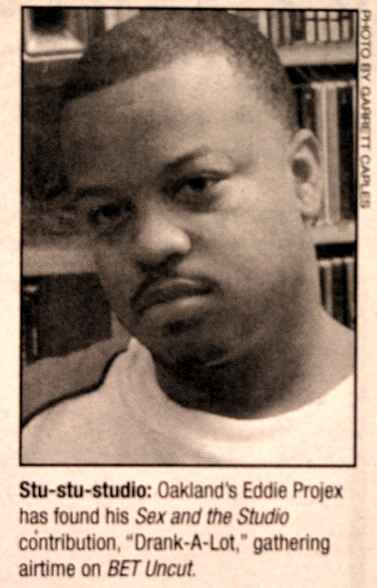
IF YOU SEE the video for "Drank-A-Lot" and aren't too distracted by the clubful of ass cheeks jiggling, you might notice the guy who spits the hook and first verse. He's Eddie Projex, from Oakland's Hittaz on tha Payroll, and the huge grin that never leaves his face throughout the clip is inspired by more than booty and booze. As the lead single from the soundtrack to episode two of the Sex and the Studio series, with verses by better-known buddies Numskull and Money B, "Drank-A-Lot" puts Eddie out front. The video has raised his profile, garnering nationwide "cable play" on BET Uncut, the station's adult-oriented music show (Wednesdays through Fridays, 3 to 4 a.m.). Now, after years of grinding away underground, Eddie's ready to shine.

"I like Hittaz on tha Payroll anyway, and Eddie's voice stands out," says Money B, recalling the "Drank-A-Lot" session. "I said, 'You pick the beat. Tell me which one you dig.' I went out the room, came back, and he'd already laid the hook. I was like, 'Yeeeaaahhhh.' "

Eddie's eagerness and efficiency reflect his persistence over the course of a decade in which Bay Area hip-hop got little mainstream love or major-label support. Along with MCs Polo, Curcinado, and Fletchberg Slim, Eddie formed Hittaz on tha Payroll in 1996.

"When 'I Got 5 on It' came out," Eddie says, referring to the Luniz' 1995 platinum hit, "we was in different groups. Everybody started fallin' off, and we were the only ones left standing. While the Luniz were making their mark, Num was busy doin' him. But we knew each other from back in the day, and when he came back, and sees we were still at it, he couldn't do nothing but accept it." Indeed, Num soon moved beyond acceptance. "He took me off the turf and flew me to L.A. Took care of me, gave me money, bought me clothes. He was like, 'Y'all gotta be my niggas.' "

Numskull premiered his new crew in 1999 on Good Laaawd, That's a Lot of Drank. In 2001, with no distribution deal, the Hittaz sold their debut disc, Underground Like Dead People, straight out the trunk, but it was with the release of Ghetto Storm (2003), on their own City Hall-distributed Hitta Records, that the Payroll began to attract attention. Produced entirely by the Mekanix, save for one banger by Sean T, Ghetto Storm was an instant East Oakland classic, due in no small part to Eddie's hook-writing ability on tracks like the atmospheric gangsta drama "Tha Game" and the sideshow anthem "Rims." Clearly Money B hadn't overlooked this elusive talent when he picked the Fifth-produced "Drank-A-Lot" as the single for Sex and the Studio's episode two.

Currently Eddie is shopping for a deal for his debut solo disc, Now or Never, even as he finishes two others: Ghetto Celebrity, for Hitta Records, and The Eddie Projex Project, for the Mekanix' Zoo Entertainment. In the meantime, taking advantage of the BET buzz, he's about to drop a street-only compilation, Eddie Projex Presents Oakland Street Music, Volume 1, which he hopes to turn into an annual showcase for emerging talent. Volume 1, which will also be sold at East Bay record stores like Rasputin's in Berkeley and Moses Music in East Oakland, features some of Oakland's hottest young artists – like Stevie Jo, E-Maculate, and R&B singer Naté – with production by the Mekanix, Sean T, and Harm and LT. Those unable to wait can check out the Hittaz' 2004 releases: Underground Like Dead People II, a recent Hitta Records mix tape, and Acid, a Polo and Curcinado duo project from FastLife Entertainment.


Read More...