by Garrett Caples
San Francisco Bay Guardian April 26, 2006
J-Stalin knows how to make an entrance.
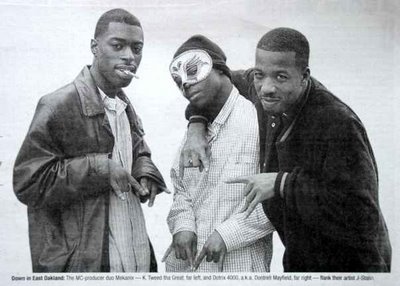
The first time we meet, in November 2004 at the Mekanix's recording studio in East Oakland, he enters nonchalantly, sporting an embroidered eye mask as though it were everyday wear. He walks up to me and shakes my hand. "I'm J-Stalin. I write and record two songs a day," he says with boyish pride.
I had a hard time retaining the notion the rapper wasn't a boy, for though he'd recently turned 21, his five-foot frame and preternatural baby face gave the impression of a raspy-voiced, blunt-puffing, Henny-swilling 14-year-old.
Yet he already had a storied past. A teen crack dealer, or "d-boy," from West Oakland's Cypress Village, Stalin was busted at age 17, spending the next 11 months on parole with weekends in juvenile hall. During this period, to both stave off boredom and possibly escape the multigenerational cycle of dope-dealing in his family, the young Jovan Smith began writing raps, finding out about the other Stalin in 11th-grade history class, and soaking up game at the Grill in Emeryville, where family friend DJ Daryl had a recording studio.
After letting him watch for a year, Daryl put Stalin on a track — the result so impressed Daryl's frequent collaborator, Bay Area legend Richie Rich, he immediately commissioned a hook. Stalin would end up on three cuts on Rich's Nixon Pryor Roundtree (Ten-Six, 2002) and on two as a member of the Replacement Killers, a group that included Rich and Crestside Vallejo's PSD. Several more songs from this period had just surfaced on Rich's 2004 compilation, Snatches, Grabs, and Takes (Ten-Six), though Stalin had since defected to the Mekanix's production company, Zoo Entertainment. By the time we met, the highly productive crew had recorded most of Stalin's upcoming debut, On Behalf of Tha Streets.He's next
During the next 18 months, J-Stalin would generate no small amount of buzz, thanks in part to high-profile guest shots on projects like the Jacka's The Jack Artist (Artist, 2005) and the Delinquents' Have Money Have Heart (Dank or Die, 2005). Three advance tracks from On Behalf — "Party Jumpin’," featuring Jacka; a clean version of "Fuck You"; and an homage to the classic drum machine, "My 808" — have accumulated spins on KMEL, while the video for "My 808" has more than 20,000 plays on Youtube.com. Too $hort says he's "next," E-40's dubbed him "the future," and major labels like Capitol and Universal are checking him hard.
To crown these achievements, Stalin's copped a coveted spot hosting an upcoming project for the Bay Area's mix-tape kings, DJ Devro and Impereal, alias the Demolition Men (see sidebar).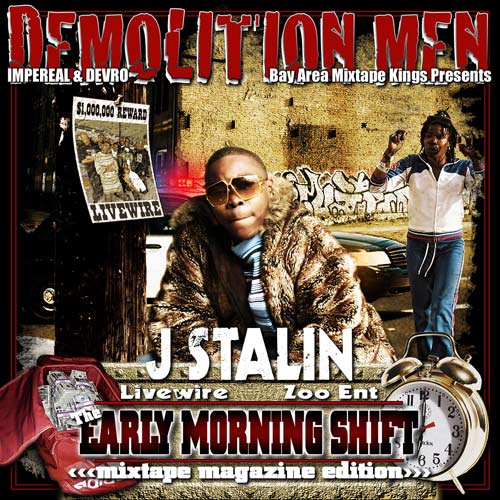 Named after Stalin's penchant for calling the DJs at 7 a.m., ready to lay verses, The Early Morning Shift is a potent fusion of mix tape beats and Mekanix originals, laced with Stalin's melodic raps and distinctively raw, R&B-style vocals. Taking advantage of the industry's current structure, whereby you can drop a mix tape or two without compromising your "debut" album marketability, The Early Morning Shift will be most listeners' first chance to hear the prolific J-Stalin at length, in the company of stars like Keak, F.A.B., and the Team, as well as Stalin's Cypress Village crew, Livewire. Having generated some 60 tracks in the scant two weeks devoted to recording the disc, Stalin has literally given the Demolition Men more than they can handle: Talk of a "part two" is already in the air, though the DJs are still rushing to finish the first for an early-May release.
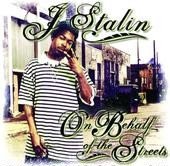 The Early Morning Shift comes at a pivotal time in J-Stalin's career. At the very least, the mix tape will warm up the Bay for On Behalf, which Zoo Entertainment plans to release independently in the next few months. With everywhere from Rolling Stone to USA Today catching on to the Bay's hyphy/thizz culture, and major labels lurking in the wings, it's probably only a matter of time before Stalin gets a deal. But the rapper is adamant on signing only as part of the Mekanix's Zoo.
"We don't want an artist deal," he says. "If they give us a label deal, it'll work, because I ain't fittin' to sign no artist deal."
If this sounds a tad dictatorial in the mouth of so young a playa, consider that Stalin left a famous rapper's camp to work with a then-unknown production duo, a decision fraught with risk. But Stalin's instincts regarding his own artistic strengths are sound. He thrives on quantity, and the Mekanix's intense productivity suits Stalin's seemingly endless supply of rhymes and hooks. The duo's ominous, minor-key soundscapes provide perfect vehicles for the rapper's exuberant tales of West Oakland street hustle and melancholy, often poignant reflections on d-boy life.
"I used to listen to their beats," Stalin recalls, "and be like, 'Damn, them niggas got heat!' Plus they ain't no haters. I mean, I'm a leader; I ain't no follower. They allow me to still be me and fuck with them at the same time."
A few months ago I had a chance to watch this process in action, dropping by the studio as Dot and Tweed were putting the finishing touches on a hot new beat, one in tune with current hyphy trends yet retaining the dark urgency characteristic of the Mekanix sound.
"Let me get on it," Stalin says, as he usually does when he hears something he likes.
Sometimes Dot says yes, sometimes no, depending on their plans for a particular session. With a beat this fresh and radio-ready, one they could easily sell, Dot is noncommittal: "What you got for it?"
Without a pause Stalin breaks into a melody, accompanied by an impromptu dance: "That's my name / Don't wear it out, wear it out, wear it out ..." Simple, catchy, the phrase totally works, and in less time than it takes to tell, he's in the booth laying down what promises to be the main single from On Behalf: "That's My Name."
Sitting behind the mixing board, Dot shoots me a smile, as if to say, "See why we work with this guy?"On the Go Movement
With The Early Morning Shift about to drop, and On Behalf on the way, the only thing Stalin needs is his own catchword, à la hyphy or thizz. Enter the Go movement. Among recent innovations in Bay Area hip-hop slang is a certain use of the word go to indicate a kind of dynamic state of being, widely attributed to Stalin.
"I ain't sayin' I made it up, but somebody from West Oakland did," Stalin says. "Even before there was hella songs talkin' about Go and shit, that shit came from ecstasy pills. We used to say, 'Goddamn, you motherfuckers go.' And then you refer to a female like, 'She go.' I swear it used to just be me and my niggas in the hood. I started fuckin' with the Mekanix and sayin' it at they place. Then, before I knew it, everybody was talking about Go."
Like thizz, Go quickly expanded beyond its drug-related origins, partly because it epitomizes so well the fast-paced environment of rappers' lifestyles. Among the early cosigners of the Go movement is the Team, whose album World Premiere (Moedoe) dropped at the beginning of April. Not only did the group release a between-album mix tape and DVD called Go Music (Siccness.net, 2005), but Team member Kaz Kyzah has hooked up with Stalin and the Mekanix for a side project called the Go Boyz. First previewed on Go Music, on a track also featuring Mistah F.A.B., the Go Boyz have already recorded their self-titled debut, and Zoo is in talks with Moedoe about an eventual corelease.
"Where I'm from, we don't say, 'Go stupid.' 'Go dumb.' We just go," Kaz Kyzah says, explaining the term's appeal.
"Really, it's a way of life for us," he continues. "Me, Stalin, Dot, and Tweed, we'd be up all night just goin'. Every song was recorded at like four in the morning. Listening to some of the stuff now, you can feel it in the music."Getting in early
Since I began this piece, Stalin, it seems, has gotten even bigger, as word of The Early Morning Shift and the Go Boyz has spread through the scene. People are suddenly lining up to work with him, and he's already committed to new projects with DJ Fresh, Beeda Weeda, the Gorilla Pits, and J-Nash, an R&B singer featured on Mistah F.A.B.'s upcoming Yellow Bus Driver. In a late-breaking development, E-40 confirms he intends to sign the Stalin/Beeda Weeda duo project to Sick Wid It Records.
During our interview, Stalin and I run by DJ Fresh's studio so J can lay a rhyme for an upcoming installment of Fresh's mix tape series, The Tonite Show. Another rapper, watching Stalin pull a verse out of thin air four bars at a time, is clearly awed: "He's amazing. I mean, he's on the records I buy."
Stalin takes it all in stride, though; aside from when I've watched him perform live, this is the first time I've ever seen someone react to him like he was a star. I get the feeling, however, it's far from the last.
J-Stalin
Fri/28, 10 p.m. doors
Club Rawhide
280 Seventh St., SF
$20
(415) 621-1197
myspace.com/jstalinofficialpage
20061029
Ruling party -- Rising hip-hop star J-Stalin morphs from d-boy to Go Boy

20061014
You ain't knowin' -- DU and 2Pac
| All roads lead back to the Digital Underground and 2Pac By Garrett Caples San Francisco Bay Guardian March 16, 2005 I CAN'T COUNT how many surprised responses I've elicited with the information that 2Pac started out in Digital Underground. To anyone first exposed to him through the movies or during his final phase on Death Row Records, the idea of Pac coming up under the plastic-nosed guidance of Humpty Hump is scandalous. Such skeptics are referred to the 2004 documentary DVD Digital Underground: Raw Uncut, which features footage of the future Makaveli rocking "The Humpty Dance" for all he's worth. 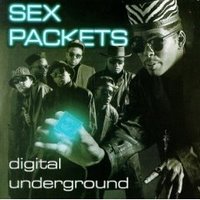 Atron Gregory, the group's first manager, introduced the young 2Pac to Humpty's alter-ego, D.U. leader and producer Shock-G, after the group completed Sex Packets (Tommy Boy, 1990) but before the album's release. As a result, Pac was on hand for the group's MTV-fueled explosion, making his recording debut on "Same Song," from their 1991 This Is an EP Release (Tommy Boy). Inevitably, once he blew up with the 1992 film Juice, 2Pac concentrated on his solo career, though he continued to appear on D.U. albums until 1996's Future Rhythm (Critique). Atron Gregory, the group's first manager, introduced the young 2Pac to Humpty's alter-ego, D.U. leader and producer Shock-G, after the group completed Sex Packets (Tommy Boy, 1990) but before the album's release. As a result, Pac was on hand for the group's MTV-fueled explosion, making his recording debut on "Same Song," from their 1991 This Is an EP Release (Tommy Boy). Inevitably, once he blew up with the 1992 film Juice, 2Pac concentrated on his solo career, though he continued to appear on D.U. albums until 1996's Future Rhythm (Critique).
"I couldn't have ever been 2Pac," Shock says now. "It's not my personality. By the same token, Pac probably couldn't have ever made it like I did as a producer-central figure in a collage of people. You gotta do you."
Though he moved out of the Bay Area – first to the Pocanos, then to Los Angeles – after the Oakland hills fire in late 1991, Shock has always turned to the Bay for new talent. Rap historians might note he was the first to tap Richmond, helping the duo Goldmoney score a deal with Tommy Boy and featuring them on Sons of the P (Tommy Boy, 1991). But Shock's most successful protégés after 2Pac are undoubtedly the Luniz, who appear on Future Rhythm and whose platinum debut, Operation Stackola (Noo Tribe, 1995), features production by Shock. That year Shock appeared on the remix of the Luniz' weed-smoking anthem "I Got 5 on It," alongside such local heavyweights as E-40 and Richie Rich. 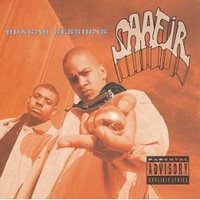 In the late '90s, Shock continued to influence the Bay through his associates. D.U. members DJ JZ and Saafir joined Hobo Junction for the critically acclaimed Box Car Sessions (Qwest, 1999) as well as three classic underground discs on their own Hobo Records. While D.U.'s 1998 album Who Got the Gravy? (Jake) failed to make a huge impression, it introduced Esinchill (see "Breaking Down the Battle Lines," page 43) as well as Mystic, whose debut, Cuts for Luck, Scars for Freedom (JCor), was nominated for a Grammy in 2002. Now, with the release of his first solo album, Fear of a Mixed Planet (33rd St), Shock has finally begun to receive his due as a pioneer. He's been producing tracks for Hunters Point MC Kev Kelly, even as he's transformed D.U.'s live show with the addition of an eight-piece funk band called Slapback. "I think people saw Humpty as a gimmick," Numskull of the Luniz says, "but Humpty is just a part of Shock. Shock is our driving force. For real. He's a genius." 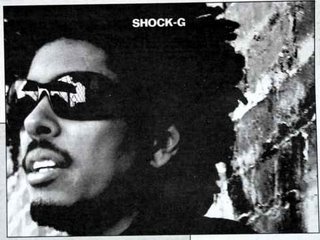 | ||||
| | ||||

Breaking Down the Battle Lines: Frontline's Locksmith and DU's Esinchill
By Garrett Caples
San Francisco Bay Guardian March 16, 2005
ESINCHILL FIRST DROPPED on Digital Underground's Who Got the Gravy? (see "You Ain't Knowin'," page 44), honing his skills with the group for the next five years on the road, and he has the support of fellow D.U. members like Numskull, also of the Luniz. "Esinchill is one of the best artists coming out of the Bay right now," he says. "He's book smart, and that comes out in his rhymes."
He's also a ferocious freestyler, so I was impressed to learn the Frontline's Locksmith beat him in a battle on KMEL, 106 FM, a few months ago. "We went one round, and they was like, 'It's a tie,' " Esinchill recalls. "Then we went a second round, and I fumbled. I couldn't bring it back."
But E remains philosophical. "I think what the Frontline do best is battle. That's where Locksmith shines. But there's a difference between being able to rap and being able to make songs. I think I make better songs."
 He raises an interesting point, insofar as the majority of the Frontline's verses are battle rhymes. The "realness" of the battle rhymer is almost inevitably gauged by "hardness," which we might provisionally define here as experience with, and stoicism in the face of, street life. As much as I dig their refusal to adopt the usual gangsta pose, the Frontline's emphasis on hardness limits their lyrics.
Take four bars of Locksmith on "I Gotcha," from the Richie Rich comp Grabs, Snatches, and Takes (Ten-Six, 2004):
You might see Lock on the block in some Tims and Nikes
Making motherfuckers duck when I extend my right
I'm an mc; I fight with pens and mics
You're a bitch; you fight for women's rights
Like many of rap's memorable moments, the third and fourth lines are at once clever and offensive. The repeated grammatical structure creates the expectation of a similar parallel in logic, which is then violated by the second half of the fourth line. (Remember your SATs: "MC" is to "bitch" as "pens and mics" are to "women's rights" is not the correct answer.) Though he might have shored it up with a better rhyme than "right" and "rights," the structure is complex and compelling, even if – for a UC Berkeley grad like Lock – the sentiment isn't very nice.
Here are four bars from the "Intro" to Esinchill's Everything to Lose! (Rceason, 2002):
Born sick and with seizures, massive head trauma
Bitch-ass doctors woulda killed me if it wasn't for mama
Took me off the medicine, didn't have no more falls
No more emergency phone calls and hospital halls
Though the difference in subject matter makes it absurd to compare these examples, each is representative of the rappers' respective concerns. With the notable exception of "Hennessy," Esinchill doesn't really stunt on brand names, and where Locksmith raps about being hard, Esinchill is introspective at the top of his lungs, eliding pronouns and breaking up syntax to pack a few years into four lines. On paper, "hospital halls" seems like a throwaway, yet on disc it leaps out, neatly condensing a kid's perspective on hospitals: boredom and waiting.
Here's the conclusion of both verses – Locksmith's, then Esinchill's:
Lock: Nigga, me no singer
I'm from the Rich where them boys like to keep those things
And they stay with their ring on bling
And they wear more gold than a Chinese ping pong team
I rap instead; I notice I'm at peace when I rhyme
I think with my dick so let me give you a piece of my mind –
Suck it; me in a nutshell, forever passionate
I'm through with this control; I gotta go, I got some ass to get
We've already heard Lock "stretch metaphors like a Chinese jump rope" on Who R You, so the use of "Chinese" for mere verbal flashiness begins to pall this time around. E's ending crushes it. To hear "passionate" rhymed with "ass to get" is exactly what I turn to rap for. The other rhyme is nearly as pleasing, and the second line's combination of two shopworn phrases leads so inevitably to "suck it," you can admire its formal invention even while declining its invitation.
 Esinchill's versatility in style and subject matter is what makes Everything to Lose! so accomplished a debut. And just as the Frontline's run of luck began with Locksmith's questionable 2003 battle loss on MTV, so Esinchill's buzz has picked up since losing to Locksmith. He's in talks with Hiero Imperium to release his next album, a duo record with partner King Beef called Choice Cuts, while the advance single – the Touré-produced "Hip Hop" – has been bubbling up in Funkmaster Flex's record pool. Maybe losing is everything.
Is There Really a New Bay Rising?
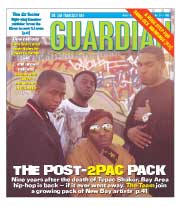
The post-2Pac pack
Did the death of Tupac Shakur throw Bay Area hip-hop into a tailspin? And is there really a "New Bay" rising?
By Garrett Caples
San Francisco Bay Guardian March 16, 2005
You can pick me up; I'll be posted on 10th Street
'Cause you know that's where I'll be
Stuck like a telephone pole.
SO SINGS YOUNG rapper J-Stalin – a DJ Darryl discovery and former Richie Rich protégé – on a hook from his recent first mix tape, R-N-B. And it's true. As I roll up 10th Street in West Oakland's Oak Center, I see the short, wiry MC in the distance, standing in the middle of the street, talking on his cell. On the other end of the line, next to me in the car, is Dotrix 4000, a.k.a. Dontrell Mayfield, a former Digital Underground DJ turned MC-producer as half of the Mekanix. We've just driven from his house in East Oakland to pick up Stalin and bring him back to the Mekanix's studio, where they're finishing Stalin's debut, On Behalf of the Streets, for the duo's new label, Zoo Entertainment.
I live downtown, in a neighborhood no one calls Lakeside, about 20 blocks from where Stalin's "posted." In effect, I've spent my day doing a citywide doughnut. But Stalin's hood is worth it. A post-WWII black community inhabiting the structures of a middle-class Victorian past, Oak Center is funky as hell, beautiful blocks of houses in all shades and states of repair, dotted with buildings of a more recent vintage.
According to the fall 2003 Oakland Heritage Alliance News, the entire neighborhood was slated for demolition by the Department of Housing and Urban Development in the early '60s to make way for vast, anonymous housing projects. Only stubborn local resistance thwarted the plan.
'New Bay' vibed
Like Oak Center, Bay Area hip-hop is characterized by stubborn resistance, epitomized by 2Pac and still evident in Stalin's provocative choice of namesake. And that same spirit animates the community's reception of the catchphrase "New Bay." 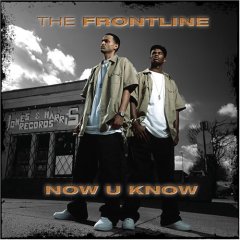 Coined by Oakland MC Balance but popularized by Richmond duo the Frontline, the term "New Bay" has led to press in national publications like Vibe and XXL. The latter forecast a "resurrection" of Bay Area hip-hop based on Virgin's 2004 success with the Federation (from Fairfield) and Ryko's signing of the Frontline on the strength of their EA-SKI-produced hit "What Is It." Since the single broke into the rotation of the notoriously local-leery KMEL, 106 FM, the radio exposure has helped the group move 10,000 copies of Who R You (IMG), their 2004 independent debut, which will be updated and rereleased by Ryko as Now U Know.
Yet the phrase has also sparked a firestorm of controversy in the Bay Area hip-hop scene.
"I guess people are like, we done worked too hard to let people come in and say, 'We're the New Bay – fuck all the old shit,' " Dotrix 4000 says. "Those cats screaming, 'New Bay' – they ain't connected. But the underground is all connected. We've been connected."
As if cued, G-Stack of Oakland's Delinquents calls Dotrix 4000's cell. "I think it's bullshit," he says of the New Bay concept. At the same time, he lets it be known his gripe isn't personal. "I think the Frontline does have talent, and I wish them well. But it's about public perception. 'New' comes right after 'old.' "
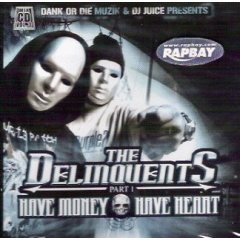 Therein lies the problem. Like most forms of popular entertainment, hip-hop is extremely susceptible to the cult of the new. Careers start young and end early, unless you can adapt to rap's ever-changing circumstances. It requires indefatigable effort to stay on top of the game, the type of effort that's driven the Delinquents to record not one but two mix CDs – Have Money Have Heart volumes 1 and 2 (Dank or Die Records) – addressing the New Bay controversy. In a gesture of defiance, G-Stack and fellow Delinquent V. White enlisted the aid of Too $hort, Oakland's ultimate OG, for "Say Bitch," the lead single, which disses the New Bay in no uncertain terms.
The "2Pacalypse" Theory
To fully understand why a phrase so small could generate a reaction so extreme from a vet like G-Stack, we must invoke the "2Pacalypse" theory. Believers argue that Pac's death in '96 triggered an artistic decline that left Bay Area hip-hop incapable of attracting a national audience or major-label interest. Thus, the Frontline's bio on www.thefrontlineonline.com offers, "In the past six years, the Bay Area hip-hop scene has become stagnant, passing off replicas of established artists as new talent." Add a couple of years to account for the age of this blurb and we're back at 1997, without even mentioning Makaveli directly. The New Bay clearly presupposes the 2Pacalypse, insofar as there must be a grave from which to resurrect Bay Area hip-hop.
But the 2Pacalypse theory has at least two major holes that make it an unsuitable foundation on which to build an understanding of local hip-hop. For starters, it holds the artists responsible for the behavior of major labels. Yet even before 2Pac's death, major labels were getting cold feet in the Bay. On his Web site, www.guerillafunk.com, for example, Paris is vocal about his problems with Tommy Boy and then Priority regarding the political content of his work, which effectively stalled his career in the mid-'90s.
Or take the case of Ray Luv, 2Pac's partner in the Marin City group Strictly D.O.P.E. In 1993, Ray scored an independent radio hit with "Get Your Money On," on Mac Dre's Strictly Business Records. In 1995, with Dre in prison, Ray signed with Atlantic (once part of Time Warner and now with Warner Music Group), through Khayree's label, Young Black Brotha. Atlantic, he tells me, "put out my album about six weeks before Time Warner was about to fire Interscope over Death Row and 2Pac. So every record like Pac's basically got shelved because they didn't want you to blow up."
"I'd be in L.A. – I'm getting walk-ons on the biggest shows," he says. "Shows they couldn't get me, I'm getting. Atlantic moved me from there and sent me to Kansas City for five days. And I'm like, what just happened? Once we pissed each other off, they were sending me to hotels where my window faced a brick wall. It got weird, so I quit. I took from '96 to '99 off."
If this sounds like the paranoia of a could've-been contender, consider the source. Handsome and charismatic, Ray was already a proven hit-maker, as was Khayree. The label exec who couldn't exploit so close a connection to Pac for at least gold in 1995, when he was already the biggest-selling rapper ever, strikes me as an underachiever at best.
The second hole in the 2Pacalypse theory is the fact that the creative decline of Bay Area hip-hop never really occurred. With the major labels increasingly reluctant to sign acts, much of the scene went underground. 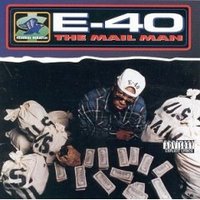 If you generated huge numbers, like E-40, whose 1993 EP, The Mail Man, debuted in the Billboard Top 20 with no distribution deal, you could force the majors to deal with you. (E-40 was quickly signed by Jive.)
But it grew increasingly apparent that you could do without them. Indie scenes sprang up around artists like Blackalicious and the Soulsides/Quannum collective. In Oakland, Pam the Funkstress and Boots reinvigorated political rap on a national level as the Coup. Artists like Del tha Funky Homosapien left labels like Elektra to establish their own companies, while others, like the Delinquents, built huge followings from the ground up.
New bosses
By 1999, the revolution was in full swing, as independent tunes began to infiltrate the airwaves. 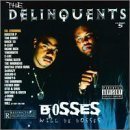 Among the local hits on KMEL that year was "That Man!," by the Delinquents, who went on to move 50,000 copies of 1999's Bosses Will Be Bosses (Dank or Die). By the end of the year, however, Clear Channel had bought KMEL, and G-Stack says he's been unable to get airplay since. (As of press time, KMEL musical director "Big Von" Johnson was unavailable for comment.)
The Delinquents maintain a sizable fan base. "They are Oakland," Dotrix 4000 says, "in terms of selling records and reppin' our city. They can't throw a party and it's not sold out." But while successful acts like the Delinquents have countered the lack of radio exposure and label support through relentless hustle, it's unclear whether hustle alone can withstand the effect of the media actively promoting other artists as New Bay hip-hop.
On the phone, the Frontline are more conciliatory than they come off online. They seem genuinely nonplused by the furor the New Bay catchphrase has provoked. "Without the veterans," MC Locksmith of the Frontline says, "you have no Frontline, without the Too $horts, the E-40s, the Delinquents, the Luniz, without any of these cats." His partner, Left, concurs: New Bay was meant to be "a fresh way of looking at Bay music" rather than an attack. "Let everybody come up. Let's all make good music and all come up together."
I brought this statement to a number of rappers, and responses ranged from "They should've said that first" to "SKI should've known better" to "Fuck them niggas" – disappointing, but you can see their point. We're talking about a scene that still produces entire albums dedicated to Rappin' Ron of Bad Influenz, who died in a car crash in 1997. Most Bay Area rappers I've spoken to have real reverence for the tradition on which they build, and the New Bay concept offends their sensibilities.
Like the residents of Oak Center, they're proud of their community and don't want it wrecked by decisions made outside. In that light, the resentment provoked by the New Bay concept and the flurry of accompanying diss records shouldn't be ascribed to envy. They signify, instead, the stubborn resistance of a community that has survived without assistance and that refuses to cooperate, or be co-opted, except on its own terms.