by Garrett Caples
Luniz 10th Anniversary Special exclusive to hyphythizzgo.com
Numskull is a hard man to pin down. When I first interviewed him in March, he was staying in Sacramento, shuttling back and forth to Reno to work on Caliban—his long-awaited first solo album—with producer C-Dash. Since then, we’ve periodically touched base by phone, at Digital Underground shows, or at the Garage in East Oakland, where former Luniz dj Dotrix and partner Kenny Tweed produce tracks as Tha Mekanix. One night in September in San Francisco, I bump into Num after a DU show, during which he brought down the house with a 3-song set from Caliban, backed by his group of the same name. Thizzing on a pill as well as on the crowd’s enthusiastic response, he gives me hug and tells me the album is done. Then he pulls me aside.
“This is important; you have to put this in the interview,” he says. “I was actually born in Mississippi; my mom moved to Oakland when I was a baby. And on my birth certificate, under race, its says ‘Negro.’”
He doesn’t elaborate further, but, only about a month after Hurricane Katrina, it was easy to catch his drift. Num was born in the ’70s, well after the peak of the civil rights movement when the term fell into disuse, but his birth certificate is evidence of the kind Katrina provided in abundance, that very little in fact had changed for certain black populations in America. If this seems like an atypical concern for the rapper who sometimes records under the name Drank-A-Lot, it does give a foretaste of what Caliban has in store for listeners.
“It’s gonna be Numskull’s solo album,” he says, “but I’m introducing the group so I got ‘em on a lot of songs. The Caliban is basically artists who don’t see the world like everybody else see it. We’re not worried about this club shit. Caliban—we took it from the Taliban, so we bitter about hella shit that’s going on. In the United States and overseas, all the shit. We hate Bush. It’s a Num album. And Num don’t really give a fuck about shit.”
The logistical details behind Caliban are still in flux. One minute Num is in talks with basketball players starting labels, next it’s supposed to be Koch, next he’s releasing it himself on the internet. Even the line-up of the Caliban seems to periodically undergo reassessment, though the core seems to be former No Limit soldier Don P; former Dangerous Crew member F.M. Blue, whose own long-delayed first album, The World Is Blue (FastLife 2004), is largely produced by the Mekanix; Blue’s younger brother Cheese Whosain; and DU member Esinchill, who just dropped his own C-Dash-produced project, a duo disc with King Beef called Choice Cuts (RCeason).
One thing, however, I can say for sure: the music Num played for me during our interview in Sacramento was some of the most advanced hip hop I’ve ever heard. Both Numskull and Esinchill hooked up with the newly-thriving Reno scene through Element, a trio who spent 5 years on the road as DU’s support crew and appear on Shock-G’s solo album, Fear of a Mixed Planet (33rd Street 2004). The beats coming out of Reno these days are wildly futuristic blends of the synthetic and the organic that sound truly like nothing else in rap. Clearly they inspired Num to take his own experimental approach to the vocals; the group tracks feature incredibly tight interplay between the rappers, as opposed to the usual structure of simply trading verses. As half of one of the greatest hip hop duos of all time, Num appreciates the power of group dynamics.
“I don’t like to be alone,” he confesses. “On stage, at home, anything. So I always bring people with me wherever I go. And these cats have talent, so why not put ‘em on?”
Such an attitude goes a long way towards explaining Num’s career in the years since Lunitik Muzik, for while Yukmouth has remained highly visible and productive—preparing to release his fourth solo album, Million Dollar Mouthpiece, in 2006—Num has kept a much lower profile. This has been partly due to circumstance; though he recorded a solo album in the late ’90s for NY-based K-Tel Records, the company folded before releasing it. Yet he also freely admits, “I didn’t think I was ready to do a solo album, at all. I was still into that Luniz shit. When I came out with my own album, I wanted it to be me, not people thinking he gotta make shit like the Luniz.”
Instead of pursuing a solo career, Num spent much of the period between Muzik and 2002’s Silver & Black on the road with the steadily-touring DU. “I was the animal on tour,” he admits. “I’m talking about drugs everywhere every night, drinking. And Shock was kinda coming along with me. But then he was like, we’re not going to take you and Clee on the next one. We understood. We were wild, acting a fool. I was still living out my Luniz fantasies. But Shock told me the reason we wasn’t making good music anymore was that we were partying too much. And I appreciated him for that.”
While the rest of DU embarked on tour, Num and Clee began hanging out in LA with producer Poli Pol, prior to his association with the Black-Eyed Peas. “The guy had a studio,” Num recalls. “We were just kicking it really cause we’d brought some other cats over to work with him. We were making songs that we wanted to hear. Shit that we were going through at that time. Like, you don’t have no pussy, so we made a jack off song. Shit like that. We weren’t even thinking about doing an album together at all. But then he’s like, fuck it; let’s do a whole album.” The result of these sessions was the brilliant but hard-to-find, label-less disc Good Laaawd That’s a Lot of Drank (1999), credited to Clee and Drank-A-Lot.
“That’s a classic album,” Num says proudly. “But we tried to put it out ourselves, and we didn’t know nothing about going independent. We pressed up 5,000 units and sold all 5,000 in stores. We would get the money back from the first sales, and we would try to put it into promotion. Then we’d have no money to press it up again when everybody’s asking for it. But I’ve never heard one person say that they didn’t like that album. I actually want to rerelease it.”
The duo eventually parted on friendly terms, but not before teaming with Money B for his Poli Pol-produced single “Putcha Thang on Me,” a Bay Area hit in 1999. Based on the chops displayed on his video for Good Laaawd’s single, “Knockdiesel,” Clee, now known as Cleetis Mack, went on to direct the successful Sex in the Studio adult hip hop dvd series (Metro Entertainment). Num, meanwhile, used Good Laaawd to help launch his proteges, Hittaz on tha Payroll, whose Mekanix-produced Ghetto Storm (Hitta) was one of the hottest albums in the Bay in 2003. The association continues, as Num co-hosts Sex in the Studio’s second episode (2004) and also features in the soundtrack single, “Drank-A-Lot,” with Money B and Eddi Projex of the Hittaz. Produced by the same Fifth who portrays “The Lame” on Yukmouth’s Regime mixtape, “Drank-A-Lot” generated a buzz earlier this year from numerous spins on BET’s late-night video show Uncut.
After years of crew-oriented endeavors, Num feels he’s finally “ready” to do a solo album, especially as he’s put together a powerful new crew to do it. The quality of the music on Caliban reveals the hidden perfectionism behind Num’s slow development into a solo artist
“Before I was just doing songs just to do them, and I don’t think that that’s my best work. A lot of those songs came from like me dealing with people and they’re like, ‘Num you should put this on your album.’ And I do hella songs by myself. None of it was worthy to me. That’s why I took so long. Out of 60 songs that I have, I’ll probably pick like 7 that I like.”
“I’m trying to make a classic album,” he concludes. “I don’t want an album with 2 good songs and 16 ok songs. I want an album that’s a classic all the way through, that you can just sit down and listen to. And I got something for everybody too. I have a song for this group, but other groups’ll want to listen to that song too. That’s the type of album I want to do.”
(part one: The Luniz: 10 On It!
part two: Yukmouth: The Regime Declares War)
20061022
The Mystery of Numskull

20061018
Esinchill cuts
by Garrett Caples
San Francisco Bay Guardian October 26, 2005
Also performing with Digital Underground Oct. 28 at the Red Devil are Esinchill and King Beef. A relentless freestyler, inventive writer, and habitual stage-diver, Esinchill has one of the tightest flows in the Bay, and if he remains Oakland's best-kept secret, it's due to lack of exposure. After a show-stealing debut on DU's Who Got the Gravy? (Jake, 1998) and extensive touring with the group, E only made a handful of guest appearances, on discs by DJ Quik, the Delinquents, and so forth, before dropping the hard-to-find Everything to Lose! (Rceason, 2002). Displaying an unexpected metaphysical streak, as well as harrowing tales of a mysterious childhood illness, Everything is an astonishingly assured album showcasing E's versatility and eagerness to expand his range.
Having secured distribution for his Rceason label, Esinchill teamed up with childhood pal King Beef for Choice Cuts, Volume One, whose advance single – the Touré-produced "Hip Hop" – began generating a buzz with East Coast radio play earlier this year. Self-designated "hip-hop mood music," Choice Cuts is a frank genre workout of club/party songs that is less ambitious than its predecessor yet in many ways more accomplished. Much credit goes to the duo's main collaborator, Reno's C-Dash, who produced 11 of its 15 tracks, providing a unity of mood absent from so many rap albums. Dash's music is a dense mixture of synthetic and organic sounds with heavy R&B leanings – so crucial is he to the project that he warrants the rare hip-hop instrumental, which fits seamlessly into the album's flow.
As performers, Esinchill and King Beef display the deep rapport of classic rap duos, egging each other on to further audacity. Smooth-voiced and heavyset, Beef makes a perfect verbal and visual foil for E's rapid-fire staccato flow and compact frame. Sharing a disdain for rap's overreliance on guns, crack, hos, and bling, E and Beef concoct distinctive songs that should give less-adventurous lyricists pause. Their material is also untainted by the misogyny endemic to rap – they might joke about the perils of hooking up with the unattractive on a song like "Wing Man," but for the most part they adopt the Romeo approach, if only out of romantic self-interest. "It's just my attitude and gratitude and respect to a queen, and when respect exudes, then great sex ensues," E raps on "Mojo."
With a second single, "If You Want It," on the way, Esinchill and Beef are busy promoting Choice Cuts, as well as working in the studio on E's next solo album, Vigilantism, and Beef's first, The Swing Party, both tentatively slated for release next year on Rceason. Also look for Esinchill to appear on several cuts off Caliban, the long-awaited solo album from Numskull of the Luniz.
20061016
Sex and the Studio climaxes with a -- video hit?
This summary is not available. Please click here to view the post.
20061014
You ain't knowin' -- DU and 2Pac
| All roads lead back to the Digital Underground and 2Pac By Garrett Caples San Francisco Bay Guardian March 16, 2005 I CAN'T COUNT how many surprised responses I've elicited with the information that 2Pac started out in Digital Underground. To anyone first exposed to him through the movies or during his final phase on Death Row Records, the idea of Pac coming up under the plastic-nosed guidance of Humpty Hump is scandalous. Such skeptics are referred to the 2004 documentary DVD Digital Underground: Raw Uncut, which features footage of the future Makaveli rocking "The Humpty Dance" for all he's worth. 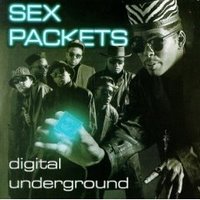 Atron Gregory, the group's first manager, introduced the young 2Pac to Humpty's alter-ego, D.U. leader and producer Shock-G, after the group completed Sex Packets (Tommy Boy, 1990) but before the album's release. As a result, Pac was on hand for the group's MTV-fueled explosion, making his recording debut on "Same Song," from their 1991 This Is an EP Release (Tommy Boy). Inevitably, once he blew up with the 1992 film Juice, 2Pac concentrated on his solo career, though he continued to appear on D.U. albums until 1996's Future Rhythm (Critique). Atron Gregory, the group's first manager, introduced the young 2Pac to Humpty's alter-ego, D.U. leader and producer Shock-G, after the group completed Sex Packets (Tommy Boy, 1990) but before the album's release. As a result, Pac was on hand for the group's MTV-fueled explosion, making his recording debut on "Same Song," from their 1991 This Is an EP Release (Tommy Boy). Inevitably, once he blew up with the 1992 film Juice, 2Pac concentrated on his solo career, though he continued to appear on D.U. albums until 1996's Future Rhythm (Critique).
"I couldn't have ever been 2Pac," Shock says now. "It's not my personality. By the same token, Pac probably couldn't have ever made it like I did as a producer-central figure in a collage of people. You gotta do you."
Though he moved out of the Bay Area – first to the Pocanos, then to Los Angeles – after the Oakland hills fire in late 1991, Shock has always turned to the Bay for new talent. Rap historians might note he was the first to tap Richmond, helping the duo Goldmoney score a deal with Tommy Boy and featuring them on Sons of the P (Tommy Boy, 1991). But Shock's most successful protégés after 2Pac are undoubtedly the Luniz, who appear on Future Rhythm and whose platinum debut, Operation Stackola (Noo Tribe, 1995), features production by Shock. That year Shock appeared on the remix of the Luniz' weed-smoking anthem "I Got 5 on It," alongside such local heavyweights as E-40 and Richie Rich. 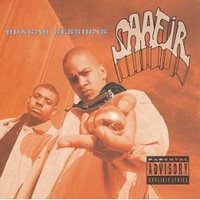 In the late '90s, Shock continued to influence the Bay through his associates. D.U. members DJ JZ and Saafir joined Hobo Junction for the critically acclaimed Box Car Sessions (Qwest, 1999) as well as three classic underground discs on their own Hobo Records. While D.U.'s 1998 album Who Got the Gravy? (Jake) failed to make a huge impression, it introduced Esinchill (see "Breaking Down the Battle Lines," page 43) as well as Mystic, whose debut, Cuts for Luck, Scars for Freedom (JCor), was nominated for a Grammy in 2002. Now, with the release of his first solo album, Fear of a Mixed Planet (33rd St), Shock has finally begun to receive his due as a pioneer. He's been producing tracks for Hunters Point MC Kev Kelly, even as he's transformed D.U.'s live show with the addition of an eight-piece funk band called Slapback. "I think people saw Humpty as a gimmick," Numskull of the Luniz says, "but Humpty is just a part of Shock. Shock is our driving force. For real. He's a genius." 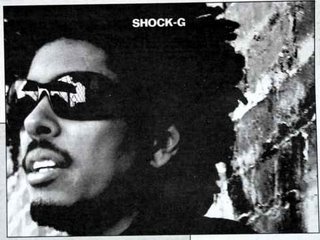 | ||||
| | ||||

Breaking Down the Battle Lines: Frontline's Locksmith and DU's Esinchill
By Garrett Caples
San Francisco Bay Guardian March 16, 2005
ESINCHILL FIRST DROPPED on Digital Underground's Who Got the Gravy? (see "You Ain't Knowin'," page 44), honing his skills with the group for the next five years on the road, and he has the support of fellow D.U. members like Numskull, also of the Luniz. "Esinchill is one of the best artists coming out of the Bay right now," he says. "He's book smart, and that comes out in his rhymes."
He's also a ferocious freestyler, so I was impressed to learn the Frontline's Locksmith beat him in a battle on KMEL, 106 FM, a few months ago. "We went one round, and they was like, 'It's a tie,' " Esinchill recalls. "Then we went a second round, and I fumbled. I couldn't bring it back."
But E remains philosophical. "I think what the Frontline do best is battle. That's where Locksmith shines. But there's a difference between being able to rap and being able to make songs. I think I make better songs."
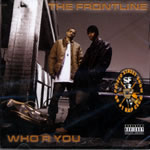 He raises an interesting point, insofar as the majority of the Frontline's verses are battle rhymes. The "realness" of the battle rhymer is almost inevitably gauged by "hardness," which we might provisionally define here as experience with, and stoicism in the face of, street life. As much as I dig their refusal to adopt the usual gangsta pose, the Frontline's emphasis on hardness limits their lyrics.
Take four bars of Locksmith on "I Gotcha," from the Richie Rich comp Grabs, Snatches, and Takes (Ten-Six, 2004):
You might see Lock on the block in some Tims and Nikes
Making motherfuckers duck when I extend my right
I'm an mc; I fight with pens and mics
You're a bitch; you fight for women's rights
Like many of rap's memorable moments, the third and fourth lines are at once clever and offensive. The repeated grammatical structure creates the expectation of a similar parallel in logic, which is then violated by the second half of the fourth line. (Remember your SATs: "MC" is to "bitch" as "pens and mics" are to "women's rights" is not the correct answer.) Though he might have shored it up with a better rhyme than "right" and "rights," the structure is complex and compelling, even if – for a UC Berkeley grad like Lock – the sentiment isn't very nice.
Here are four bars from the "Intro" to Esinchill's Everything to Lose! (Rceason, 2002):
Born sick and with seizures, massive head trauma
Bitch-ass doctors woulda killed me if it wasn't for mama
Took me off the medicine, didn't have no more falls
No more emergency phone calls and hospital halls
Though the difference in subject matter makes it absurd to compare these examples, each is representative of the rappers' respective concerns. With the notable exception of "Hennessy," Esinchill doesn't really stunt on brand names, and where Locksmith raps about being hard, Esinchill is introspective at the top of his lungs, eliding pronouns and breaking up syntax to pack a few years into four lines. On paper, "hospital halls" seems like a throwaway, yet on disc it leaps out, neatly condensing a kid's perspective on hospitals: boredom and waiting.
Here's the conclusion of both verses – Locksmith's, then Esinchill's:
Lock: Nigga, me no singer
I'm from the Rich where them boys like to keep those things
And they stay with their ring on bling
And they wear more gold than a Chinese ping pong team
I rap instead; I notice I'm at peace when I rhyme
I think with my dick so let me give you a piece of my mind –
Suck it; me in a nutshell, forever passionate
I'm through with this control; I gotta go, I got some ass to get
We've already heard Lock "stretch metaphors like a Chinese jump rope" on Who R You, so the use of "Chinese" for mere verbal flashiness begins to pall this time around. E's ending crushes it. To hear "passionate" rhymed with "ass to get" is exactly what I turn to rap for. The other rhyme is nearly as pleasing, and the second line's combination of two shopworn phrases leads so inevitably to "suck it," you can admire its formal invention even while declining its invitation.
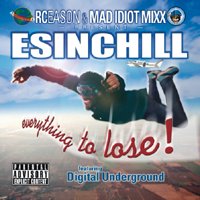 Esinchill's versatility in style and subject matter is what makes Everything to Lose! so accomplished a debut. And just as the Frontline's run of luck began with Locksmith's questionable 2003 battle loss on MTV, so Esinchill's buzz has picked up since losing to Locksmith. He's in talks with Hiero Imperium to release his next album, a duo record with partner King Beef called Choice Cuts, while the advance single – the Touré-produced "Hip Hop" – has been bubbling up in Funkmaster Flex's record pool. Maybe losing is everything.