by Garrett Caples
San Francisco Bay Guardian April 26, 2006
J-Stalin knows how to make an entrance.
The first time we meet, in November 2004 at the Mekanix's recording studio in East Oakland, he enters nonchalantly, sporting an embroidered eye mask as though it were everyday wear. He walks up to me and shakes my hand. "I'm J-Stalin. I write and record two songs a day," he says with boyish pride.
I had a hard time retaining the notion the rapper wasn't a boy, for though he'd recently turned 21, his five-foot frame and preternatural baby face gave the impression of a raspy-voiced, blunt-puffing, Henny-swilling 14-year-old.
Yet he already had a storied past. A teen crack dealer, or "d-boy," from West Oakland's Cypress Village, Stalin was busted at age 17, spending the next 11 months on parole with weekends in juvenile hall. During this period, to both stave off boredom and possibly escape the multigenerational cycle of dope-dealing in his family, the young Jovan Smith began writing raps, finding out about the other Stalin in 11th-grade history class, and soaking up game at the Grill in Emeryville, where family friend DJ Daryl had a recording studio.
After letting him watch for a year, Daryl put Stalin on a track — the result so impressed Daryl's frequent collaborator, Bay Area legend Richie Rich, he immediately commissioned a hook. Stalin would end up on three cuts on Rich's Nixon Pryor Roundtree (Ten-Six, 2002) and on two as a member of the Replacement Killers, a group that included Rich and Crestside Vallejo's PSD. Several more songs from this period had just surfaced on Rich's 2004 compilation, Snatches, Grabs, and Takes (Ten-Six), though Stalin had since defected to the Mekanix's production company, Zoo Entertainment. By the time we met, the highly productive crew had recorded most of Stalin's upcoming debut, On Behalf of Tha Streets.He's next
During the next 18 months, J-Stalin would generate no small amount of buzz, thanks in part to high-profile guest shots on projects like the Jacka's The Jack Artist (Artist, 2005) and the Delinquents' Have Money Have Heart (Dank or Die, 2005). Three advance tracks from On Behalf — "Party Jumpin’," featuring Jacka; a clean version of "Fuck You"; and an homage to the classic drum machine, "My 808" — have accumulated spins on KMEL, while the video for "My 808" has more than 20,000 plays on Youtube.com. Too $hort says he's "next," E-40's dubbed him "the future," and major labels like Capitol and Universal are checking him hard.
To crown these achievements, Stalin's copped a coveted spot hosting an upcoming project for the Bay Area's mix-tape kings, DJ Devro and Impereal, alias the Demolition Men (see sidebar).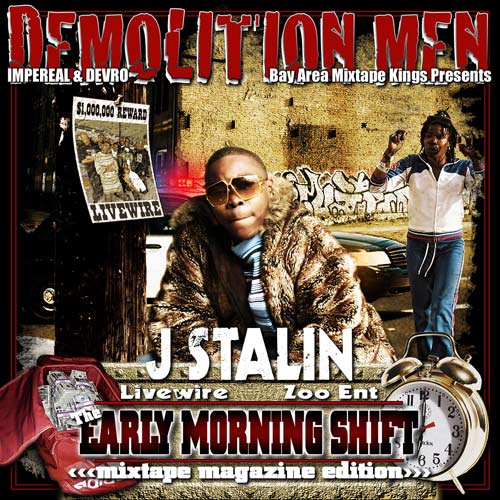 Named after Stalin's penchant for calling the DJs at 7 a.m., ready to lay verses, The Early Morning Shift is a potent fusion of mix tape beats and Mekanix originals, laced with Stalin's melodic raps and distinctively raw, R&B-style vocals. Taking advantage of the industry's current structure, whereby you can drop a mix tape or two without compromising your "debut" album marketability, The Early Morning Shift will be most listeners' first chance to hear the prolific J-Stalin at length, in the company of stars like Keak, F.A.B., and the Team, as well as Stalin's Cypress Village crew, Livewire. Having generated some 60 tracks in the scant two weeks devoted to recording the disc, Stalin has literally given the Demolition Men more than they can handle: Talk of a "part two" is already in the air, though the DJs are still rushing to finish the first for an early-May release.
 The Early Morning Shift comes at a pivotal time in J-Stalin's career. At the very least, the mix tape will warm up the Bay for On Behalf, which Zoo Entertainment plans to release independently in the next few months. With everywhere from Rolling Stone to USA Today catching on to the Bay's hyphy/thizz culture, and major labels lurking in the wings, it's probably only a matter of time before Stalin gets a deal. But the rapper is adamant on signing only as part of the Mekanix's Zoo.
"We don't want an artist deal," he says. "If they give us a label deal, it'll work, because I ain't fittin' to sign no artist deal."
If this sounds a tad dictatorial in the mouth of so young a playa, consider that Stalin left a famous rapper's camp to work with a then-unknown production duo, a decision fraught with risk. But Stalin's instincts regarding his own artistic strengths are sound. He thrives on quantity, and the Mekanix's intense productivity suits Stalin's seemingly endless supply of rhymes and hooks. The duo's ominous, minor-key soundscapes provide perfect vehicles for the rapper's exuberant tales of West Oakland street hustle and melancholy, often poignant reflections on d-boy life.
"I used to listen to their beats," Stalin recalls, "and be like, 'Damn, them niggas got heat!' Plus they ain't no haters. I mean, I'm a leader; I ain't no follower. They allow me to still be me and fuck with them at the same time."
A few months ago I had a chance to watch this process in action, dropping by the studio as Dot and Tweed were putting the finishing touches on a hot new beat, one in tune with current hyphy trends yet retaining the dark urgency characteristic of the Mekanix sound.
"Let me get on it," Stalin says, as he usually does when he hears something he likes.
Sometimes Dot says yes, sometimes no, depending on their plans for a particular session. With a beat this fresh and radio-ready, one they could easily sell, Dot is noncommittal: "What you got for it?"
Without a pause Stalin breaks into a melody, accompanied by an impromptu dance: "That's my name / Don't wear it out, wear it out, wear it out ..." Simple, catchy, the phrase totally works, and in less time than it takes to tell, he's in the booth laying down what promises to be the main single from On Behalf: "That's My Name."
Sitting behind the mixing board, Dot shoots me a smile, as if to say, "See why we work with this guy?"On the Go Movement
With The Early Morning Shift about to drop, and On Behalf on the way, the only thing Stalin needs is his own catchword, à la hyphy or thizz. Enter the Go movement. Among recent innovations in Bay Area hip-hop slang is a certain use of the word go to indicate a kind of dynamic state of being, widely attributed to Stalin.
"I ain't sayin' I made it up, but somebody from West Oakland did," Stalin says. "Even before there was hella songs talkin' about Go and shit, that shit came from ecstasy pills. We used to say, 'Goddamn, you motherfuckers go.' And then you refer to a female like, 'She go.' I swear it used to just be me and my niggas in the hood. I started fuckin' with the Mekanix and sayin' it at they place. Then, before I knew it, everybody was talking about Go."
Like thizz, Go quickly expanded beyond its drug-related origins, partly because it epitomizes so well the fast-paced environment of rappers' lifestyles. Among the early cosigners of the Go movement is the Team, whose album World Premiere (Moedoe) dropped at the beginning of April. Not only did the group release a between-album mix tape and DVD called Go Music (Siccness.net, 2005), but Team member Kaz Kyzah has hooked up with Stalin and the Mekanix for a side project called the Go Boyz. First previewed on Go Music, on a track also featuring Mistah F.A.B., the Go Boyz have already recorded their self-titled debut, and Zoo is in talks with Moedoe about an eventual corelease.
"Where I'm from, we don't say, 'Go stupid.' 'Go dumb.' We just go," Kaz Kyzah says, explaining the term's appeal.
"Really, it's a way of life for us," he continues. "Me, Stalin, Dot, and Tweed, we'd be up all night just goin'. Every song was recorded at like four in the morning. Listening to some of the stuff now, you can feel it in the music."Getting in early
Since I began this piece, Stalin, it seems, has gotten even bigger, as word of The Early Morning Shift and the Go Boyz has spread through the scene. People are suddenly lining up to work with him, and he's already committed to new projects with DJ Fresh, Beeda Weeda, the Gorilla Pits, and J-Nash, an R&B singer featured on Mistah F.A.B.'s upcoming Yellow Bus Driver. In a late-breaking development, E-40 confirms he intends to sign the Stalin/Beeda Weeda duo project to Sick Wid It Records.
During our interview, Stalin and I run by DJ Fresh's studio so J can lay a rhyme for an upcoming installment of Fresh's mix tape series, The Tonite Show. Another rapper, watching Stalin pull a verse out of thin air four bars at a time, is clearly awed: "He's amazing. I mean, he's on the records I buy."
Stalin takes it all in stride, though; aside from when I've watched him perform live, this is the first time I've ever seen someone react to him like he was a star. I get the feeling, however, it's far from the last.
J-Stalin
Fri/28, 10 p.m. doors
Club Rawhide
280 Seventh St., SF
$20
(415) 621-1197
myspace.com/jstalinofficialpage
20061029
Ruling party -- Rising hip-hop star J-Stalin morphs from d-boy to Go Boy

20061022
Don't hate the playa ... Hate the game: Mac Dre's murder is still a mystery, but that doesn't mean he ought to be crucified

By Garrett Caples
Mac Dre painting by Eustinove P. Smith
San Francisco Bay Guardian November 16, 2005
VALLEJO'S CRESTSIDE NEIGHBORHOOD occupies a tear-shaped square mile on the northeastern edge of town, wedged between a major thoroughfare and the freeways shuttling tourists to nearby Marine World. Centered on Crest Ranch Park, with bucolic street names like Miravista and Haviture Way, it was clearly designed as suburban space – modest homes with tidy lawns are laid out in traffic-impeding loops and dead ends, at once labyrinthine and insular. But far from being a commuter haven, Crestside is the toughest hood in Vallejo, home to a small, proud, extremely close-knit African American community that contributes a disproportionately large share of talent to Bay Area hip-hop.
The Mac may have been first, and Mac Mall may have been more famous due to his mid-'90s stint on Sony/Relativity, but the undisputed king of the Crest for more than a decade was Andre Hicks, better known as Mac Dre, a pioneer of Bay Area independent rap who scored his first underground hit in 1989 with "2 Hard 4 the Fuckin' Radio." A prolific artist with more than 20 releases – the vast majority released after 1996 on his own Thizz Entertainment/Romp Records label – the 34-year-old Mac Dre had already dropped three solo albums in 2004 and was more popular than ever when he was murdered on Nov. 1 that year, in a Kansas City highway shooting.
A year later, I'm in the Crest for a block party marking the anniversary of Dre's death. The Associated Press's subsequent characterization of the event as a "memorial service" attended by "150 people" fails to do it justice; there had to be a few hundred people in the street, mostly Crest residents of all ages who came together by word of mouth, without a permit, to celebrate Mac Dre in the most spontaneous manner possible.
"Dre loved his neighborhood," his friend and fellow Crestsider PSD told me earlier. "He loved people. As a result, people loved him."
The feeling is palpable in the Crest. I'm riding with another of Dre's friends, J-Diggs, in a van wrapped in an ad for his CD California Livin', Part Two, one of six new albums released that day on Thizz (see "Nation of Thizzlam," page 38). As we approach the block party, Diggs cranks Dre's "Boss Tycoon" and literally dances the van through the crowd, assisted by a half dozen dudes who jump on the running boards to rock us in time to the beat ("Dipped in sauce"–step–"I floss"–step–"I'm a boss"–step-step). People dance, or rather, parade, in front of the van as it struts around the block, and for a few moments I'm in the center of a communal outpouring of love, the kind usually reserved for folk heroes and saints. Dre's charisma had that effect on people, even his closest associates.
"He was the word of the Crest," affirms Dubee, a.k.a. Sugawolf, who started a neighborhood supergroup, the Cutthroat Committee, with Dre and PSD in the late '90s. "Just to get a response back from him was to know your existence in this turf shit was acknowledged."
The party rages on, rowdy but cordial, for a couple of hours: People drink, smoke, dance, and generally testify about Dre. At length, I return to the van, drunkenly devouring barbecue, when I hear two shots pop off. I quickly get acquainted with the floorboard.
Another volley – I count five shots – screams, and then another burst of gunfire. People are fleeing in all directions, by car and on foot.
Diggs packs his entourage into the van and sends us around the corner while he investigates. He immediately returns and pilots us out of Crestside's intricate maze. A 20-year-old Crest resident, Michael Clinton Banks, is dead of a gunshot wound. No one's sure who shot him or why – or even if it was intentional.
"I apologize for all the gunshots around your head today," Diggs later says. "But that's the neighborhood. That's what Dre rapped about. Some people who came to the Crest today was tourists, but tonight was living proof it's not a tourist attraction. To us in the neighborhood, that's routine."
Before the night is over, two other men – including Baygeen of the Crest Creepaz, whose CD The Thizzics Room also dropped that day – are shot near the crime scene. It's a bit much, even for Diggs: "Imagine getting shot the same day your album comes out!"
In the age of 50 Cent, in which being shot is fetishized as evidence of a rapper's street authenticity, being shot might help your career. But Diggs – who carries a bullet in his arm and one in his back, an inch away from his spine – knows it isn't a joke. It might kill you.
'They knew who they were after'
From the world-famous Tupac Shakur to local legends like Plan Bee of Hobo Junction, Rappin' Ron of Bad Influenz, and Eclipse of Cydal, the list of Bay Area rappers to die from gunshot wounds is as distinguished as it is long. The Crest itself had already suffered losses. The first rapper in Crestside, if not all Vallejo, Michael "the Mac" Robinson was fatally shot in 1991. Cecil "DJ Cee" Allison – a local mainstay who worked with both Macs – was killed in a drive-by shooting in 1995. Both incidents occurred in Vallejo, and both were reportedly cases of mistaken identity. In fact, with the exception of Shakur, none of the rappers mentioned above was an actual target – they were instead victims of proximity or misidentification, and the availability of firearms.
Dre's murder is different, however, as he was definitely the intended target of a hit, according to Kansas City police detective Everett Babcock, lead investigator in the case. "They knew who they were after," he says in a phone interview from Kansas City. Over the past year, Babcock has been piecing together a picture of the crime in terms of suspects and motives, though he cautioned it could take years before conclusive evidence comes to light. While he couldn't divulge details due to the ongoing nature of the case, he would confirm that his investigation turned up no evidence of any criminal activity on Mac Dre's part.
This is a detail worthy of emphasis, for the overwhelming impression left by media coverage of Dre's death was that he was a gangster whose criminal past had finally caught up with him. Most reports were based on a single Nov. 1, 2004, AP story, "Underground Rapper from Bay Area Killed in Shooting in Kansas City," which introduces Dre as a "rap star, who police say was also a member of a gang of robbers," before even printing his name. Only eight paragraphs later do we learn that this alleged gang membership was in "the early 1990s," and the story imperfectly distinguishes Kansas City from Vallejo police throughout, making his death seem connected to 15-years-old events.
Granted it'd be unrealistic to expect nuanced coverage of Dre's death on what happened to be the day before the most contentious presidential election in US history. But the way his death was reported not only denigrates Dre's artistic achievements, but also relies on the crudest of stereotypes (black male = rapper = criminal).
Rapper gone bad?
This is not to deny Dre's criminal record. Like many aspiring MCs, Dre began writing raps to stave off boredom in juvenile hall. After his release in 1988, he hooked up with the Mac and producer Khayree, who'd already put out the Mac's The Game Is Thick. (The last album Dre released, 2004's The Game Is Thick, Part 2, on Sumo, is a sequel/homage to his friend and mentor's underground classic.) Building a buzz with songs like "2 Hard for the Fuckin' Radio" and "California Livin' " (1991), Dre was clearly on his way to the majors when his career was derailed by an arrest for "conspiracy to commit bank robbery." Accused of being a member of the Romper Room Gang, responsible for a string of old-fashioned bank holdups in the Vallejo area in the early '90s, Dre wound up doing four years and four months in federal prison. But he maintained he was framed by Vallejo police, whose inability to catch the robbers he had mocked in the 1992 song "Punk Police."
According to J-Diggs, Dre's codefendant, who served eight years on the weightier charge of conspiracy to commit armed bank robbery, "the Romper Room crew was a group of youngsters growing up together – the name 'gang' was attached to us by the media. Our crew was only 11 deep and 9 of us went to the feds."
"I was into the bank robbery game," J-Diggs freely admits. "But not Dre. We was going to Fresno to rob a bank – me, my cousin, and another guy who was an informant wearing a wire. Dre ended up coming down there with us, to go mess with some girls. We had 32 FBI agents following us around for a couple of days.
"All they wanted out of Dre was to say, 'Yeah, I knew they was going to rob a bank. I didn't have nothing to do with it.' He could've went home, but he kept his mouth shut. Out of the crew, Dre is the only person I can say went to prison for nothing, for basically not telling on nobody."
What's really going on
Regardless of how you weigh such testimony – and Lt. Rick Nichelman, the Vallejo Police Department officer named by Dre on his recorded-over-the-phone-from-jail album, Back N Da Hood (Young Black Brotha 1993), maintains Dre was guilty as charged – one thing is certain: If Dre committed a crime, he'd done his time. Friends and collaborators describe the postprison Dre as completely focused on music, to the exclusion of extracurricular income.
"Dre wasn't a criminal," PSD insists. "He wouldn't know how to steal. I heard him denounce pimping, the whole getting supported from a female, three or four Gs every night. He said, 'Man, I just want to rap.' He was dedicated."
Dubee similarly recalls Dre's encouragement to concentrate strictly on music: "I'm a street rapper. He used to get mad at me because I'm so street. 'Dubee, you got to leave this street shit alone sometimes.' We didn't know it, but Dre had stopped looking at us as 'the little cuddies.' He was like, 'Y'all with me now.' "
"He gave a lot of people the opportunity to do music," says North Oakland rapper Mistah F.A.B., who became tight with Dre in the last year and a half of his life. "He was a good dude, a philanthropist. He didn't base a lot of things on the materialist ideology a lot of rappers have. I've never heard anyone say anything bad about Dre."
Such universal goodwill in the notoriously factional world of Bay Area hip-hop is rare, but stories of Dre's own generosity to his fellow artists are legion. Perhaps the most illustrative comes from producer One Drop Scott, who himself was brutally beaten and left for dead in an incident at the Berkeley Marina a couple of years ago.
"When I got out the hospital, I was at Harm's studio at the Soundwave. I ran into Mac Dre. He listened to what I'd been doing since I got back. He was loving that I was still doing my thing. He came back the next day, handed me a fat-ass check. 'Drop, I need you, bro.' He was the first to chisel me off and make sure that I was cool."
Clearly Dre appreciated defiance in the face of overwhelming odds and appalling setbacks. When he was about to blow up, he was sent to prison for what would be considered his prime in an age-conscious industry like hip-hop. When he got out, he had to start over at a time when the Bay was ice cold; even then, he consistently moved around 30,000 units, with the occasional disc selling more than 60,000 copies, according to SoundScan reports. When he started getting hot again after the Treal T.V. (2003) DVD, he warmed up the Bay with him. When he was about to blow up again, he was murdered.
When all is said and done, Dre was the one who was robbed.
Nation of Thizzlam: The Rebirth of Thizz Entertainment
by Garrett Caples
San Francisco Bay Guardian November 16, 2005
The real legacy of Mac Dre is not his criminal record but rather the music he made and the label he started as Romp Records after his release from prison in 1996. In a characteristically generous move, Dre’s first project was a Rompalation featuring the new generation of Crestside rappers who’d begun to establish themselves in his absence. In 2001, continuing friction with the Vallejo Police convinced Dre to relocate to Sacramento and rename his company Thizz Entertainment, downplaying the association with “Romper Room Gang” (see main article). Originally slang for an ecstasy high, “thizzin’” grew to be an extremely elastic concept in Dre’s hands, encompassing a wide range of hedonistic associations.
While Thizz long boasted an impressive roster of largely Crestside-bred talent, the death of its charismatic leader and best-seller obviously threatened the company’s existence. But Thizz wouldn’t die. Dre’s business partners, Miami Tha Most and Kilo Curt, instead brought in Crestside native Mac Mall as co-owner, flagship artist, and public face of the organization. Though Mall and Dre had fallen out in the mid-’90s, they’d recently reunited to record Da U.S. Open (Thizz 2005), the last project Dre completed, down to its tennis-themed cover art.
“We started doing a lot of shows on the road and bonded our friendship first,” Mall recalls. “Then that record was the easiest I ever made in my life. It was so organic. Me and Dre was getting ready to take over the world, doing projects together and then solos, along with the rest of Thizz. So we already had this in mind.”
“When dude passed, I made a vow; I’m not gonna let this story end. I gotta step up and keep Crestside music alive.”
Thizz has done more than keep alive. The period since Dre passed has been one of the hottest times for Bay Area rap in years, and no label has brought more heat than Thizz. In addition to maintaining Dre’s own vast catalogue, Thizz has dropped one underground banger after another, releasing new albums from its established core of Crestside artists like PSD (The Guru), Little Bruce (Base Rocks & Pimp Socks), and J-Diggs (California Livin’, Part 2), as well as more recent affiliates like former Steady Mobbin’ member BavGate (The InstaGator) and North Oakland’s Mistah F.A.B. (Son of a Pimp), whose Droop-E-produced single, “Super Sic Wid It” featuring Turf Talk and E-40, cracked the top 5 on KMEL, making it the label’s biggest radio success. (Dre’s own Sean-T-produced “Fellin’ Myself,” from his 2004 album Ronald Dregan, continues to play in heavy rotation.) Mob Figaz member Rydah J. Klyde, a friend of Dre from his Sacramento days, already had two big albums on Thizz this year—The Best of the Mob Figaz and a duo album, as Money Gang, with Johnny Cash of Da Hoodfellas, called Bang Fo’ Bread—when he dropped two more: one solo, What’s Really Thizzin?, one duo, with Freako, El Pueblo Children. This doesn’t even exhaust the list, which also includes four Thizz Nation compilations. Taken as a whole, it’s an unprecedented single-year output for a Bay Area independent hip hop label.
Dreganomics
The sheer volume of Thizz releases over the past year has been made possible by an increased level of collaboration within Bay Area hip hop’s notoriously cutthroat business environment. Dre’s goodwill extended far beyond Crestside, and the tragic circumstances of his death provided a sudden common ground on which a divided scene could unite.
“Thizz Nation, that’s everybody all put together, because that’s what Dre always wanted,” PSD says. “The Bay Area didn’t know how to come together. But with Thizz it’s starting to happen. A lot of neighborhoods that had problems squashed those problems in the name of Mac Dre and Thizz.”
“We’re trying to carry on what Dre had going on, to put the shine back on the Bay,” he continues. “This is a fire he started. It’s up to us to keep it lit. It’d not only be disrespectful not to; we’d be idiots.”
“Thizz isn’t just a label; it’s a movement,” says Mistah F.A.B. “Of course we want to do ourselves as our artists but really we want to keep Mac Dre’s legacy alive. He started a lot of things that’s taking place right now. We want to put the Bay Area back out front.”
This new spirit of cooperation involves more than just pooling creative resources, though this helps; in F.A.B.’s case he recorded his entire album, including guest shots and producers, for free. More radically, however, has been Thizz’s adaptation of the co-branding principle to local hip hop on an unprecedented scale, teaming with rappers like F.A.B. or BavGate, who often have their own labels and put their own albums together. “We do albums and we bring them to Kilo, who is the C.E.O.,” F.A.B. explains. “Each artist has their own different ways of completing his album. But if it’s an album Thizz feels is worth putting out, putting their stamp on, they’re gonna put it out.” In exchange for a cut of the profits, Thizz lends logistical support and promotional dollars, as well as the “Mac Dre Presents” logo. Ultimately such independent dollars only go so far; as is increasingly the case even with major labels, it’s ultimately the artist’s responsibility to break the record. But Thizz lends the power, infrastructure, and name-recognition of a corporation to artists who otherwise might not be able to push a record without it; it also exposes them to potential new fans through association with other Thizz artists.
“There comes a point of saturation,” F.A.B. admits. “You don’t want people to burn out on the whole movement before it even gets a chance to expand.” What is striking, however, is the sheer quality of the Thizz releases thus far. Obviously Dre’s death has lent an incredible urgency to this music. The effect might best be gauged by comparing PSD’s current The Guru to his 2003 U Ain’t Heard of Me???, both co-released by Thizz and his own Gateway Entertainment. While the earlier disc is an impressive if overpacked collection of a top-notch rapper, The Guru is a true masterpiece of an album, bluesy and soulful, tinged throughout with PSD’s Mississippi roots.
With the addition of Keak Da Sneak, who confirmed his much awaited upcoming album will be a Thizz co-release with his own AllNDaDoe label, Thizz continues to gain momentum. The one hold out thus far is Dre’s fellow Cutthroat Committee member Dubee. While he willingly helped PSD finish the group’s second album, Money Iz Motive, among the final projects Dre worked on, Dubee doesn’t feel ready to drop another album yet. “I put my game on pause,” he says, “out of respect for the cuddie.” While he may not agree, PSD understands his friend’s position; no one wants to exploit Dre even as they want to further his work.
“We could have used more songs with Dre,” PSD says, “But we were like no, save it for his kids. We have to eventually let go; we can’t just keep giving you Dre songs like Dre alive.”