After grinding in the Bay for the past three years, Chicago native Alias John Brown has cranked up his buzz due to a recent tour with André Nickatina and this 24-track anthology of new songs, singles, and freestyles.
Combining gravelly vocals with smooth, rapid-fire flows, AJB defies characterization: he's "an educated thug," he suggests on "Certified Mobsters," at ease among gangstas Amp Pachino and the Jacka though perhaps more at home dropping lines such as "We done put in more work than a sharecropper / But we ain't gettin' our fair share of the proper" alongside Planet Asia on "State to State."
AJB charts an independent course, eschewing brand-name filler and dull bling in favor of timeless hip-hop themes, from partying ("Tear the Club Up") to a friend's violent death ("Dante"). Instead of jumping on the yellow bus for local cred, AJB never once cries "hyphy," though the uptempo bounce of "Catch Yo Breath" would fit in nicely alongside recent hits by, say, Mistah FAB.
With much of its production divided between local phenom Aristotle and Chicago legend No I.D., For the Non-Believers is authentically Bay even as its heavy Chi flavor makes it unique in a trend-chasing time.
ALIAS JOHN BROWN With the Jacka, Big Rich, Equipto, and DJ Juice. Sat/3, 8 p.m., $20. Fat City (formerly Studio Z), 314 11th St., SF. (415) 252-7666
Following two superb, albumlike mixtapes — Early Morning Shift with the Demolition Men and The Real World: West Oakland with DJ Fresh — On Behalf of the Streets is J-Stalin's so-called official debut, produced by Tha Mekanix, a.k.a. Dotrix4000 and Kenny Tweed. While the East Oakland producers have dropped album-length bombs in the past, Streets is the first release over which they've had total control, and the result is one of the most individual Bay Area rap albums since the region got hot again. With their ultrasynthetic sonic palette and penchant for minor chord filigree, Tha Mekanix are among the most distinctive producers in the area, making music that works with hyphy (check "The Function") but also is its own thing.
Much credit, of course, goes to the pint-size rapper with the gravelly voice whose self-harmonized hooks lend real poignancy to semiautobiographical tales of life as a young d-boy in West Oakland's Cypress Village: "A long time ago, man, I was told / If you got money, man, crack you sold," Stalin warbles on "I Was Told." Stalin is most surprising with his unabashed flair for R&B, evident on "Party Jumpin' " and the sensuous "Fuck U," on which the young playa engages in Prince-like seduction over the fattest, roundest bass thump in recent memory. With the right mix of local dons (Keak Da Sneak, Mistah FAB) and Stalin's own formidable crew (Shady, Jonah, Maybeck), Streets is state-of-the-art Oakland hip-hop from a rapper who's only just begun.
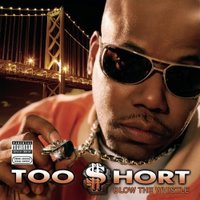
Although largely recorded in Atlanta with production by Jazze Pha and coexecutive producer Lil Jon, Blow the Whistle is Too Short's most Bay-sounding album in years and certainly his best disc since 2000's You Nasty (Jive). Having rapped professionally since 1983, Short might not bring his utmost to every recording, but Whistle sounds as hungry as the most hyphy debut imaginable. His subject matter has not changed significantly — shouts of “beeyatch!” still abound — but he brings a fresh intensity to his raps, as though reenergized by the youthful Bay Area movement.Songs like the title track and the Droop-E-produced "I Want Your Girl" (featuring E-40 and Mistah FAB) find Short Dogg perfectly at home with the latest Bay sound, while on "Keep Bouncing" he even gets Snoop Dogg "ghostridin’ the whip." While it may be true that Short's wordplay tends toward the misogynistic, it's equally the case that he receives no credit for his gestures in the opposite direction. Witness his support rap on Kelis's girl-power anthem "Bossy" and the following lines from Whistle's "Sophisticated":
Y'all thought Too Short was all about pimpin' Foul-mouthed mack just talkin’ bad about women You heard bitch and cut it off You ain't even listenin’ All I said was, if the shoe fits wear it And if it don't apply, act like you didn't hear it.
No one has the right to take away from Short the word that made him famous. And nobody is obliged to take it seriously either.
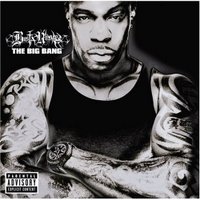
It's hard not to compare The Big Bang to E-40's recent My Ghetto Report Card (BME/Warner): Both are "relaunches" of rappers who never really fell off, and have many more albums left in them. But where 40's hookup with Lil Jon seemed like a stroke of brilliance, the teaming of Busta with Dr. Dre has a slight air of corporate reshuffling, like Clive Davis handing Jimmy Iovine the keys and saying, "See what you can do." Trouble is, Dre isn't as interested in Busta as Lil Jon is in 40. Dre produces five tracks, tweaks half a dozen more, and mixes all, yet he feels fairly remote. Of his tracks, only the Missy Elliot feature, "How We Do It Over Here," is single-worthy, though it sounds like Dre biting hyphy, an impression reinforced by Missy's "Pop ya colla like this/Bottles up like this" chant.
If Dre isn't putting up his best, you can be sure everyone else is. The Swizz Beatz–produced single, "Touch It," is old but retains its charms, although the same can't be said for Swizz's vocalizations on the otherwise fine DJ Scratch track, "New York Shit." Probably the two best numbers are J-Dilla's fat, soulful Fender Rhodes groove, "You Can't Hold a Torch," and Timbaland's frenetically minimalist, quasi-African "Get Down," which makes you wonder what kind of album he would cook up if he had Busta at his disposal. As a whole, The Big Bang isn't disappointing, but it doesn't quite live up to expectations.
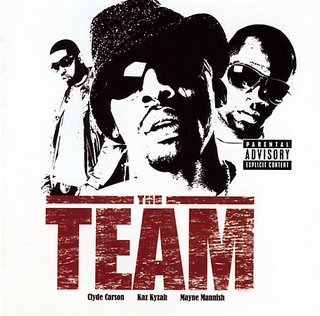
After months of delay, the Team's World Premiere has dropped, not on Universal as expected, but rather on large independent Koch. Whether this label jockeying had anything to do with the disc's belated appearance is unclear, yet the finished product is unquestionably one of the best, if most curiously assembled, albums to emerge under the banner of the hyphy movement.
While not a redo of the Bay Area group's 2004 debut, The Negro League (Moedoe), Premiere nonetheless lifts a pair of tracks, including the ShoNuff-produced hit "It's Getting Hot." The album also raids last year's Team mixtape, Go Music (Siccness.net), for the single "Patron," as well as the star-studded remix of "It's Getting Hot," which amusingly resuscitates MC Hammer. Two other singles from last year, "Just Go" and "Hyphy Juice," round out the familiar material, whereas their current single, the "Hyphy Juice" remix, is nowhere to be found.
All this sounds like a recipe for disaster, the same combination of ill timing and hit recycling that blunted the impact of Keak da Sneak's Kunta Kinte (Moedoe, 2006). Yet amazingly enough, Premiere overcomes its checkered origins and bangs from start to finish. The older material sounds fresh and is even heightened in the context of new tunes like "Top of the World" and "Good Girl," which add an almost psychedelic R&B dimension to the hyphy tonal palette. The innovative qualities of the music make any protest against its lyrical limitations — geared almost exclusively toward the club — beside the point, and the group's lack of gangsta posturing is refreshing in itself.
A multiregional force composed of Houston legend Scarface, Young Malice of Jackson, Miss., and the Fillmore District's own Will Hen, the Product is one of the more intriguing new groups in hip-hop. One Hunid is that ultimate rarity: a conscious album made by hood rappers for hood consumption, rather than for the backpack circuit. ’Face's list of thug credentials is as long as anyone's — stretching back to the Geto Boys — so his commitment to such a project is of genuine worth; he reaches a vast segment of inner-city youth who are deaf to the more substantial critiques of, say, the Coup.
Perhaps inevitably, the consciousness on One Hunid is limited to a sense of consequences: "I wasn't trying to kill that man; he was in my way/And now I'll never see the light of day," intones Hen, suggesting fear of prison more than a realignment of values. Consciousness is also apparently for men, as little distinguishes the Product's talk of "bitches" from your average thug's. I've been told by rappers who know that this approach is a necessary exercise in spoon-feeding, but it's hard to recall 2Pac songs like "Keep Ya Head Up" and not wonder if there isn't another way.
Ultimately a record stands or falls on musical merit, and One Hunid doesn't disappoint. The rappers have heat — Hen arguably outshines Scarface himself. Oakland producer and longtime ’Face collaborator Tone Capone, who had a hand in the group's development, contributes five modern-day mob tracks, which serve as a useful reminder that there's more to Bay Area rap than just hyphy.
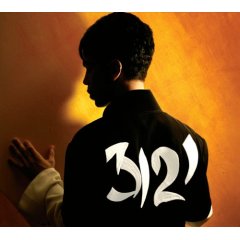
Following his massive Musicology (NPG/Sony, 2004) campaign, Prince was uncharacteristically silent for ’05, though clearly he spent a lot of time working on 3121, named after his new residence-complex in LA. The contrast between the albums is instructive, for where Musicology sounds like something Prince tossed off in a month, 3121 feels polished and composed.
Sony's publicity machine may have heavily exploited the nostalgia value of Purple Rain's 20th anniversary, but the current album is far more evocative of classic Prince.
"Love" directly quotes "Glam Slam." The cheese synth–driven "Lolita" by turns conjures "Soft and Wet," "Raspberry Beret," and the Time, far outshining its Musicology equivalent, "Illusion, Coma, Pimp and Circumstance." "Black Sweat," the hottest track, is like a combination of "Kiss" and "Housequake" — yet its freshness shows how ahead of their time such songs were. Derived from his own past rather than hip-hop's present, "Black Sweat" nonetheless sounds positively hyphy.
Having appeased fans with this high-gloss coat of purple paint, Prince proceeds to go about his business, largely devoted to his faith as a Jehovah's Witness and his desire to launch his new protégé, Tamar. Her slightly raspy, tremulous R&B vocals spice up several songs, including the bluesy title track, which, judging by the other personnel, is a souped-up outtake from The Undertaker (Warner, 1994), a live-in-the-studio power-trio album released only in Japan.
Exactly where 3121 ranks in the pantheon of Prince albums is uncertain, but even a cursory listen reveals a more substantial disc than Musicology.
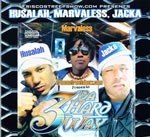
Except for a retrospective Best of (Thizz), Pittsburg's own Mob Figaz spent 2005 in divide-and-conquer mode. Particularly hot were Rydah J. Klyde – who dropped two duo discs (El Pueblo Children with Freako and Bang Fo Bread with Johnny Cash as Money Gang) and a solo What's Really Thizzin? (all on Thizz) – and Jacka, whose solo debut, The Jack Artist (Artist), generated a huge buzz in the early part of the year. The present disc, teaming Jacka and fellow Figa Husalah with tough-talkin' Sac Town female rapper Marvaless, is one of the tightest side-projects in hip-hop history. If this were a full-time trio, they'd be a hardcore Fugees. It doesn't hurt that most of the tracks are produced by Rob-Lo, who provides ample evidence of why people speak of him in the hushed tones reserved for Rick Rock or E-A-Ski. He cooks up tracks in every style, yet everything he does is his own.
With all eyes on Klyde and Jacka, picking Husalah as your favorite Mob Figa is a bit like claiming George as your favorite Beatle, but I'm convinced that, like George, whose interest in India added unexpected depth to the band's psychedelia, Husalah is the Mob's special ingredient, bringing a sublime ridiculousness to every track. Witness "Shower Posse," a faux-dancehall gem that Husalah handles in a patois of Jamaican slang and invented nonsense, or "Moblife," where he phones in some vocals from the freeway. This willingness to go the extra creative mile is what distinguishes the Mob from every other thugged-out crew out there.
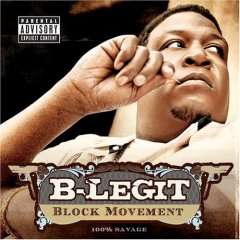
Apart from cousin E-40, B-Legitis the most accomplished rapper from Vallejo's Sick Wid It camp, his danked-out baritone providing the ideal complement to 40's high-pitched, hyperspeed delivery. With two mid-'90s discs for Jive, and two on Koch earlier this century, Block Movement is B-La's fifth solo album, and it shows just how far the Bay Area's original Savage has evolved since his most popular release, The Hemp Museum (Jive, 1996). Where that album relied heavily on 40's early blueprint – a solid mob foundation by the likes of Studio Ton and Mike Mosley – Block Movement shows B-La cultivating a distinct artistic sensibility. Other than 40's guest spot on "Guess Who's Back," produced by longtime associate Rick Rock, the album's best tracks – "Sick Wid It" (Damon Todd), "Trap Game" (Bedrock and Clyde Carson), "Get High" (One Drop Scott) – have little resemblance to 40's recent hyphy phase, taking advantage instead of the sheer depth of B's voice to explore more atmospheric vocal effects. This tendency is heightened by appearances from vocalists Harm and Naté on a trio of tracks produced by LJ, recalling his work on BavGate's The InstaGator (Black Mafia/Thizz, 2004).
The only missteps on Block Movement result from the few obvious attempts to ensure regional crossover success: "Block 4 Life," with Jadakiss and Styles P; "Where Dem Hoes At," with Paul Wall; and the crunk snoozefest "Handle Up." That's part of the game these days, but the album gains immeasurably by excluding these. Otherwise, Block Movement shows B-Legit has fully come into his own.
Kev Kelley is excited. The Hunters Point emcee has been taken on as a protege by Shock-G, legendary leader of Digital Underground, who produces two tracks on the 23-year-old’s upcoming debut. It’s 3 a.m. Shock’s exhausted, having just wrapped a two-hour jam between DU and a funk band called Slapback, in celebration of his own “solo debut,” Fear Of A Mixed Planet. As we roll to the hotel for the interview, Kev insists on carrying Shock’s bag, despite its owner’s modest protests. “Fuck that!” Kev yells, zooming ahead with his treasure. “I’m doing what 2Pac did!”Shock accepts this with the habitual calm that contrasts so strikingly with his on-stage presence, whether as Shock-G or as his plastic-nosed alter ego, Humpty Hump. And Kev has a point. While never just a roadie — “We were producing and grooming and trying to get him a deal the whole time,” Shock says — 2Pac definitely lugged his share of equipment on the first DU tour in 1989. Shock’s ear for talent, moreover, is undeniable; through DU over the years he’s also boosted the careers of Saafir, the Luniz, and Mystic, among many others.As a producer Shock profoundly influenced rap’s development in the early ’90s. Two years before The Chronic had everyone jumping on the Mothership, Shock drew the blueprints for a hip-hop built on P-Funk principles. Tracks like “Rhymin’ on the Funk” (Sex Packets, 1990), “Same Song” (This Is An EP Release, 1991), and “The D-Flo Shuttle” (Sons Of The P, 1991) — all on Tommy Boy Records — laid the groundwork for much that followed. According to Digital Underground: Raw Uncut, a new DVD documenting the group’s entire history, “Freaks Of The Industry” remains, after 14 years, the #1 requested song on the Bay Area’s main hip-hop station KMEL despite never being a single. (#2? The Bay Area Ballers mix of the Luniz’s “I Got 5 On It,” also featuring Shock.) Such achievements and innovations have been obscured, however, by the huge pop success of “The Humpty Dance,” which led many to see the group as a bubblegum novelty. The beautifully eclectic, meticulously detailed, and deeply felt Fear Of A Mixed Planet is Shock’s ambitious attempt to finally step out of the shadow of Humpty Hump.