With two hot collaborations, one new solo joint, and an upcoming reunion with Mob Figaz in the works, Husalah should be on top of the world. Instead, he's spending the next four and a half years behind bars I'm on the set of the video for "Never Blink," a song off Mob Figaz member the Jacka's 2005 solo disc, The Jack Artist (Artist), featuring Dubb 20 and J-Stalin. The "set" in West Oakland where 10th Street meets Mandela is not sanctioned by a film commission but monitored from a distance by a slowly circling caravan of three police cruisers. A Mercedes SL500 creeps through the crowd and parks in the middle of the road, retracting its hard top with the slow-motion elegance of a moon landing before a familiar 6-foot-3-inch frame unfolds from the low roadster and begins the usual round of hand slaps and hugs. Husalah is on the set. "I represent the Iraqi Space Program," he announces, then immediately reconsiders. "The Nigga Spaceship Association." He has the air of one whose wit is so fertile he must double-stack its results. Though Hus doesn't perform on "Never Blink," he has turned up on behalf of his fellow Mob Figa for some whoridin' — that art of dancing, lyric miming, and tough posturing behind the rapper — and for the next several takes nearly steals the show. He can't help it. Combined with his athletic build and strikingly handsome face, his height makes him conspicuous in any crowd, while his desire to "take it further," evident in his innovative, melodic flows and ever-evolving gangsta argot, also animates his appearance. Instead of imaginary bills, Husalah pulls out a stack of new hundreds, fans it to show it's all hundreds, shuts the fan, and begins to count, licking the bills instead of his thumb as he goes while bobbing to the mournful yet light-as-air RobLo production. Fielding an imaginary call, Hus shoulders his phone as he continues to count and dance, gazing off abstractedly as though processing information. It's a performance worthy of a Mac Dre or an André, though more thugged out and unmistakably Husalah's own. Husalah's been recording for eight years, debuting as a teen with the other Mob Figaz — Jacka, Fed-X, AP9, and Rydah J. Klyde — on "Ride til We Die," the opening cut on C-Bo's Til My Casket Drops (Awol, 1998). Now, at 25 he is hitting his creative stride just as Bay Area rap is making itself felt on a national level. Three hot Husalah projects are currently in stores: 3 da Hard Way (FriscoStreetShow, 2005), a trio with Jacka and hard-spitting MC Marvaless; Animal Planet (2006), a Demolition Men mixtape cohosted with Jacka; and Dope, Guns and Religion (Sumo, 2006), a solo debut drawing on new and unreleased material. With a Mob Figaz reunion on the horizon, the timing couldn't be better, except for one small catch. In February, Husalah was sentenced to four and a half years in federal prison for possession with intent to distribute "more than five kilos" of cocaine, a charge dating from 2001, when the rapper was 20. At press time, he was set to turn himself in July 10. "Where I come from," Husalah says several days before the video shoot, at the Mob Figaz's studio, hidden away in an upper-middle-class chunk of Antioch, "it's all about getting money, staying fly, being the coolest dude." Born in 1981 in nearby Pittsburg, the young Tito Alston grew up in el Pueblo Housing Project, notorious for its colorful "hood rich" hustlers, who made small fortunes dealing dope and pimping. It's exactly the sort of "subculture that glorifies swagger over work," according to a March 20 New York Times article and "causes the deepening ruin of black youth." Such preferences likely are also the effect of poor education and few opportunities for low-income inner-city families. Pittsburg may not be your classic inner city, but it's certainly no exurban paradise. An inland port first known as New York Landing, it was rechristened Black Diamond following the 1903 discovery of coal in the hills and received its present name in 1911 to honor the arrival of the steel industry. The low-paying jobs available to unskilled laborers (in chemical and power plants and oil refineries and distribution centers) are ones few would wish to take or even consider safe. As a teen Husalah rapped in talent shows, but his first love was sports. He played basketball and football and even boxed. His hoop dreams were quashed, however, when he was expelled from Pittsburg High in 10th grade after being caught with crack he intended to sell. Following a brief stint at the alternative Riverside High, where he was again busted with his stash, he was expelled for good and sentenced to a year of house arrest. "I used to sneak out at 10 every night, until 8 in the morning [to sell crack]," he recalls. "That was my shift." By 16, Hus was "heavy into the streets. I didn't care about music no more." "Then one day I was playing basketball in the gym," he continues. "Jacka, AP9, and RobLo came and got me. They was, like, 'C-Bo at the record store — he want to hear y'all rap.' I was, like, 'I don't care about this shit no more.' I got $4,000 in my pocket. To a young ’un that's big." Fortunately his friends managed to persuade the young Husalah to have his date with destiny. "We weren't even a group," he says. "We were just the tightest dudes in the area. But C-Bo was fresh off 2Pac's All Eyez on Me [Polygram, 1996], selling 300- or 400,000 units consistently. We went into the studio that day and did 'Ride til We Die.' After that, Bo's, like, 'We fittin' to do an album.' We went on tour, dropped the album [C-Bo's Mob Figaz (Git Paid, 1999)], and sold 140,000." If the number seems small to platinum-conscious readers, consider that this occurred in the middle of Bay Area rap's long commercial decline, when even an album with a radio hit — such as the Delinquents' Bosses Will Be Bosses (Dank or Die, 1999), featuring "That Man!" — only moved 50,000 units. Or that the stir caused two years ago by Frontline's Who R U? (IMG) was based on sales of 10,000. For an independent debut in the Bay, 140,000 would still be huge. The figure was more than sufficient to establish the Figaz as a force in Bay Area rap. For a couple of years, Husalah says, "I was, like, 'OK, this is money.' But then Bo went to jail and it got stagnated." The loss of C-Bo's leadership coupled with the Bay's commercial misfortunes slowed the group's momentum. "I fell back into [dope dealing] because it was lucrative," Hus confesses. "I've always been the nigga to wear the flyest kicks, the best fits, the best chick, so I gotta keep that standard going." Work on an attempted follow-up album, Mob Figaz, languished so long that the exasperated Warlock Records would eventually release it unfinished in 2003. As he returned to the streets, however, Husalah began to develop a spiritual consciousness. E-40's remark on In a Major Way (Jive, 1995) advising the listener to "read Proverbs" in times of stress got Husalah perusing the Bible, and from there he moved to the Koran. It was the Koran that spoke to his struggles and sensibility. "It's all about God first," he says. "It ain't about preaching. It's about knowing what's real." His conversion to Islam led him to wrestle seriously for the first time with the implications of selling crack to his community. "Allah says you can't be judged for what you weren't aware of," Hus comments. "I thought I was doing right as a youth. That's what all the older people I came up under did to make money. You get dope at hoop or be catching long bombs or sell dope. There's not a lot of opportunity here. But once you become a man, you get aware of what you doing. It's not an excuse now that you're aware of it." The ambivalence Hus developed toward his primary source of income is documented on Dope, Guns and Religion, which despite its celebration of the hustling lifestyle is threaded with contradictory feelings born of his spiritual awakening: "But at the same time I barely touch packages/ ’Cause I believe pushing poison is for savages/ But then again, this shit got advantages/ How could I live if my pockets is Somalian?" As these lines from "Rainman" illustrate, Husalah has tapped into Bay Area rap's 2Pac-inspired tradition of the "conscious thug," using the dope dealer or pimp persona to articulate the dilemmas faced by black high school dropouts — more of whom, by their late 20s, are incarcerated (34 percent) than employed (30 percent), according to the same New York Times article. But where 2Pac was a conscious rapper who adopted the thug persona, partly from his on-screen success in Juice, partly as a way to get his message across, Husalah is a thug rapper who achieved consciousness, seeking a way out of the dope game even as he remained ensnared by its financial rewards. Though he scaled back his activities, Husalah was unable to resist what seemed like a quick job for a big payoff in 2001 and arranged to help ferry "a large amount of cocaine" from Chicago to Cali. "That was a decision I made," he explains today. "It wasn't out of ignorance. It was out of a sense of desperation or hopelessness. I felt like I had no other choice." "Some dude ratted me out; we were being watched the whole time," he continues. "I caught a federal conspiracy charge in Chicago. There was another guy driving the car, but they said I was the one who coordinated, flew him out there to pick something up, to take something around. With the feds, you got to take the charge and do your time. You can't win." Nonetheless, after posting bail Hus returned to the Bay, hiding out for the next 18 months. "I wasn't really on the run because it was an out-of-state case and they didn't know where I was," he explains. "I'm, like, 'I'm not surrendering until they pick me up.' In the meantime, the grand jury indicted me, and I was snatched up by the task force in Pittsburg. "I didn't have no criminal record. I'd been to juvenile hall, but this was my first time going to jail and I'm looking at 10 years." Bailed out again, Hus would spend another three years fighting the case in court before eventually agreeing to plead guilty to possession and intent in exchange for the feds dropping the weightier conspiracy charge. Sentencing him to 53 months in February, the judge granted Husalah a six-month stay to get his musical affairs in order before entering the Federal Correctional Institute in Sheridan, Ore. "My whole thing now is making music," says Husalah, who, in addition to completing his parts for the upcoming Mob Figaz album, has been hard at work finishing a half dozen projects, including a rock album, The Unusual Suspects; a dancehall disc with Jacka as the Shower Posse; and Harsh Reality, the full-length he was making when his legal woes began. "Plus, I figure I'll still be able to work in there, because in the federal system it's a lot more open. I'm pretty sure I'll have a mini ADAT recorder. There'll be new product." With the group’s business partnership, MobFigaz, LLC, continuing in his absence, Husalah has no fear of losing his musical profits. “I know they’re gonna keep it rockin',” he says. “We gonna make sure our check is in the mail.” “Husalah is a phenomenal artist,” says Mistah F.A.B., who featured a farewell interview with Hus on the most recent installment of his new WILD 94 show. “He’s very intelligent and his character and charisma leave an impression on people. It’s unfortunate he has to go to jail for his past mistakes, but his stock will rise for doing his time and we’ll be waiting for him when he gets back. It’s going to be a learning experience.” Husalah, it seems, agrees. “If Allah made me go through what I had to go through, there's a reason. I'm a better person. I learned what not to do. The statistics show it's death or jail for a street nigga, so for me it happened to be jail. I feel like it's a blessing that I'm breathing, I'm healthy." "When you look at the whole situation, I had a lot of fun," he concludes philosophically. "I rocked a lot of models, rode a lot of rims, dropped a lot of tops, popped a lot of bottles, all that bullshit, so I'm trying to see what I'll evolve into now. I might be heavily religious. I might be into different types of music. Whatever it is, I'm gonna stay a real nigga, keeping this mob shit rocking. I'm gonna lay down and do my time. Then get right back and make money like I never left." www.myspace.com/husalahofthemobfigaz
by Garrett Caples
San Francisco Bay Guardian July 12, 2006BLACK DIAMOND
“THIS IS MONEY”
COKE ADDS LIFE?
20061104
Dope, rap, and religion

20061029
Bring on the Demolition Men
by Garrett Caples
San Francisco Bay Guardian April 26, 2006
The Demolition Men, Impereal and DJ Devro, definitely didn't earn their reputation as the Bay Area's mix-tape kings by staying at home. As DJs the duo has performed together and separately at clubs all over the world, from China and Japan to South America and Europe. Native Spanish speakers — Impereal hails from the Colombian community in Queens, NY, while Devro is Southern California Creole — the pair also hosts Demolition Men Radio, broadcast Thursdays from 6 to 7 p.m. on Azul 1063, a hip-hop station in Colombia's Medellin. Yet if you live in the Bay, you're most liable to see them on the street, selling mix tapes out of their backpacks.
"We're like a walking promotional retail machine," Impereal jokes. "If you don't buy a mix tape, you going home with a flyer."
Such determination, coupled with the DJs' high output (more than 30 releases since late 2003, including three volumes each of R&B and reggaeton) and elaborate graphics, has finally kick-started the Bay's once lackadaisical mix tape scene.
An integral component of hip-hop in New York and the South, enabling new talents to be heard alongside vets and vets to issue bulletins with an immediacy unavailable to corporate labels, DJ-assembled mix tapes at their best are the ultimate in no-holds-barred hip-hop. Considered "promotional material" and usually printed in limited quantities, the discs are generally unencumbered by legal requirements like sample clearance.
Until recently, however, mix tapes weren't much of a factor here. While the Demolition Men are quick to pay homage to their local predecessors — like Mad Idiot, DJ Natural, and DJ Supreme — Natural acknowledges the mix tape scene was a bit dead before the Demolition Men began shaking it up.
"Out here DJs were concentrating on clubs," Natural says. "Then they started putting stuff out constantly." Now there's sufficient trade in mix tapes for Natural to move his formerly virtual business, Urban Era, to brick-and-mortar digs at 5088 Mission, making it the Bay's only all–mix tape music store. Yet even with increased competition, he notes, the Demolition Men still routinely sell out.
In addition to their up-tempo release schedule, the success of the Demolition Men's mixes might be attributed to the conceptual coherence they bring to their projects. While they do put together general mixes featuring more mainstream fare — such as the Out the Trunk series, which boasts exclusives from Ludacris — the duo's hottest projects tend to tap into the Bay's reservoir of talent. Aside from their multifaceted Best of the Bay series, the Demolition Men have released mix tapes hosted by Bay Area artists like Balance, Cellski, El Dorado Red, and the Team.
Currently the Demolition Men's most successful disc has been their most ambitious: Animal Planet, not so much a mix tape as music cinema, starring the Mob Figaz' Husalah and Jacka. A mighty 34 tracks — featuring production by Rob Lo, Traxamillion, and the Mekanix, and appearances by F.A.B., Keak, and Pretty Black — Animal Planet is an incredible collection of almost entirely exclusive, original material, seriously blurring the boundary between mix tape and album. Its success has encouraged bold undertakings, like The Early Morning Shift with J-Stalin and Block Tested, Hood Approved, a mix tape/DVD starring Fillmore rapper Big Rich. "I guess we're taking the mix tape to the next level," Devro says.
Demolition Men DJ
Thurs/27 and the last Thursday of every month, 9 p.m. doors
Vault
81 W. Santa Clara, San Jose
$10
(408) 298-1112
myspace.com/demolitionmenmusic
20061028
The Mob Figaz Meet Marvaless -- 3 Da Hard Way (FriscoStreetShow.com)
Album Review by Garrett Caples
San Francisco Bay Guardian January 25, 2006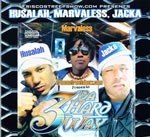
Except for a retrospective Best of (Thizz), Pittsburg's own Mob Figaz spent 2005 in divide-and-conquer mode. Particularly hot were Rydah J. Klyde – who dropped two duo discs (El Pueblo Children with Freako and Bang Fo Bread with Johnny Cash as Money Gang) and a solo What's Really Thizzin? (all on Thizz) – and Jacka, whose solo debut, The Jack Artist (Artist), generated a huge buzz in the early part of the year. The present disc, teaming Jacka and fellow Figa Husalah with tough-talkin' Sac Town female rapper Marvaless, is one of the tightest side-projects in hip-hop history. If this were a full-time trio, they'd be a hardcore Fugees. It doesn't hurt that most of the tracks are produced by Rob-Lo, who provides ample evidence of why people speak of him in the hushed tones reserved for Rick Rock or E-A-Ski. He cooks up tracks in every style, yet everything he does is his own.
With all eyes on Klyde and Jacka, picking Husalah as your favorite Mob Figa is a bit like claiming George as your favorite Beatle, but I'm convinced that, like George, whose interest in India added unexpected depth to the band's psychedelia, Husalah is the Mob's special ingredient, bringing a sublime ridiculousness to every track. Witness "Shower Posse," a faux-dancehall gem that Husalah handles in a patois of Jamaican slang and invented nonsense, or "Moblife," where he phones in some vocals from the freeway. This willingness to go the extra creative mile is what distinguishes the Mob from every other thugged-out crew out there.
20061022
Nation of Thizzlam: The Rebirth of Thizz Entertainment
by Garrett Caples
San Francisco Bay Guardian November 16, 2005
The real legacy of Mac Dre is not his criminal record but rather the music he made and the label he started as Romp Records after his release from prison in 1996. In a characteristically generous move, Dre’s first project was a Rompalation featuring the new generation of Crestside rappers who’d begun to establish themselves in his absence. In 2001, continuing friction with the Vallejo Police convinced Dre to relocate to Sacramento and rename his company Thizz Entertainment, downplaying the association with “Romper Room Gang” (see main article). Originally slang for an ecstasy high, “thizzin’” grew to be an extremely elastic concept in Dre’s hands, encompassing a wide range of hedonistic associations.
While Thizz long boasted an impressive roster of largely Crestside-bred talent, the death of its charismatic leader and best-seller obviously threatened the company’s existence. But Thizz wouldn’t die. Dre’s business partners, Miami Tha Most and Kilo Curt, instead brought in Crestside native Mac Mall as co-owner, flagship artist, and public face of the organization. Though Mall and Dre had fallen out in the mid-’90s, they’d recently reunited to record Da U.S. Open (Thizz 2005), the last project Dre completed, down to its tennis-themed cover art.
“We started doing a lot of shows on the road and bonded our friendship first,” Mall recalls. “Then that record was the easiest I ever made in my life. It was so organic. Me and Dre was getting ready to take over the world, doing projects together and then solos, along with the rest of Thizz. So we already had this in mind.”
“When dude passed, I made a vow; I’m not gonna let this story end. I gotta step up and keep Crestside music alive.”
Thizz has done more than keep alive. The period since Dre passed has been one of the hottest times for Bay Area rap in years, and no label has brought more heat than Thizz. In addition to maintaining Dre’s own vast catalogue, Thizz has dropped one underground banger after another, releasing new albums from its established core of Crestside artists like PSD (The Guru), Little Bruce (Base Rocks & Pimp Socks), and J-Diggs (California Livin’, Part 2), as well as more recent affiliates like former Steady Mobbin’ member BavGate (The InstaGator) and North Oakland’s Mistah F.A.B. (Son of a Pimp), whose Droop-E-produced single, “Super Sic Wid It” featuring Turf Talk and E-40, cracked the top 5 on KMEL, making it the label’s biggest radio success. (Dre’s own Sean-T-produced “Fellin’ Myself,” from his 2004 album Ronald Dregan, continues to play in heavy rotation.) Mob Figaz member Rydah J. Klyde, a friend of Dre from his Sacramento days, already had two big albums on Thizz this year—The Best of the Mob Figaz and a duo album, as Money Gang, with Johnny Cash of Da Hoodfellas, called Bang Fo’ Bread—when he dropped two more: one solo, What’s Really Thizzin?, one duo, with Freako, El Pueblo Children. This doesn’t even exhaust the list, which also includes four Thizz Nation compilations. Taken as a whole, it’s an unprecedented single-year output for a Bay Area independent hip hop label.
Dreganomics
The sheer volume of Thizz releases over the past year has been made possible by an increased level of collaboration within Bay Area hip hop’s notoriously cutthroat business environment. Dre’s goodwill extended far beyond Crestside, and the tragic circumstances of his death provided a sudden common ground on which a divided scene could unite.
“Thizz Nation, that’s everybody all put together, because that’s what Dre always wanted,” PSD says. “The Bay Area didn’t know how to come together. But with Thizz it’s starting to happen. A lot of neighborhoods that had problems squashed those problems in the name of Mac Dre and Thizz.”
“We’re trying to carry on what Dre had going on, to put the shine back on the Bay,” he continues. “This is a fire he started. It’s up to us to keep it lit. It’d not only be disrespectful not to; we’d be idiots.”
“Thizz isn’t just a label; it’s a movement,” says Mistah F.A.B. “Of course we want to do ourselves as our artists but really we want to keep Mac Dre’s legacy alive. He started a lot of things that’s taking place right now. We want to put the Bay Area back out front.”
This new spirit of cooperation involves more than just pooling creative resources, though this helps; in F.A.B.’s case he recorded his entire album, including guest shots and producers, for free. More radically, however, has been Thizz’s adaptation of the co-branding principle to local hip hop on an unprecedented scale, teaming with rappers like F.A.B. or BavGate, who often have their own labels and put their own albums together. “We do albums and we bring them to Kilo, who is the C.E.O.,” F.A.B. explains. “Each artist has their own different ways of completing his album. But if it’s an album Thizz feels is worth putting out, putting their stamp on, they’re gonna put it out.” In exchange for a cut of the profits, Thizz lends logistical support and promotional dollars, as well as the “Mac Dre Presents” logo. Ultimately such independent dollars only go so far; as is increasingly the case even with major labels, it’s ultimately the artist’s responsibility to break the record. But Thizz lends the power, infrastructure, and name-recognition of a corporation to artists who otherwise might not be able to push a record without it; it also exposes them to potential new fans through association with other Thizz artists.
“There comes a point of saturation,” F.A.B. admits. “You don’t want people to burn out on the whole movement before it even gets a chance to expand.” What is striking, however, is the sheer quality of the Thizz releases thus far. Obviously Dre’s death has lent an incredible urgency to this music. The effect might best be gauged by comparing PSD’s current The Guru to his 2003 U Ain’t Heard of Me???, both co-released by Thizz and his own Gateway Entertainment. While the earlier disc is an impressive if overpacked collection of a top-notch rapper, The Guru is a true masterpiece of an album, bluesy and soulful, tinged throughout with PSD’s Mississippi roots.
With the addition of Keak Da Sneak, who confirmed his much awaited upcoming album will be a Thizz co-release with his own AllNDaDoe label, Thizz continues to gain momentum. The one hold out thus far is Dre’s fellow Cutthroat Committee member Dubee. While he willingly helped PSD finish the group’s second album, Money Iz Motive, among the final projects Dre worked on, Dubee doesn’t feel ready to drop another album yet. “I put my game on pause,” he says, “out of respect for the cuddie.” While he may not agree, PSD understands his friend’s position; no one wants to exploit Dre even as they want to further his work.
“We could have used more songs with Dre,” PSD says, “But we were like no, save it for his kids. We have to eventually let go; we can’t just keep giving you Dre songs like Dre alive.”