by Garrett Caples
July 2005
After a prolonged eclipse following its mid-’90s commercial peak, Bay Area hip hop is once again starting to shine. Major labels long leery of the Bay’s reputation for violence off wax as well as on have begun to sign acts, from new groups like The Team (Universal) and The Frontline (Penalty/Ryko) to veterans like Sean T (Interscope) and E-A-Ski (Penalty/Ryko). Anticipation of E-40’s new album for Lil Jon’s Warner-distributed BME has only added fuel to the fire. But the man who perhaps sparked this major label flame is, appropriately enough, a Rock: Rick Rock, the innovative producer who laid the foundation for the Bay Area sound known as “hyphy.”
If the word “hyphy” means anything to you then you’re probably familiar with the Bay’s homegrown alternative to crunk: aggressively uptempo beats serving as vehicles for frenetic flows whose contrast to the more leisurely enunciations of the Dirty South’s chief export could hardly be more apparent. In the amount of time an Eastside Boy will spend stretching a single phoneme beyond recognition, a Bay rapper like Keak Da Sneak will deliver a brief dissertation on the fine art of ballin’. While the influence of crunk had been creeping into Bay Area club music for quite some time, it was the single “Hyphy” by the Fairfield, CA-based trio Federation, featuring a guest spot by 40 himself, that formalized the tendency. Produced by Rock and released on his own Southwest Federation label, “Hyphy” generated sufficient noise both in the club and on the radio to attract the attention of Virgin/EMI, who signed Rock’s label in time to release Federation’s 2004 debut, The Album. Emboldened by this example, or for fear of being left behind, other companies began to follow suit, leading to the present flurry of Bay Area deals.
Tucked away in a semi-rural corner of Sacramento, in a housing tract of relatively recent vintage, the home Rick Rock shares with his wife and baby daughter is a picture of domestic bliss, albeit one decorated with gold and platinum plaques. In person, Rock presents a marked contrast to the behavior suggested by Federation songs like “Go Dumb” and “Mayhem.” Laid back, soft spoken, able to disarm his toddler of a deafening musical Elmo toy without spoiling her sunny disposition, Rock displays throughout our interview an unfailing politeness more evocative of southern hospitality than elbow-throwing in the club.
“I was born in Montgomary, Alabama,” Rock says, “but raised in Suisun and Fairfield, California. Doonie Baby [of Federation] I met in Alabama. He was born in Mississippi. That’s how we came with the name Southwest Federation, because we’re a combination of both. I moved here when I was 15, then I moved back to Alabama until I was 25. Goldie Gold, he’s from Vallejo. And Stres is from Fairfield.”
“When I came here from Alabama,” he continues, “I was really doing East Coast music. SB-1200. I went into a store down there called the Fonkey Chicken, and my friend there said, ‘The type of music you’re doing, they’re not gonna feel it here;. you gotta switch up.’ And I was like, ‘I’m going to do me and have the game switch to me.’ And it’s weird because he brings that up, after what’s happened, and I listen to the radio, and now everyone’s trying to do me.”
Naturally such a change didn’t occur overnight, but rather resulted from patient toil and sacrifice; at this point, Rock has put a solid 10 years into the game.
“I began producing in 1995 with Conscious Daughters, a female group Paris had. Then I did one for 2pac. Most of these records were under the radar and I was just lucky to be on them at the time. I actually got on E-40’s Hall of Game (Jive, 1996). I did ‘Record Haters’ and ‘Circumstances.’ I didn’t charge money because at the time I didn’t have nowhere to live. I was sleeping on the floor, just trying to get my name out. That was two songs; his last three albums I did something like 9 songs on each.”
Though working with E-40 definitely put Rock in radar range, the Bay itself was just entering its lengthy turn-of-the-century drought, a time when many deserving artists languished without major label support or access to the airwaves. What saved Rock from a similar fate was a summons from Jay-Z to produce 4 songs for his Roc-A-Fella family album The Dynasty (2000), including the hit single “Change the Game.”
“When I did Jay-Z, things started heating up for me. Calls start coming in, ‘Who’s this guy? He’s got a different sound. West Coast-type of beat but not your typical West Coast beat, with East Coast rhyming on it.’ That’s when Fabolous came around.” Unlike Jay-Z, a proven star who could score a hit over polka, Fabolous was an unknown quantity, but the resulting single, “Can’t Deny It,” had no small role in making the rookie rapper a mispelled household word in 2001. “It just snowballed from there,” Rock says, continuing his winning streak over the next couple of years with hits like “Make it Clap” (Busta Rhymes), “Automatic” (E-40 and Fabolous), and “I Know What You Want” (Busta Rhymes and Mariah Carey), for which he won an ASCAP pop award.
While extensive collaborations with East Coast artists gave him a level of exposure he couldn’t have achieved in the Bay Area—including airplay on the region’s main hip hop station, Clear Channel-owned 106.1FM KMEL—Rock never abandoned his base in Sacramento. Indeed, his nationwide status as an A-list producer became a source of pride for the local hip hop community at a time when it desperately needed one.
“I love what I’m doing for the Bay Area,” Rock confirms, “for Northern Cali period, because there’s been a drought out here and I’ve been able to work with a lot of people and still represent Northern Cali. It gives people a hope, and me too. Working with different people from different places, like New York, or Atlanta, gives you another perspective and it translates into your music when you come home.” Nonetheless, he admits, being classed among elite hitmakers like Dre, Timbaland, and the Neptunes is “a different type of stress.”
“When you’re not on the radar, it’s cool; you’re getting a few dollars, you’re on the grind. The minute you got a couple of hits, you’re on the clock. Because then it’s like, when’s the next one? Right now, I got 2 or 3 singles in the pipe, and I can’t wait for them to come because my last record was ‘Breathe Stretch Shake’ [Mase featuring P.Diddy] and that’s like 6 months old now. If not longer. You get kinda nervous. And it’s something that new producers, they never feel that pressure.”
In the meantime, Rock hasn’t stood idle, throwing his energies into his own roster of artists. In addition to producing an album by Oakland group Kinsmoke, Rock has accumulated 18 tracks towards the next Federation album. “I’ve already started mixing the record,” he says with evident enthusiasm. What remains in question, however, is whether either album will be released through Virgin. In a textbook case of industry irony, the man who began the Bay’s new round of major label deals can’t wait to get out of his. For Rock was dissatisfied with Virgin’s handling of Federation’s The Album.
“It didn’t do well,” he sighs, like the ace pitcher whose team can’t score any runs for him. “It’s a classic Bay Area album. But what we did I can do independent and make way more.” Among his particular frustrations was Virgin’s decision not to make a video for “Hyphy,” cutting off one of the most likely routes for a regional hit to go national. “I really wanted to make these dudes stars, not just independent, around here stars. There was nothing out here and I wanted to make everything seem bigger than it is.”
“When I signed with Virgin, I was at Mister Chow’s in LA,” he continues, conjuring an image of the elite environment in which superproducers dwell. “Pharrell was there. He was complaining about how Virgin did N.E.R.D. and how they did Lenny Kravitz. And I’m sitting there listening, and it was just crazy that I ended up signing with Virgin.”
“I have to do a few more records for them unless they say we’re cool. They decide. We can’t drop them. I’m supposed to know what they want to do in a minute; hopefully they’ll be like, ‘We should sever ties,” because I’d really like to open another door.”
Fortunately, while Virgin makes up its mind, Rock is by no means in limbo; as a producer, he’s still a free agent. “I knew I couldn’t cross my production with Virgin because more than likely, we’d be off the label soon. I understood going into this that more times than not it doesn’t work.” Among his latest projects: splitting production chores with Lil Jon for the new E-40 album, proving that crunk and hyphy aren’t rivals but more like family.
“That’s gonna be a trip,” Rock says. “Lil Jon’s having the best 2-3 year run. I talk to 40, ‘What’s Lil Jon like in the studio?’ and 40 says, ‘Just like you. He comes from the ground up.’ Like some people, they don’t do nothing. Somebody else might do it and they put their name on it. So I always wonder, does he really turn knobs and hit keys and everything, and 40’s like, ‘Yeah, man. He’s doing it for real.’”
20061019
Rick Rock Changes the Game

20061017
Say 'Bay' -- Behind the New Bay sound of local hip-hop: NorCal producers
by Garrett Caples
San Francisco Bay Guardian July 6, 2005
'WHAT AM I – Old Bay?" a sardonic Tone Capone says, digging up some 3X Krazy tracks on his computer. One of the main architects of the Bay Area's classic midtempo mid-1990s mob music, the North Oakland native Anthony Gilmour, a.k.a. Tone Capone, is perhaps best known as the producer of the Luniz's 1995 weed anthem, "I Got Five on It," the second-most-requested track in KMEL history. Tone was instrumental in launching the solo career of the Geto Boys' Scarface and later put high-schoolers Keak da Sneak, BA, and Agerman together as 3X Krazy. But despite the enduring popularity of "Five on It," the classic sound Tone helped pioneer has lately been held responsible for the Bay's subsequent commercial drought.
It's an idea Black Dog Bone, editor of Vallejo's redoubtable Murder Dog Magazine, doesn't quite buy. "I do think things got stagnant in the Bay, with the same sound for a long time. But mob music was really popular. People loved it." As a longtime observer, Black Dog attributes the Bay's subsequent commercial decline more to a lack of radio support. "I think the only reason KMEL is playing Bay music now is because of [Power 92.7]," he says. "KMEL was losing its audience. It wasn't about tempo."
Nevertheless, Black Dog's excited about the new sounds coming out of the Bay: "It's hyphy. The beats are faster and crunk-influenced, but the rap is still more like mob." Ivan Heredia, a marketing manager for Penalty/Rykodisc who heard the buzz E-A-Ski and the Frontline were generating out in New York, is confident the label can break the Frontline's Now U Know nationally because its "aggressive, more accessible sound" will appeal in other regions, like the South and the East Coast. "Now's the time for the New Bay to shine," he insists.
Tone Capone is unimpressed: "It's more of a club sound, if there's any kind of vibe attached to it. The New Bay stuff I hear is all kick-clap. Techno sounds. I even did one like that because that's what they wanted. But I can't say that that defines the Bay."
As Tone's remark suggests, the variety of sounds presently flourishing in the Bay can't be reduced to any single category. These days, most Bay Area producers won't even admit to having a particular style, but one thing's for sure: From Federation to the Frontline, most of the recent major signings in the Bay have occurred through local labels, themselves often based around the work of a single producer. In an age of increasingly capable digital technology, the producer has achieved an unprecedented autonomy and importance in hip-hop. Often he wears many hats: arranger, songwriter, musician, label head, artist rep, talent scout, surrogate parent, and sometimes also rapper. The ultimate model, of course, is Dr. Dre, a star in his own right, with million-dollar budgets and a continually expanding roster of platinum artists. Here are a few of the major players in and around the Bay.
Rick Rock
Label: Southwest Federation
Reppin': Fairfield and Sacramento
Like E-A-Ski, Rick Rock has maintained a national reputation as a producer even during the driest days of the Bay's commercial drought, providing hits for the likes of Fabolous, Jay-Z, and Busta Rhymes. And like Ski, Rock has played a central role in the present resurgence. In 2003, on the strength of the radio and club success of "Hyphy," the Fairfield trio Federation were picked up by Virgin through Rock's own Southwest Federation imprint. But Rock was unhappy with Virgin's promotion of Federation's The Album last year. "The whole reason why I did the major-label thing was I wanted the visuals," Rick groans. "But they didn't have a video. It's depressing to know we had a great body of work, and it falls by the wayside."
Besides completing a new Federation album, Rock's splitting production chores with Lil Jon on E-40's album for the crunk king's new BME label, due in September. "When everything was the slow mob music, I came through with the up-tempo, hard-hitting, Rick Rock aggressive music," he says. "Now people are switching to that up-tempo, hard-hitting type of thing. And that's cool – just do it your way. Because next time I come around, I'm going to come around with something else."
Droop E
Production team: The Pharmaceuticals
Reppin': Vallejo
"As far as the Bay Area," Rick Rock says, "I think Droop E, E-40's son, is gonna blow up. A youngster – he's 17 now. He was raised in music, though." Indeed, Droop E's first appearance on wax was at the age of three on his father's 1993 album, Federal (Sick wid It), though his production debut, at 15, was a Turf Talk track on Mack 10's 2003 compilation, Ghetto, Gutter and Gangsta (Ark21). He's also laced tracks for Mistah F.A.B., Baby Jaymes, and, of course, his pops.
"Pharmaceuticals: We're basically prescriptions and antidotes for these rappers," Droop E explains. Yet he adheres to no one formula. Compare the slow, swelling R&B brass on his "Can't Nobody," from Messy Marv's Disobayish (Scalen, 2004), with the techno-influenced shuffle of "Get On My Hype," from Marv's Bandanas, Tattoos and Tongue Rings (Scalen, 2005). "I flip-flop," he says. "I don't want to stay in one category." His own group, the Cabinet, is currently working on their Sick Wid It debut.
Sean T
Production Team: Dallas Squad
Reppin': East Palo Alto
If you're feelin' Mac Dre's posthumous hit, "Feelin' Myself," then you're feelin' Sean T. With a career stretching back to 1989 with Murder One Records, Sean T has numerous solo albums, but he is more known these days as a producer of "slaps," those monster handclap beats that remain a staple of a Bay Area hip-hop diet. Still, his production is diverse: The multi-instrumentalist draws on exotic varieties of world music in his search for sounds, layering them into thick, piano-laced slabs of gangsta funk. "I don't really have a style, because I'm like a chameleon," he says.
Having produced much of JT the Bigga Figga's two proto-Game releases, 2004's The Untold Story and 2005's West Coast Resurrection (both Get Low), Sean maintained ties with the Aftermath signee, who helped the producer land a distribution deal with Interscope for his own Get Gone Records. His album, Long Time Comin', is due out this month.
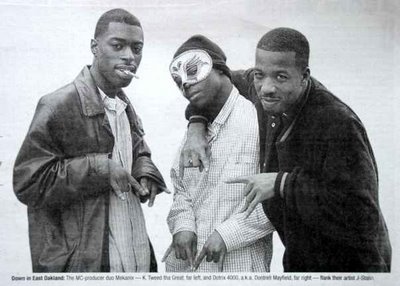
Mekanix (Dotrix and K. Tweed)
Label: Zoo Entertainment
Reppin': East Oakland
The Mekanix were accidentally formed in 1999, when former Digital Underground DJ Dotrix hooked up with street producer Kenny Tweed to work on a couple of tracks. Six years later they're still working together on a daily basis, laying down darkly atmospheric, stridently synthetic grooves for Eddie Projex, Dru Down, the Delinquents, Keak da Sneak, and Yukmouth. "They're definitely coming with something new that's not your typical Bay sound," E-A-Ski partner CMT remarks. "Very innovative beats." Recent albums featuring mostly Mekanix music include former Cydal member T-Luni's The Autobiography and FM Blue's The World Is Blue (both FastLife, 2004) and female rapper Okolo's Diamond N tha Ruff (HereAfter, 2005).
Touré
Label: 101% Music
Reppin': East Oakland
Touré's been holding it down for years as chief DJ for the Hieroglyphics, as recently documented on their Full Circle Tour DVD-live album (Hiero). His career as a producer started gradually, beginning with a track on Casual's 1994 classic, Fear Itself (Jive). Currently in the process of establishing his own label, 101% Music, Touré is working with former TWDY member Dolla Will, Emaculate, and Rhythm & Green members Ray Royal and Crown Jewel. He's also formulating Touré's Theory with the 101% roster.
Touré attributes the club sounds circulating throughout Bay music at present to the current software packages. "Hip-hop comes bundled with techno," he says. "And a lot of these keyboards now, you can manipulate and change the sound waveforms and create your whole sound."
Mike D
Label: Mo Slap Beats
Reppin': Oakland
An accomplished organist who enlivens the services at both Abyssian Baptist Church and Millenium Ministries in Oakland, Mike D has served as a musical director and performer on tours with TLC, Faith Evans, and Tony! Toni! Tone! But he is best known for laying down dark slices of funk behind OGs like Too $hort and the Delinquents. With his former partner, Sonny B, Mike laced $hort's coming-out-of-retirement albums, 1999's Can't Stay Away and 2000's You Nasty (Short), with four tracks each. His experience with the Delinquents' 1999 smash, "That Man!" confirms Ski's remarks on making music for the radio (see " 'Pressure' Drop"): "They really wasn't feelin' it, but I told them, 'You gotta give the radio something that moves.' " More recently Mike's been talking with Def Jam about his new label, Mo Slap Beats, and helping to promote Yella Paidgez (DoWhatchaDo), by his brother Yella Yezz.
One Drop Scott
Reppin': Berkeley
The son of Thalmus Rasulala (who appeared in such films as 1975's Friday Foster) and born in LA, Scott moved to the Bay as a kid in the early '70s. The accomplished percussionist helped form Salsa de Berkeley, played drums for jazz giants like Bill Summers, and replaced then-girlfriend Sheila E in Confunkshun.
While a member of the Freaky Executives, Scott wrote and produced a novelty rap song "Surf or Die" – a 1987 full-length of that name, credited to the Surf MC's on Profile Records, just edges out Life Is...Too Short (Jive, 1988) as the first big-label Bay Area rap album. One Drop worked with Tone Capone on Scarface and 3X Krazy projects, but it was his work on C-Bo's Til My Casket Drops (AWOL, 1998) that earned him his reputation for densely layered, musically sophisticated tracks that still bring the boom. One Drop recently contributed to BavGate's The InstaGator (Thizz, 2005).
Tone Capone
Reppin': North Oakland
"Straight mob," Tone says, his gravely voiced, staccato pronouncements betraying the world-weariness of one who's been to the platinum mountain yet found it wanting. "Just want to make some good music before I die, do my part." Yet despite Tone's seeming lack of ambition, his utter refusal to get excited about the latest round of major-label courtship, the ongoing intensity of his music is evident. In addition to recent work with San Quinn, Tone is preparing a conscious thug project called The Product, due on Koch in a few months, with Scarface, SF's Will Hen, and Mississippi's Young Malice. "It's a group with different flavors from different regions," he says, playing me cuts of awesomely revamped mob music, bouncing and slapping a little bit faster, more spaciously.
A track comes on that's a little slower, with the huge whomp bass of classic Bay mob. It's totally Tone, and I start to describe why this track reminds me of the old mob music in a way the other ones didn't, though I'm aware of an amusement dawning behind his impassive features. He waits for me to finish my explanation, then savors his mirth a moment longer. "Scarface produced that one."
part 1
'Pressure' Drop -- E-A-Ski cooks up a Bay sound from a higher ground
by Garrett Caples
San Francisco Bay Guardian July 6, 2005
I'M FOLLOWING E-A-Ski's black Mercedes at a brisk clip through the winding turns of the Oakland Hills, en route to our interview.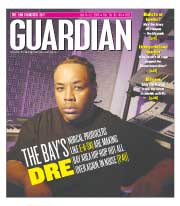
Suddenly we plunge down a steep, straight road lined by two rows of enormous trees, like we were on our way to stately Wayne Manor but accidentally took the secret path to the Batcave. Our destination involves a little of both, for the immense, shingled affair, whose overall shape I can't quite determine, serves as residence and laboratory for an undeniably dynamic duo. Ski's cousin and coproducer, CMT – who combines the easy camaraderie of Robin with the quiet discretion of Alfred – later describes the house as having a "log-cabin feel," which, compared to any of the more vertically oriented mansions in the immediate vicinity, it does. But its size and weathered-wood exterior more readily recall a small sawmill, bent to a purpose alien to the more stockbrokerly pursuits of its neighbors.
CMT is already in the lab working when we arrive. The "lab" in question is a studio – not a home studio or preproduction studio, but a fully equipped, 32-track, take-it-from-here-and-press-it-up professional recording studio, the needs of which clearly dictate the house's design, an ocean-liner layout of skinny corridors surrounding large interior rooms. Built at the pair's behest 11 years ago with proceeds from a million-dollar deal with Priority for an album that never came out, the structure is a monument to Ski's business acumen, to the "Excellent Ability to stay on top" embodied in his initials. "Skiing" is Ski's metaphor for this, and it's apt, for Ski has skied through the wreckage of no less than four such deals.
Obstacles that have sent other careers into free fall have only launched Ski and CMT into higher tax brackets. In 1998, for example, when DreamWorks refused to release his completed second album, Earthquake, unless he added a track with an artist from the newly hot Dirty South, Ski forced the company into a breach-of-contract settlement. "A big settlement," he adds, not with relish or bitterness so much as a sense of outraged honor appeased by appropriate compensation.
Yet Ski's refusal to be ensnared in industry machinations has come at a cost. Platinum-hit makers since their first major label production – Spice One's "Trigger Gots No Heart," from the 1993 Menace II Society soundtrack (Jive) – the duo's extensive list of big-name clientele includes E-40, Ice Cube, even the almighty Dr. Dre himself. But Ski's own output as an artist has been limited to a handful of fugitive releases; he has yet to drop a proper solo album (one can't count the now-out-of-print 2003 limited-edition mix tape, Past and Present). Now, with a new distribution deal for his Infrared Music Group through Penalty/Rykodisc, and a hot young act, the Frontline, on his hands, Ski is putting the finishing touches on Apply Pressure, his debut and masterpiece rolled into one. Begun in 1998 as Aftershock – the follow-up to Earthquake (which was never released due to the dissolution of Relativity) and his 1992 EP, 1 Step Head of Yall (No Limit) – Apply Pressure has already spawned two hit singles, "Ride," in 2003, and "My Bad," from earlier this year. Given the current momentum of Bay Area hip-hop in terms of signings and airplay, a momentum he's had no small role in generating, the time is ripe for the Chronic-level event that Apply Pressure threatens to be. More than a dozen years into his career, will Ski finally release the classic he's always said he would?
The negotiator
Born Shon LaAnthony Adams and raised in East Oakland, E-A-Ski drives a hard bargain; it took no end of negotiations just to get me here. But Ski is more than ready to deliver: During the next two hours, under the attentive, confirming eye of CMT, he unreels enough material to fill several volumes. By turns guarded and unguarded, coolly rational and bubbling with an anger for which his raps serve as a therapeutic release, Ski is nothing if not complex. And productive: He and C claim a total of 15 million records sold, and with all the gold and platinum on the walls, I don't need to inspect the books.
"We're not young like we used to be," says the 30-year-old Ski. "We don't dictate the music. We have to make sure that we revolve around whatever the kids is liking." To this end, the producers do their "homework," bringing fresh tracks to the hood and playing them for kids in the 12- to 17-year-old range. They also study whatever music is popular. "We don't make music that's personal. We might not even like the stuff that's winning but we're like, I can see why this sound is moving the younger audience."
Such methodical research has helped Ski and C stay on top of hip-hop's constantly shifting terrain. Their consistent hit-making ability as producers has allowed them to achieve amicable resolutions when deals haven't turned out to their satisfaction. Apart from the contractual dispute with DreamWorks, whenever they've lost faith in a company's direction, they've been able to withdraw on good terms, using production to offset any advances.
"None of these companies were bad companies," Ski insists. "But ... wrong timing. With Priority in '94, everything was going right until they merged with EMI. So we opted out. Relativity was closed down because it was bought out. Columbia in 2001 did a merger and fired the A and R person who brought us there. But we've been fortunate because we've been able to use our production to leverage my situation as an artist."
Major label signees would do well to pause here and study Ski's game before buying that diamond-crusted bezzle they always wanted. Studio time is expensive – the primary expense of making albums – but once they'd built their own, Ski and C used it to work off the advance they'd used to pay for it, without having to spend their own money. After that, free studio. Free money-making machine. Not to mention a place to live. You don't need to be a college graduate, like College of Alameda alum Ski, to appreciate the economics of this arrangement.
"That's one of the things me and CMT did: We invested in our future," Ski explains. "We were smart. Our parents were smart. We can't say we don't have nothing to fall back on like property because we invested in dumb shit."
Rap dreams
After Columbia became the fourth consecutive label to sign him without releasing an album, a less stoic soul might have consoled himself by dropping his own records locally, or even settling into the lucrative and enviable position of a nationally recognized A-list hip-hop production team. Yet I doubt this is possible in E-A-Ski's case. His desire to rock the mic is undiminished from the days when he and CMT were in the basement rehearsing routines copped from a live tape of Run-DMC. And this hunger, more than any other single factor, seems to motivate the pair's rigorous quest to stay current in an age-conscious industry where short careers are the norm.
But rather than immediately shop for another deal, Ski decided to switch tactics "to show how you could make records without being under a major situation and get your community to support them." This campaign took two fronts, one of which, appropriately enough, was the Frontline: Left and Locksmith. Impressed by Locksmith's famous Bay-repping performance during MTV's 2003 freestyle competition, Ski subsequently met the Richmond rappers through MC Balance, a mutual friend. "They had great attitudes," Ski says. "They didn't smoke, didn't drink – they were focused, going to school. It was a great combination." The equally abstemious Ski and CMT quickly clicked with the Frontline, signing them to IMG, and moving around 10,000 units of their locally released debut, Who R You (2004). Fusing Left's own idiosyncratic, rock-influenced productions onto a solid backbone of E-A-Ski/CMT bangers, Who R You was sufficient proof of Ski's continued viability for Penalty/Rykodisc to sign on as distributor for the entire IMG label.
"I see what Ski is doing," veteran East Palo Alto rapper-producer Sean T says. "He's integrating Frontline with himself to bring himself back out there and let people know, 'Yeah, I rap too. Listen to my rap, plus I produce.' And that's a good thing too. I love Ski for that. A lot of people now are starting to know Ski as a rapper as opposed to when they didn't know about Ski at all."
Can't live without my radio
The impressive sales of Who R You even without distribution were stimulated in part by the strong support for the Ski-and-CMT-produced single, "What Is It," from the once local-leery Clear Channel station KMEL. KMEL, of course, was the second front of Ski's campaign. While he has generally maintained a radio presence as a producer, and even as an act in his own right, the level of rap superstardom Ski envisioned called for more than his own individual success. It required the support of a vibrant, hit-making scene in which Bay Area artists appeared on the radio, in the mix with nationally known acts from New York, the South, and LA. So he took the direct approach: He went to KMEL, willing to negotiate.
"If a veteran comes in with a résumé and gives you a hot record, and you don't take a chance on the record, you're basically saying that you don't want to try to make our area hot," he says. "That's all I ever said. If I give you a record that can compete with anything that's going on across the country, will you play it? They said yes. It was pretty much that simple.
"[KMEL managing director] Big Von told me clearly, 'You have to make records with a certain tempo. You have to tone down the profanity and subject matter.' I said, 'OK.' If you're trying to reach the commercial audience that radio reaches, you have to change your way of thinking, and I understood that."
Such deliberate catering to corporate dictates may have a Faustian ring to some ears, but Ski plainly feels this perspective is foolish. "Everything has a format," he points out, and getting KMEL to articulate one allowed Ski the opportunity to fulfill the format. The relative lack of stricture the station's ultimately vague requirements have placed on his creativity may be gauged by the Frontline's new single, "Bang It," from Rykodisc's recent revamped reissue of Who R You, retitled Now U Know. Compared to the hyper-boogie of "What Is It," "Bang It" is positively stately in its pace. What both songs share are the burbling techno noises, '80s synth sounds, and general club orientation found in much recent Bay Area hip-hop (see "Say 'Bay'"). Sounds that would have raised eyebrows in the mob-music milieu are becoming central to the Bay's digitally expanded tone palette.
Release the pressure
While Ski by no means deserves all the credit, his personal role in making the Bay Area hot again can't be denied. Yet even with all eyes on the Bay, and IMG's distribution deal already in hand, don't expect Ski to rush Apply Pressure out before he thinks it's ready.
"If you're gonna go out and make an album, you gotta stand firm behind it," he says. "And until I'm firm, my album will be out when it be out." The release is tentatively set for fall 2005.
With their own studio at their disposal, Ski and CMT have been able to update Apply Pressure at their leisure, replacing tracks that have become dated with ever more advanced material. Before I leave, they play me a few cuts, and I have to admit, I'm totally convinced. A spacious, aired-out reinvention of G-Funk, complete with radio-friendly singles, Apply Pressure is as far advanced as the duo claim. "This is some 2007 shit," Ski says proudly – though hopefully not literally. The Bay could use it right about now.
20061014
Breaking Down the Battle Lines: Frontline's Locksmith and DU's Esinchill
By Garrett Caples
San Francisco Bay Guardian March 16, 2005
ESINCHILL FIRST DROPPED on Digital Underground's Who Got the Gravy? (see "You Ain't Knowin'," page 44), honing his skills with the group for the next five years on the road, and he has the support of fellow D.U. members like Numskull, also of the Luniz. "Esinchill is one of the best artists coming out of the Bay right now," he says. "He's book smart, and that comes out in his rhymes."
He's also a ferocious freestyler, so I was impressed to learn the Frontline's Locksmith beat him in a battle on KMEL, 106 FM, a few months ago. "We went one round, and they was like, 'It's a tie,' " Esinchill recalls. "Then we went a second round, and I fumbled. I couldn't bring it back."
But E remains philosophical. "I think what the Frontline do best is battle. That's where Locksmith shines. But there's a difference between being able to rap and being able to make songs. I think I make better songs."
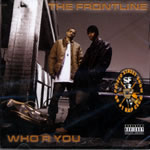 He raises an interesting point, insofar as the majority of the Frontline's verses are battle rhymes. The "realness" of the battle rhymer is almost inevitably gauged by "hardness," which we might provisionally define here as experience with, and stoicism in the face of, street life. As much as I dig their refusal to adopt the usual gangsta pose, the Frontline's emphasis on hardness limits their lyrics.
Take four bars of Locksmith on "I Gotcha," from the Richie Rich comp Grabs, Snatches, and Takes (Ten-Six, 2004):
You might see Lock on the block in some Tims and Nikes
Making motherfuckers duck when I extend my right
I'm an mc; I fight with pens and mics
You're a bitch; you fight for women's rights
Like many of rap's memorable moments, the third and fourth lines are at once clever and offensive. The repeated grammatical structure creates the expectation of a similar parallel in logic, which is then violated by the second half of the fourth line. (Remember your SATs: "MC" is to "bitch" as "pens and mics" are to "women's rights" is not the correct answer.) Though he might have shored it up with a better rhyme than "right" and "rights," the structure is complex and compelling, even if – for a UC Berkeley grad like Lock – the sentiment isn't very nice.
Here are four bars from the "Intro" to Esinchill's Everything to Lose! (Rceason, 2002):
Born sick and with seizures, massive head trauma
Bitch-ass doctors woulda killed me if it wasn't for mama
Took me off the medicine, didn't have no more falls
No more emergency phone calls and hospital halls
Though the difference in subject matter makes it absurd to compare these examples, each is representative of the rappers' respective concerns. With the notable exception of "Hennessy," Esinchill doesn't really stunt on brand names, and where Locksmith raps about being hard, Esinchill is introspective at the top of his lungs, eliding pronouns and breaking up syntax to pack a few years into four lines. On paper, "hospital halls" seems like a throwaway, yet on disc it leaps out, neatly condensing a kid's perspective on hospitals: boredom and waiting.
Here's the conclusion of both verses – Locksmith's, then Esinchill's:
Lock: Nigga, me no singer
I'm from the Rich where them boys like to keep those things
And they stay with their ring on bling
And they wear more gold than a Chinese ping pong team
I rap instead; I notice I'm at peace when I rhyme
I think with my dick so let me give you a piece of my mind –
Suck it; me in a nutshell, forever passionate
I'm through with this control; I gotta go, I got some ass to get
We've already heard Lock "stretch metaphors like a Chinese jump rope" on Who R You, so the use of "Chinese" for mere verbal flashiness begins to pall this time around. E's ending crushes it. To hear "passionate" rhymed with "ass to get" is exactly what I turn to rap for. The other rhyme is nearly as pleasing, and the second line's combination of two shopworn phrases leads so inevitably to "suck it," you can admire its formal invention even while declining its invitation.
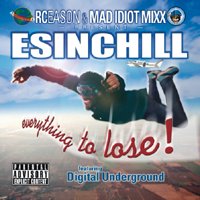 Esinchill's versatility in style and subject matter is what makes Everything to Lose! so accomplished a debut. And just as the Frontline's run of luck began with Locksmith's questionable 2003 battle loss on MTV, so Esinchill's buzz has picked up since losing to Locksmith. He's in talks with Hiero Imperium to release his next album, a duo record with partner King Beef called Choice Cuts, while the advance single – the Touré-produced "Hip Hop" – has been bubbling up in Funkmaster Flex's record pool. Maybe losing is everything.
Is There Really a New Bay Rising?
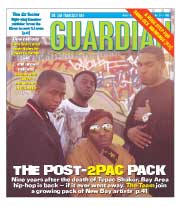
The post-2Pac pack
Did the death of Tupac Shakur throw Bay Area hip-hop into a tailspin? And is there really a "New Bay" rising?
By Garrett Caples
San Francisco Bay Guardian March 16, 2005
You can pick me up; I'll be posted on 10th Street
'Cause you know that's where I'll be
Stuck like a telephone pole.
SO SINGS YOUNG rapper J-Stalin – a DJ Darryl discovery and former Richie Rich protégé – on a hook from his recent first mix tape, R-N-B. And it's true. As I roll up 10th Street in West Oakland's Oak Center, I see the short, wiry MC in the distance, standing in the middle of the street, talking on his cell. On the other end of the line, next to me in the car, is Dotrix 4000, a.k.a. Dontrell Mayfield, a former Digital Underground DJ turned MC-producer as half of the Mekanix. We've just driven from his house in East Oakland to pick up Stalin and bring him back to the Mekanix's studio, where they're finishing Stalin's debut, On Behalf of the Streets, for the duo's new label, Zoo Entertainment.
I live downtown, in a neighborhood no one calls Lakeside, about 20 blocks from where Stalin's "posted." In effect, I've spent my day doing a citywide doughnut. But Stalin's hood is worth it. A post-WWII black community inhabiting the structures of a middle-class Victorian past, Oak Center is funky as hell, beautiful blocks of houses in all shades and states of repair, dotted with buildings of a more recent vintage.
According to the fall 2003 Oakland Heritage Alliance News, the entire neighborhood was slated for demolition by the Department of Housing and Urban Development in the early '60s to make way for vast, anonymous housing projects. Only stubborn local resistance thwarted the plan.
'New Bay' vibed
Like Oak Center, Bay Area hip-hop is characterized by stubborn resistance, epitomized by 2Pac and still evident in Stalin's provocative choice of namesake. And that same spirit animates the community's reception of the catchphrase "New Bay." 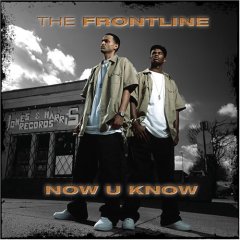 Coined by Oakland MC Balance but popularized by Richmond duo the Frontline, the term "New Bay" has led to press in national publications like Vibe and XXL. The latter forecast a "resurrection" of Bay Area hip-hop based on Virgin's 2004 success with the Federation (from Fairfield) and Ryko's signing of the Frontline on the strength of their EA-SKI-produced hit "What Is It." Since the single broke into the rotation of the notoriously local-leery KMEL, 106 FM, the radio exposure has helped the group move 10,000 copies of Who R You (IMG), their 2004 independent debut, which will be updated and rereleased by Ryko as Now U Know.
Yet the phrase has also sparked a firestorm of controversy in the Bay Area hip-hop scene.
"I guess people are like, we done worked too hard to let people come in and say, 'We're the New Bay – fuck all the old shit,' " Dotrix 4000 says. "Those cats screaming, 'New Bay' – they ain't connected. But the underground is all connected. We've been connected."
As if cued, G-Stack of Oakland's Delinquents calls Dotrix 4000's cell. "I think it's bullshit," he says of the New Bay concept. At the same time, he lets it be known his gripe isn't personal. "I think the Frontline does have talent, and I wish them well. But it's about public perception. 'New' comes right after 'old.' "
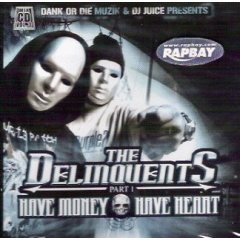 Therein lies the problem. Like most forms of popular entertainment, hip-hop is extremely susceptible to the cult of the new. Careers start young and end early, unless you can adapt to rap's ever-changing circumstances. It requires indefatigable effort to stay on top of the game, the type of effort that's driven the Delinquents to record not one but two mix CDs – Have Money Have Heart volumes 1 and 2 (Dank or Die Records) – addressing the New Bay controversy. In a gesture of defiance, G-Stack and fellow Delinquent V. White enlisted the aid of Too $hort, Oakland's ultimate OG, for "Say Bitch," the lead single, which disses the New Bay in no uncertain terms.
The "2Pacalypse" Theory
To fully understand why a phrase so small could generate a reaction so extreme from a vet like G-Stack, we must invoke the "2Pacalypse" theory. Believers argue that Pac's death in '96 triggered an artistic decline that left Bay Area hip-hop incapable of attracting a national audience or major-label interest. Thus, the Frontline's bio on www.thefrontlineonline.com offers, "In the past six years, the Bay Area hip-hop scene has become stagnant, passing off replicas of established artists as new talent." Add a couple of years to account for the age of this blurb and we're back at 1997, without even mentioning Makaveli directly. The New Bay clearly presupposes the 2Pacalypse, insofar as there must be a grave from which to resurrect Bay Area hip-hop.
But the 2Pacalypse theory has at least two major holes that make it an unsuitable foundation on which to build an understanding of local hip-hop. For starters, it holds the artists responsible for the behavior of major labels. Yet even before 2Pac's death, major labels were getting cold feet in the Bay. On his Web site, www.guerillafunk.com, for example, Paris is vocal about his problems with Tommy Boy and then Priority regarding the political content of his work, which effectively stalled his career in the mid-'90s.
Or take the case of Ray Luv, 2Pac's partner in the Marin City group Strictly D.O.P.E. In 1993, Ray scored an independent radio hit with "Get Your Money On," on Mac Dre's Strictly Business Records. In 1995, with Dre in prison, Ray signed with Atlantic (once part of Time Warner and now with Warner Music Group), through Khayree's label, Young Black Brotha. Atlantic, he tells me, "put out my album about six weeks before Time Warner was about to fire Interscope over Death Row and 2Pac. So every record like Pac's basically got shelved because they didn't want you to blow up."
"I'd be in L.A. – I'm getting walk-ons on the biggest shows," he says. "Shows they couldn't get me, I'm getting. Atlantic moved me from there and sent me to Kansas City for five days. And I'm like, what just happened? Once we pissed each other off, they were sending me to hotels where my window faced a brick wall. It got weird, so I quit. I took from '96 to '99 off."
If this sounds like the paranoia of a could've-been contender, consider the source. Handsome and charismatic, Ray was already a proven hit-maker, as was Khayree. The label exec who couldn't exploit so close a connection to Pac for at least gold in 1995, when he was already the biggest-selling rapper ever, strikes me as an underachiever at best.
The second hole in the 2Pacalypse theory is the fact that the creative decline of Bay Area hip-hop never really occurred. With the major labels increasingly reluctant to sign acts, much of the scene went underground. 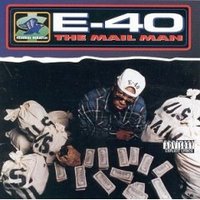 If you generated huge numbers, like E-40, whose 1993 EP, The Mail Man, debuted in the Billboard Top 20 with no distribution deal, you could force the majors to deal with you. (E-40 was quickly signed by Jive.)
But it grew increasingly apparent that you could do without them. Indie scenes sprang up around artists like Blackalicious and the Soulsides/Quannum collective. In Oakland, Pam the Funkstress and Boots reinvigorated political rap on a national level as the Coup. Artists like Del tha Funky Homosapien left labels like Elektra to establish their own companies, while others, like the Delinquents, built huge followings from the ground up.
New bosses
By 1999, the revolution was in full swing, as independent tunes began to infiltrate the airwaves. 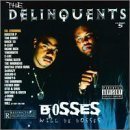 Among the local hits on KMEL that year was "That Man!," by the Delinquents, who went on to move 50,000 copies of 1999's Bosses Will Be Bosses (Dank or Die). By the end of the year, however, Clear Channel had bought KMEL, and G-Stack says he's been unable to get airplay since. (As of press time, KMEL musical director "Big Von" Johnson was unavailable for comment.)
The Delinquents maintain a sizable fan base. "They are Oakland," Dotrix 4000 says, "in terms of selling records and reppin' our city. They can't throw a party and it's not sold out." But while successful acts like the Delinquents have countered the lack of radio exposure and label support through relentless hustle, it's unclear whether hustle alone can withstand the effect of the media actively promoting other artists as New Bay hip-hop.
On the phone, the Frontline are more conciliatory than they come off online. They seem genuinely nonplused by the furor the New Bay catchphrase has provoked. "Without the veterans," MC Locksmith of the Frontline says, "you have no Frontline, without the Too $horts, the E-40s, the Delinquents, the Luniz, without any of these cats." His partner, Left, concurs: New Bay was meant to be "a fresh way of looking at Bay music" rather than an attack. "Let everybody come up. Let's all make good music and all come up together."
I brought this statement to a number of rappers, and responses ranged from "They should've said that first" to "SKI should've known better" to "Fuck them niggas" – disappointing, but you can see their point. We're talking about a scene that still produces entire albums dedicated to Rappin' Ron of Bad Influenz, who died in a car crash in 1997. Most Bay Area rappers I've spoken to have real reverence for the tradition on which they build, and the New Bay concept offends their sensibilities.
Like the residents of Oak Center, they're proud of their community and don't want it wrecked by decisions made outside. In that light, the resentment provoked by the New Bay concept and the flurry of accompanying diss records shouldn't be ascribed to envy. They signify, instead, the stubborn resistance of a community that has survived without assistance and that refuses to cooperate, or be co-opted, except on its own terms.