by Garrett Caples
Luniz 10th Anniversary Special exclusive to hyphythizzgo.com
2005 marks the 10th anniversary of Operation Stackola (Noo Tribe/Virgin, 1995), the platinum debut of Oakland duo Jerold “Yukmouth” Ellis, Jr. and Garrick “Numskull” Husbands: the Luniz. Featuring fat tracks by the likes of Shock-G, DJ Fuze (both from Digital Underground), DJ Darryl, and E-A-Ski & CMT, Stackola is best known for the Tone Capone-produced “I Got 5 On It,” which a decade later remains the weed-smoking anthem of hip hop. The album also established the Luniz’s peculiar brand of outrageousness. At a time when the persona of the millionaire rapper became the norm, the Luniz portrayed themselves as small-time hustlers, usually broke, always on something. Their sense of humor, moreover, was bizarre and inimitable; who but the Luniz would begin their very first album depicting their own death, at the hands of a machine-gun-toting “playa hata” shouting “Fuck the Luniz!”? (About half-way through Stackola, on “5150,” the pair are killed again, floating up to heaven to encounter Jesus, Shock-G’zus, who promptly kicks them out, though in truth Shock would bring them into DU, both on stage and in the studio.)
But what defined the Luniz above all else was the chemistry between Yukmouth and Numskull. Friends since their early teens, the two forged a bond based on their determination to succeed in hip hop. “We was both sleeping on the park bench,” Num recalls, “because his grandma and my mom wanted us to get jobs, and we’re like ‘No, we want to be rappers.’” Such shared hardships infused the pair’s complementary vocal styles, for Yuk’s frenetic flow was a perfect match for Num’s almost talking style of rap. “In every great duo, one partner brings something the other lacks,” says Mekanix production team member Dotrix, who dj’ed for the Luniz on tour for their second album, Lunitik Muzik (1997). “Num’s flow sounds simple, though it’s actually complex, but with him it’s more what he says, rather than how. Yuk, on the other hand, is all style, like a NY rapper, more how he says it than what.” Such differences mirror the Luniz’s distinct personalities. Yukmouth, to invoke a song from his 2003 album Godzilla, is “stuntastic,” rocking jewels and platinum teeth, puffing high-grade weed, sipping Moet; Numskull, by contrast, is laid back and hood, sporting white tees with no ice, no longer smoking weed but still committed to Mickey’s malt liquor.
The history of the Luniz begins in the late ’80s when Yukmouth joined Numskull’s Brothaz Wit Potential as a non-rapping visual artist who quickly became one of the tightest rhymers in the crew. Forming a duo originally called Luni Tunz, their first break came in the early ’90s when they met Chris Hicks of C-Note Records, who was in the process of recording the debut of another Oakland sensation, Dru Down. Hicks put the Luniz in the studio with Dru, where they recorded “Rescue 911” and “Ice Cream Man,” a local underground hit. The Luniz also recorded “5 On It,” which was sufficient to land a deal with Noo Trybe, while Dru’s album, Explicit Game, was picked up by Relativity.
The international impact of “5 On It” should have paved the way for the Luniz’s future. Instead, as if presaged by their multiple deaths on Operation Stackola, the duo was dealt a series of setbacks of the career-killing kind. Hoping to replicate Stackola’s success, Noo Trybe chief Eric Brooks tried to steer the Luniz in a pop direction Yuk & Num stubbornly resisted. Lunitik Muzik thus ended up sounding like the biggest-budget street album ever recorded; lacking a pop hit, the album nonetheless went gold, though it fell short of the label’s expectations.
Industry pressures began to take their toll. Ensnared in bad deals with both Brooks and Hicks, as well as legal difficulties owing to wild behavior on tour, the Luniz began to grow apart, and when Yuk jumped at a solo offer from Rap-A-Lot, their days as a duo seemed over. Yet, though mostly leading seperate lives, the Luniz never really broke up, playing the occasional gig and making joint appearances on various projects, including each others’, as well as the West Coast Mix of P.Diddy’s “5 On It”-based “Satisfy You” (Bad Boy 2000). Gradually they renewed their bond and recorded what was to be their third album, Oakland Blaze. But new complications arose. Noo Trybe folded, leaving Hicks with the rights to the Luniz name, while Yukmouth remained under contract to Rap-A-Lot. Numskull, meanwhile, refused to do business with Rap-A-Lot, as he’d never been paid for his appearances on Yuk’s projects. As negotiations ensued, bootlegs of Blaze began selling all over Oakland, even spawning the underground hit “I’m a Raider.” After endless delays, the album was finally rushed out, with a slightly different track list, in the summer of 2002, as Silver & Black (Rap-A-Lot). Though previous bootlegging resulted in low sales, the buzz the project generated was undeniable proof fans were still hungry for the Luniz, and the Luniz could still deliver.
To celebrate the Luniz’s 10th anniversary in the industry, I touched down with both Yukmouth and Numskull. With 3 solo albums, 2 United Ghettos of America comps, and 1 duo disc with C-Bo as Thug Lordz already under his belt, Yuk is promoting All Out War, Vol. 2 (Smoke-A-Lot), the second mixtape by his crew the Regime. Num, meanwhile, is preparing his first “solo” release, Caliban, named after his own new group, who are featured on the album. While the music on each reflects their respective personalities, it’s hard not to notice that both the Regime and the Caliban have adopted camouflage and fatigues, as if, even at a distance, Yuk and Num are attuned to the same wavelength. Both are optimistic about an eventual 4th Luniz album, but only when the conditions are right. “I wanna do it for me,” Numskull says, “not because of the Luniz name.” Yukmouth agrees: “We gotta build that bond back because that bond ain’t there right now. Soon as we can vibe together as the Luniz, then we can do it.”
(part two: Yukmouth: The Regime Declares War
part three: The Mystery of Numskull)
20061022
The Luniz: 10 On It!

Yukmouth: The Regime Declares War
by Garrett Caples
Luniz 10th Anniversary Special exclusive to hyphythizzgo.com
You’ve got to hand it to Yukmouth; during the Bay Area’s long post-2pac commercial drought—when E-40 and the by-then-Atlanta-based Too Short were the region’s only major-label platinum acts—Yuk routinely moved several hundred thousand units for Houston, TX independent Rap-A-Lot Records, maintaining a nationwide reputation without radio play, videos, or big-budget promotion. His success is partly due to sheer talent. Yukmouth’s flow is fierce, and while some fans were disgruntled when he smoothed out his voice on his solo albums, it soon became apparent that he was merely expanding his arsenal. His Luniz voice continues to crop up, but as one of many weapons at his disposal, and his continually-evolving technique keeps him current in an industry where styles quickly become dated.
Besides talent, Yuk’s success stems from sheer relentlessness. Having taken it upon himself to don the Thug mantle left vacant by the death of 2pac, Yukmouth has remained faithful to the role. Like Pac, he refuses to be politic, calling the game how he sees it, never backing down regardless of the opponent. As a result, he’s been involved in some legendary beefs: Master P; Scarface; Daz; Snoop (to name just a few). Most recently, Yuk’s been waging a two-front campaign against G-Unit and its erstwhile associate The Game. When we spoke he’d just released All Out War, Vol. 2, on his new Rap-A-Lot/Asylum-distributed label, Smoke-A-Lot. A 2-CD monument to spleen, War is the second mixtape by his multi-region crew, The Regime.
“Our click is from the East, Midwest, South, and the West, so we represent everybody,” Yuk says. “The Regime is Yukmouth, Tech N9ne, Gonzoe, Poppa LQ, Monster Gunjah, Menace, E-Blak, Dru Down, Young Dru, Young Skrilla, Ampichino, Nate Da Nut, Messy Marv, Mark Shyst. It’s the veterans and the young people I’ve discovered throughout my career. A lot of people come to you with CDs, rapping after shows; I happen to be one of the dudes who listens. I picked the best apples outta the bunch and formed the Regime.”
“We’re warming the streets up before we drop an album.. People heard about us from the song on my album Godzilla (Rap-A-Lot 2003), but I want people to feel us as a group; you can’t really see our diversity, our range of music, from just one song. On this new mixtape, we’re giving damn near 50 songs. We mean business.”
Indeed, and in more ways than one. While Yuk’s beefs are unquestionably sincere—fresh anger rises in his voice while discussing them—the budding label tycoon isn’t blind to the marketability of his battle with the whole G-Unit/Shady/Aftermath/Interscope juggernaut, currently the dominant commercial force in hip hop. 50 Cent and Game are even listed on the cover of War, along with more willing non-Regime participants like E-40, Jacka from Mob Figaz, and Guce of Bullys Wit Fullys fame.
“Game’s on the mixtape,” Yuk confirms. “It’s a skit where a girl clowns the shit out of him on the radio. There’s a lot of exclusive shit the average consumer couldn’t get unless you heard it that night. I got the actual shit, where 50 Cent dropped a nigga on Hot 97, the Fat Joe interview where he found out 50 did the song and he’s challenging him to a fight. I got Jay-Z on there when he dissed Game. It’s not only us; it’s a combination of everybody.”
Yuk has a point, for the sheer size of his coalition of the willing, not to mention its geographical diversity, suggests a growing backlash within hip hop against the corporate-funded hype machine that launched both 50 and Game in quick succession. The situation is extremely fluid, however. Game, for instance, takes his share of lumps on War, which features titles like “Playin Gaymez” and “It’s Not a Gayme,” as well as a surrogate, “The Lame,” portrayed with comedic panache by young San Diego rapper/producer Fifth. Yet surprisingly enough, according to Yukmouth, these portions of the mixtape are strictly historical.
“Right now, me and Game squashed the beef. He called me, after I pressed up the mixtape, and I’m like, ‘Yo, shit’s pressed up.’ And he’s like, ‘Ok, I understand. But from now on let’s not get at each other.’ I’m like, ‘Cool.’ Because he used to do the ‘Fuck you, Yukmouth’ at the beginning of every set, but he stopped that. And I respect that, so I ain’t gonna do no more songs about the dude because he’s holding his word.”
Anyone familiar with Yukmouth’s ability to hold a grudge—he’s still dissing now-retired Master P for biting “Ice Cream Man” 10 years ago—might be surprised by this abrupt about-face, but it makes sense, for Game’s war with G-Unit has inadvertently landed him on Yuk’s side of the fence. Word on the street was their beef stemmed from an incident that didn’t even involve Yuk, during a Game appearance in an Oakland record store, and for all the vitrol that’s flown between them, a beef based on a misunderstanding probably isn’t worth the effort given changing conditions on the ground.
In terms of his beef with 50, however, Yuk’s enthusiasm remains undiminished. “I’m willing to do a song with Game shitting on G-Unit,” he says. “I’m about West Coast preservation right now.” Preservation, it seems, is the very issue behind the 50 Cent backlash within the industry; unlike his clash with Game, Yuk’s beef with 50 is a matter of principle.
“50 Cent did a lot of snitching,” Yuk says, reiterating a charge frequently leveled against the G-Unit leader. “I won’t say what he said but he did a lot of dry ratting that got the hip hop industry fucked up. Major underground independent labels getting hit by the Feds, ATF, know what I mean? When dude got on BET and said what he said, he’s fucking with people’s livelihood. He’s got the magnifying glass on everybody, like everybody’s racketeering, trying to launder money. What’s all this shit coming from? Shit some rapper said on TV? When shit like that happens, it’s beef.”
“Murder Inc. ain’t the only label that got hit like that,” Yuk insists, referring to the federal prosecution of label heads Irv and Chris Gotti on money laundering charges, of which they were acquitted in early December. “Go ahead diss the shit out of Jah Rule, that’s not a problem. But when you start fucking with niggas’ livelihood, their money, their labels, it’s like, damn, are you hating on all black entrepeneurs? If you’re doing that, I have something against you, because I’m a young black entrepeneur.”
The connections Yuk makes here are striking in light of how weak the prosecution’s case was, reportedly based on a handful of text messages. The ramifications of 50 taking his beef with The Inc. off wax and into the federal court system would indeed be chilling, given that the Gotti’s are self-made record moguls and 50 is merely the nominal head of a imprint created by white corporate dollars.
“Of course Interscope is behind every move,” Yuk insists. “When Benzino started fucking with Eminem in The Source, Jimmy Iovine instantly put his money into XXL. Now every month all you see is Interscope artists on the cover. Irv Gotti said he was in a meeting with Iovine, because they all have the same parent labels—Universal, Interscope, Def Jam—so they gotta have big meetings and luncheons together. Irv sees the dude [Iovine] at the luncheon, and the dude really don’t want to look at him, talk to him or nothing, like he’s really in the beef. They’re at a table where all the execs have to talk, and Jimmy Iovine won’t look at him, like he’s really down with this beef and shit. He’s got 50 and Eminem’s back on that shit.”
“That’s a crazy way to do it because could it lead to another 2pac/Biggie sort of incident,” Yuk says. “I mean, damn, labels don’t give us life insurance. They’re putting niggas in danger, then a nigga dies and shit, and they get all the money. Same as Pac; Pac died and they got all the money.”
Whether or not Yuk’s conspiracy theories seem plausible or paranoid, it became clear early last summer that G-Unit was feeling the heat, when recent signée Spider Loc—whom Yukmouth had never met—was dispatched to snatch Yuk’s chain. “I got jumped by 6 niggas and they pulled out a pistol. I was by myself. But the very next day, by the time he got to the jewelery store, he got a call to give that shit back. So he hurried up and took his little picture with it, and then gave that shit back. I had his OGs, the people he looked up to, calling. ‘Oh what did I do; I didn’t know!’ He pleading his case like that. I had niggas that if they called the shot he couldn’t walk off his fucking doorstep, them type of niggas calling him. Had his ass on the phone apologizing.”
“As far as money, they’ve got better backing, but gangstas run the streets, man. Not money; gangstas run the street,” Yuk says defiantly. “I ain’t said I’m gonna kill nobody, but they definitely gonna get beat up or their chain snatched. Those dudes think they’re invincible with their bulletproof vans and shit. You still gotta go to sleep. Are you going to sleep in a bulletproof room? Or you still gotta hop on flights. You can have a lot of money and still be touched, man.”
(part one: The Luniz: 10 On It!
part three: The Mystery of Numskull)
The Mystery of Numskull
by Garrett Caples
Luniz 10th Anniversary Special exclusive to hyphythizzgo.com
Numskull is a hard man to pin down. When I first interviewed him in March, he was staying in Sacramento, shuttling back and forth to Reno to work on Caliban—his long-awaited first solo album—with producer C-Dash. Since then, we’ve periodically touched base by phone, at Digital Underground shows, or at the Garage in East Oakland, where former Luniz dj Dotrix and partner Kenny Tweed produce tracks as Tha Mekanix. One night in September in San Francisco, I bump into Num after a DU show, during which he brought down the house with a 3-song set from Caliban, backed by his group of the same name. Thizzing on a pill as well as on the crowd’s enthusiastic response, he gives me hug and tells me the album is done. Then he pulls me aside.
“This is important; you have to put this in the interview,” he says. “I was actually born in Mississippi; my mom moved to Oakland when I was a baby. And on my birth certificate, under race, its says ‘Negro.’”
He doesn’t elaborate further, but, only about a month after Hurricane Katrina, it was easy to catch his drift. Num was born in the ’70s, well after the peak of the civil rights movement when the term fell into disuse, but his birth certificate is evidence of the kind Katrina provided in abundance, that very little in fact had changed for certain black populations in America. If this seems like an atypical concern for the rapper who sometimes records under the name Drank-A-Lot, it does give a foretaste of what Caliban has in store for listeners.
“It’s gonna be Numskull’s solo album,” he says, “but I’m introducing the group so I got ‘em on a lot of songs. The Caliban is basically artists who don’t see the world like everybody else see it. We’re not worried about this club shit. Caliban—we took it from the Taliban, so we bitter about hella shit that’s going on. In the United States and overseas, all the shit. We hate Bush. It’s a Num album. And Num don’t really give a fuck about shit.”
The logistical details behind Caliban are still in flux. One minute Num is in talks with basketball players starting labels, next it’s supposed to be Koch, next he’s releasing it himself on the internet. Even the line-up of the Caliban seems to periodically undergo reassessment, though the core seems to be former No Limit soldier Don P; former Dangerous Crew member F.M. Blue, whose own long-delayed first album, The World Is Blue (FastLife 2004), is largely produced by the Mekanix; Blue’s younger brother Cheese Whosain; and DU member Esinchill, who just dropped his own C-Dash-produced project, a duo disc with King Beef called Choice Cuts (RCeason).
One thing, however, I can say for sure: the music Num played for me during our interview in Sacramento was some of the most advanced hip hop I’ve ever heard. Both Numskull and Esinchill hooked up with the newly-thriving Reno scene through Element, a trio who spent 5 years on the road as DU’s support crew and appear on Shock-G’s solo album, Fear of a Mixed Planet (33rd Street 2004). The beats coming out of Reno these days are wildly futuristic blends of the synthetic and the organic that sound truly like nothing else in rap. Clearly they inspired Num to take his own experimental approach to the vocals; the group tracks feature incredibly tight interplay between the rappers, as opposed to the usual structure of simply trading verses. As half of one of the greatest hip hop duos of all time, Num appreciates the power of group dynamics.
“I don’t like to be alone,” he confesses. “On stage, at home, anything. So I always bring people with me wherever I go. And these cats have talent, so why not put ‘em on?”
Such an attitude goes a long way towards explaining Num’s career in the years since Lunitik Muzik, for while Yukmouth has remained highly visible and productive—preparing to release his fourth solo album, Million Dollar Mouthpiece, in 2006—Num has kept a much lower profile. This has been partly due to circumstance; though he recorded a solo album in the late ’90s for NY-based K-Tel Records, the company folded before releasing it. Yet he also freely admits, “I didn’t think I was ready to do a solo album, at all. I was still into that Luniz shit. When I came out with my own album, I wanted it to be me, not people thinking he gotta make shit like the Luniz.”
Instead of pursuing a solo career, Num spent much of the period between Muzik and 2002’s Silver & Black on the road with the steadily-touring DU. “I was the animal on tour,” he admits. “I’m talking about drugs everywhere every night, drinking. And Shock was kinda coming along with me. But then he was like, we’re not going to take you and Clee on the next one. We understood. We were wild, acting a fool. I was still living out my Luniz fantasies. But Shock told me the reason we wasn’t making good music anymore was that we were partying too much. And I appreciated him for that.”
While the rest of DU embarked on tour, Num and Clee began hanging out in LA with producer Poli Pol, prior to his association with the Black-Eyed Peas. “The guy had a studio,” Num recalls. “We were just kicking it really cause we’d brought some other cats over to work with him. We were making songs that we wanted to hear. Shit that we were going through at that time. Like, you don’t have no pussy, so we made a jack off song. Shit like that. We weren’t even thinking about doing an album together at all. But then he’s like, fuck it; let’s do a whole album.” The result of these sessions was the brilliant but hard-to-find, label-less disc Good Laaawd That’s a Lot of Drank (1999), credited to Clee and Drank-A-Lot.
“That’s a classic album,” Num says proudly. “But we tried to put it out ourselves, and we didn’t know nothing about going independent. We pressed up 5,000 units and sold all 5,000 in stores. We would get the money back from the first sales, and we would try to put it into promotion. Then we’d have no money to press it up again when everybody’s asking for it. But I’ve never heard one person say that they didn’t like that album. I actually want to rerelease it.”
The duo eventually parted on friendly terms, but not before teaming with Money B for his Poli Pol-produced single “Putcha Thang on Me,” a Bay Area hit in 1999. Based on the chops displayed on his video for Good Laaawd’s single, “Knockdiesel,” Clee, now known as Cleetis Mack, went on to direct the successful Sex in the Studio adult hip hop dvd series (Metro Entertainment). Num, meanwhile, used Good Laaawd to help launch his proteges, Hittaz on tha Payroll, whose Mekanix-produced Ghetto Storm (Hitta) was one of the hottest albums in the Bay in 2003. The association continues, as Num co-hosts Sex in the Studio’s second episode (2004) and also features in the soundtrack single, “Drank-A-Lot,” with Money B and Eddi Projex of the Hittaz. Produced by the same Fifth who portrays “The Lame” on Yukmouth’s Regime mixtape, “Drank-A-Lot” generated a buzz earlier this year from numerous spins on BET’s late-night video show Uncut.
After years of crew-oriented endeavors, Num feels he’s finally “ready” to do a solo album, especially as he’s put together a powerful new crew to do it. The quality of the music on Caliban reveals the hidden perfectionism behind Num’s slow development into a solo artist
“Before I was just doing songs just to do them, and I don’t think that that’s my best work. A lot of those songs came from like me dealing with people and they’re like, ‘Num you should put this on your album.’ And I do hella songs by myself. None of it was worthy to me. That’s why I took so long. Out of 60 songs that I have, I’ll probably pick like 7 that I like.”
“I’m trying to make a classic album,” he concludes. “I don’t want an album with 2 good songs and 16 ok songs. I want an album that’s a classic all the way through, that you can just sit down and listen to. And I got something for everybody too. I have a song for this group, but other groups’ll want to listen to that song too. That’s the type of album I want to do.”
(part one: The Luniz: 10 On It!
part two: Yukmouth: The Regime Declares War)
20061018
Esinchill cuts
by Garrett Caples
San Francisco Bay Guardian October 26, 2005
Also performing with Digital Underground Oct. 28 at the Red Devil are Esinchill and King Beef. A relentless freestyler, inventive writer, and habitual stage-diver, Esinchill has one of the tightest flows in the Bay, and if he remains Oakland's best-kept secret, it's due to lack of exposure. After a show-stealing debut on DU's Who Got the Gravy? (Jake, 1998) and extensive touring with the group, E only made a handful of guest appearances, on discs by DJ Quik, the Delinquents, and so forth, before dropping the hard-to-find Everything to Lose! (Rceason, 2002). Displaying an unexpected metaphysical streak, as well as harrowing tales of a mysterious childhood illness, Everything is an astonishingly assured album showcasing E's versatility and eagerness to expand his range.
Having secured distribution for his Rceason label, Esinchill teamed up with childhood pal King Beef for Choice Cuts, Volume One, whose advance single – the Touré-produced "Hip Hop" – began generating a buzz with East Coast radio play earlier this year. Self-designated "hip-hop mood music," Choice Cuts is a frank genre workout of club/party songs that is less ambitious than its predecessor yet in many ways more accomplished. Much credit goes to the duo's main collaborator, Reno's C-Dash, who produced 11 of its 15 tracks, providing a unity of mood absent from so many rap albums. Dash's music is a dense mixture of synthetic and organic sounds with heavy R&B leanings – so crucial is he to the project that he warrants the rare hip-hop instrumental, which fits seamlessly into the album's flow.
As performers, Esinchill and King Beef display the deep rapport of classic rap duos, egging each other on to further audacity. Smooth-voiced and heavyset, Beef makes a perfect verbal and visual foil for E's rapid-fire staccato flow and compact frame. Sharing a disdain for rap's overreliance on guns, crack, hos, and bling, E and Beef concoct distinctive songs that should give less-adventurous lyricists pause. Their material is also untainted by the misogyny endemic to rap – they might joke about the perils of hooking up with the unattractive on a song like "Wing Man," but for the most part they adopt the Romeo approach, if only out of romantic self-interest. "It's just my attitude and gratitude and respect to a queen, and when respect exudes, then great sex ensues," E raps on "Mojo."
With a second single, "If You Want It," on the way, Esinchill and Beef are busy promoting Choice Cuts, as well as working in the studio on E's next solo album, Vigilantism, and Beef's first, The Swing Party, both tentatively slated for release next year on Rceason. Also look for Esinchill to appear on several cuts off Caliban, the long-awaited solo album from Numskull of the Luniz.
20061017
Say 'Bay' -- Behind the New Bay sound of local hip-hop: NorCal producers
by Garrett Caples
San Francisco Bay Guardian July 6, 2005
'WHAT AM I – Old Bay?" a sardonic Tone Capone says, digging up some 3X Krazy tracks on his computer. One of the main architects of the Bay Area's classic midtempo mid-1990s mob music, the North Oakland native Anthony Gilmour, a.k.a. Tone Capone, is perhaps best known as the producer of the Luniz's 1995 weed anthem, "I Got Five on It," the second-most-requested track in KMEL history. Tone was instrumental in launching the solo career of the Geto Boys' Scarface and later put high-schoolers Keak da Sneak, BA, and Agerman together as 3X Krazy. But despite the enduring popularity of "Five on It," the classic sound Tone helped pioneer has lately been held responsible for the Bay's subsequent commercial drought.
It's an idea Black Dog Bone, editor of Vallejo's redoubtable Murder Dog Magazine, doesn't quite buy. "I do think things got stagnant in the Bay, with the same sound for a long time. But mob music was really popular. People loved it." As a longtime observer, Black Dog attributes the Bay's subsequent commercial decline more to a lack of radio support. "I think the only reason KMEL is playing Bay music now is because of [Power 92.7]," he says. "KMEL was losing its audience. It wasn't about tempo."
Nevertheless, Black Dog's excited about the new sounds coming out of the Bay: "It's hyphy. The beats are faster and crunk-influenced, but the rap is still more like mob." Ivan Heredia, a marketing manager for Penalty/Rykodisc who heard the buzz E-A-Ski and the Frontline were generating out in New York, is confident the label can break the Frontline's Now U Know nationally because its "aggressive, more accessible sound" will appeal in other regions, like the South and the East Coast. "Now's the time for the New Bay to shine," he insists.
Tone Capone is unimpressed: "It's more of a club sound, if there's any kind of vibe attached to it. The New Bay stuff I hear is all kick-clap. Techno sounds. I even did one like that because that's what they wanted. But I can't say that that defines the Bay."
As Tone's remark suggests, the variety of sounds presently flourishing in the Bay can't be reduced to any single category. These days, most Bay Area producers won't even admit to having a particular style, but one thing's for sure: From Federation to the Frontline, most of the recent major signings in the Bay have occurred through local labels, themselves often based around the work of a single producer. In an age of increasingly capable digital technology, the producer has achieved an unprecedented autonomy and importance in hip-hop. Often he wears many hats: arranger, songwriter, musician, label head, artist rep, talent scout, surrogate parent, and sometimes also rapper. The ultimate model, of course, is Dr. Dre, a star in his own right, with million-dollar budgets and a continually expanding roster of platinum artists. Here are a few of the major players in and around the Bay.
Rick Rock
Label: Southwest Federation
Reppin': Fairfield and Sacramento
Like E-A-Ski, Rick Rock has maintained a national reputation as a producer even during the driest days of the Bay's commercial drought, providing hits for the likes of Fabolous, Jay-Z, and Busta Rhymes. And like Ski, Rock has played a central role in the present resurgence. In 2003, on the strength of the radio and club success of "Hyphy," the Fairfield trio Federation were picked up by Virgin through Rock's own Southwest Federation imprint. But Rock was unhappy with Virgin's promotion of Federation's The Album last year. "The whole reason why I did the major-label thing was I wanted the visuals," Rick groans. "But they didn't have a video. It's depressing to know we had a great body of work, and it falls by the wayside."
Besides completing a new Federation album, Rock's splitting production chores with Lil Jon on E-40's album for the crunk king's new BME label, due in September. "When everything was the slow mob music, I came through with the up-tempo, hard-hitting, Rick Rock aggressive music," he says. "Now people are switching to that up-tempo, hard-hitting type of thing. And that's cool – just do it your way. Because next time I come around, I'm going to come around with something else."
Droop E
Production team: The Pharmaceuticals
Reppin': Vallejo
"As far as the Bay Area," Rick Rock says, "I think Droop E, E-40's son, is gonna blow up. A youngster – he's 17 now. He was raised in music, though." Indeed, Droop E's first appearance on wax was at the age of three on his father's 1993 album, Federal (Sick wid It), though his production debut, at 15, was a Turf Talk track on Mack 10's 2003 compilation, Ghetto, Gutter and Gangsta (Ark21). He's also laced tracks for Mistah F.A.B., Baby Jaymes, and, of course, his pops.
"Pharmaceuticals: We're basically prescriptions and antidotes for these rappers," Droop E explains. Yet he adheres to no one formula. Compare the slow, swelling R&B brass on his "Can't Nobody," from Messy Marv's Disobayish (Scalen, 2004), with the techno-influenced shuffle of "Get On My Hype," from Marv's Bandanas, Tattoos and Tongue Rings (Scalen, 2005). "I flip-flop," he says. "I don't want to stay in one category." His own group, the Cabinet, is currently working on their Sick Wid It debut.
Sean T
Production Team: Dallas Squad
Reppin': East Palo Alto
If you're feelin' Mac Dre's posthumous hit, "Feelin' Myself," then you're feelin' Sean T. With a career stretching back to 1989 with Murder One Records, Sean T has numerous solo albums, but he is more known these days as a producer of "slaps," those monster handclap beats that remain a staple of a Bay Area hip-hop diet. Still, his production is diverse: The multi-instrumentalist draws on exotic varieties of world music in his search for sounds, layering them into thick, piano-laced slabs of gangsta funk. "I don't really have a style, because I'm like a chameleon," he says.
Having produced much of JT the Bigga Figga's two proto-Game releases, 2004's The Untold Story and 2005's West Coast Resurrection (both Get Low), Sean maintained ties with the Aftermath signee, who helped the producer land a distribution deal with Interscope for his own Get Gone Records. His album, Long Time Comin', is due out this month.
Mekanix (Dotrix and K. Tweed)
Label: Zoo Entertainment
Reppin': East Oakland
The Mekanix were accidentally formed in 1999, when former Digital Underground DJ Dotrix hooked up with street producer Kenny Tweed to work on a couple of tracks. Six years later they're still working together on a daily basis, laying down darkly atmospheric, stridently synthetic grooves for Eddie Projex, Dru Down, the Delinquents, Keak da Sneak, and Yukmouth. "They're definitely coming with something new that's not your typical Bay sound," E-A-Ski partner CMT remarks. "Very innovative beats." Recent albums featuring mostly Mekanix music include former Cydal member T-Luni's The Autobiography and FM Blue's The World Is Blue (both FastLife, 2004) and female rapper Okolo's Diamond N tha Ruff (HereAfter, 2005).
Touré
Label: 101% Music
Reppin': East Oakland
Touré's been holding it down for years as chief DJ for the Hieroglyphics, as recently documented on their Full Circle Tour DVD-live album (Hiero). His career as a producer started gradually, beginning with a track on Casual's 1994 classic, Fear Itself (Jive). Currently in the process of establishing his own label, 101% Music, Touré is working with former TWDY member Dolla Will, Emaculate, and Rhythm & Green members Ray Royal and Crown Jewel. He's also formulating Touré's Theory with the 101% roster.
Touré attributes the club sounds circulating throughout Bay music at present to the current software packages. "Hip-hop comes bundled with techno," he says. "And a lot of these keyboards now, you can manipulate and change the sound waveforms and create your whole sound."
Mike D
Label: Mo Slap Beats
Reppin': Oakland
An accomplished organist who enlivens the services at both Abyssian Baptist Church and Millenium Ministries in Oakland, Mike D has served as a musical director and performer on tours with TLC, Faith Evans, and Tony! Toni! Tone! But he is best known for laying down dark slices of funk behind OGs like Too $hort and the Delinquents. With his former partner, Sonny B, Mike laced $hort's coming-out-of-retirement albums, 1999's Can't Stay Away and 2000's You Nasty (Short), with four tracks each. His experience with the Delinquents' 1999 smash, "That Man!" confirms Ski's remarks on making music for the radio (see " 'Pressure' Drop"): "They really wasn't feelin' it, but I told them, 'You gotta give the radio something that moves.' " More recently Mike's been talking with Def Jam about his new label, Mo Slap Beats, and helping to promote Yella Paidgez (DoWhatchaDo), by his brother Yella Yezz.
One Drop Scott
Reppin': Berkeley
The son of Thalmus Rasulala (who appeared in such films as 1975's Friday Foster) and born in LA, Scott moved to the Bay as a kid in the early '70s. The accomplished percussionist helped form Salsa de Berkeley, played drums for jazz giants like Bill Summers, and replaced then-girlfriend Sheila E in Confunkshun.
While a member of the Freaky Executives, Scott wrote and produced a novelty rap song "Surf or Die" – a 1987 full-length of that name, credited to the Surf MC's on Profile Records, just edges out Life Is...Too Short (Jive, 1988) as the first big-label Bay Area rap album. One Drop worked with Tone Capone on Scarface and 3X Krazy projects, but it was his work on C-Bo's Til My Casket Drops (AWOL, 1998) that earned him his reputation for densely layered, musically sophisticated tracks that still bring the boom. One Drop recently contributed to BavGate's The InstaGator (Thizz, 2005).
Tone Capone
Reppin': North Oakland
"Straight mob," Tone says, his gravely voiced, staccato pronouncements betraying the world-weariness of one who's been to the platinum mountain yet found it wanting. "Just want to make some good music before I die, do my part." Yet despite Tone's seeming lack of ambition, his utter refusal to get excited about the latest round of major-label courtship, the ongoing intensity of his music is evident. In addition to recent work with San Quinn, Tone is preparing a conscious thug project called The Product, due on Koch in a few months, with Scarface, SF's Will Hen, and Mississippi's Young Malice. "It's a group with different flavors from different regions," he says, playing me cuts of awesomely revamped mob music, bouncing and slapping a little bit faster, more spaciously.
A track comes on that's a little slower, with the huge whomp bass of classic Bay mob. It's totally Tone, and I start to describe why this track reminds me of the old mob music in a way the other ones didn't, though I'm aware of an amusement dawning behind his impassive features. He waits for me to finish my explanation, then savors his mirth a moment longer. "Scarface produced that one."
part 1
20061016
Drunken Master
by Garrett Caples
San Francisco Bay Guardian April 6, 2005
When I'm drunk I don't think a lot
Wave your cups in the air if you drink a lot.
Eddie Projex, "Drank-A-Lot"
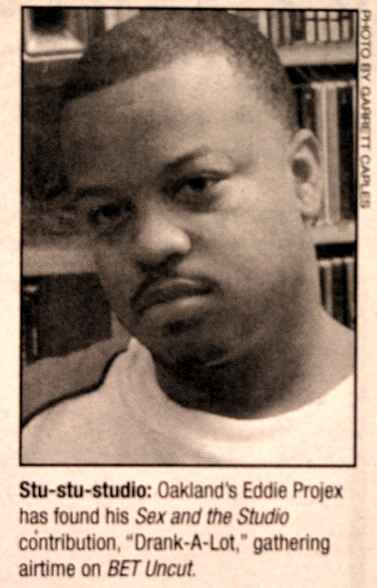
IF YOU SEE the video for "Drank-A-Lot" and aren't too distracted by the clubful of ass cheeks jiggling, you might notice the guy who spits the hook and first verse. He's Eddie Projex, from Oakland's Hittaz on tha Payroll, and the huge grin that never leaves his face throughout the clip is inspired by more than booty and booze. As the lead single from the soundtrack to episode two of the Sex and the Studio series, with verses by better-known buddies Numskull and Money B, "Drank-A-Lot" puts Eddie out front. The video has raised his profile, garnering nationwide "cable play" on BET Uncut, the station's adult-oriented music show (Wednesdays through Fridays, 3 to 4 a.m.). Now, after years of grinding away underground, Eddie's ready to shine.
"I like Hittaz on tha Payroll anyway, and Eddie's voice stands out," says Money B, recalling the "Drank-A-Lot" session. "I said, 'You pick the beat. Tell me which one you dig.' I went out the room, came back, and he'd already laid the hook. I was like, 'Yeeeaaahhhh.' "
Eddie's eagerness and efficiency reflect his persistence over the course of a decade in which Bay Area hip-hop got little mainstream love or major-label support. Along with MCs Polo, Curcinado, and Fletchberg Slim, Eddie formed Hittaz on tha Payroll in 1996.
"When 'I Got 5 on It' came out," Eddie says, referring to the Luniz' 1995 platinum hit, "we was in different groups. Everybody started fallin' off, and we were the only ones left standing. While the Luniz were making their mark, Num was busy doin' him. But we knew each other from back in the day, and when he came back, and sees we were still at it, he couldn't do nothing but accept it." Indeed, Num soon moved beyond acceptance. "He took me off the turf and flew me to L.A. Took care of me, gave me money, bought me clothes. He was like, 'Y'all gotta be my niggas.' "
Numskull premiered his new crew in 1999 on Good Laaawd, That's a Lot of Drank. In 2001, with no distribution deal, the Hittaz sold their debut disc, Underground Like Dead People, straight out the trunk, but it was with the release of Ghetto Storm (2003), on their own City Hall-distributed Hitta Records, that the Payroll began to attract attention. Produced entirely by the Mekanix, save for one banger by Sean T, Ghetto Storm was an instant East Oakland classic, due in no small part to Eddie's hook-writing ability on tracks like the atmospheric gangsta drama "Tha Game" and the sideshow anthem "Rims." Clearly Money B hadn't overlooked this elusive talent when he picked the Fifth-produced "Drank-A-Lot" as the single for Sex and the Studio's episode two.
Currently Eddie is shopping for a deal for his debut solo disc, Now or Never, even as he finishes two others: Ghetto Celebrity, for Hitta Records, and The Eddie Projex Project, for the Mekanix' Zoo Entertainment. In the meantime, taking advantage of the BET buzz, he's about to drop a street-only compilation, Eddie Projex Presents Oakland Street Music, Volume 1, which he hopes to turn into an annual showcase for emerging talent. Volume 1, which will also be sold at East Bay record stores like Rasputin's in Berkeley and Moses Music in East Oakland, features some of Oakland's hottest young artists – like Stevie Jo, E-Maculate, and R&B singer Naté – with production by the Mekanix, Sean T, and Harm and LT. Those unable to wait can check out the Hittaz' 2004 releases: Underground Like Dead People II, a recent Hitta Records mix tape, and Acid, a Polo and Curcinado duo project from FastLife Entertainment.
20061014
Behind the Nose -- Shock G steps out
by Garrett Caples
September 2005
Kev Kelley is excited. The Hunters Point emcee has been taken on as a protege by Shock-G, legendary leader of Digital Underground, who produces two tracks on the 23-year-old’s upcoming debut. It’s 3 a.m. Shock’s exhausted, having just wrapped a two-hour jam between DU and a funk band called Slapback, in celebration of his own “solo debut,” Fear Of A Mixed Planet. As we roll to the hotel for the interview, Kev insists on carrying Shock’s bag, despite its owner’s modest protests. “Fuck that!” Kev yells, zooming ahead with his treasure. “I’m doing what 2Pac did!” Shock accepts this with the habitual calm that contrasts so strikingly with his on-stage presence, whether as Shock-G or as his plastic-nosed alter ego, Humpty Hump. And Kev has a point. While never just a roadie — “We were producing and grooming and trying to get him a deal the whole time,” Shock says — 2Pac definitely lugged his share of equipment on the first DU tour in 1989. Shock’s ear for talent, moreover, is undeniable; through DU over the years he’s also boosted the careers of Saafir, the Luniz, and Mystic, among many others. As a producer Shock profoundly influenced rap’s development in the early ’90s. Two years before The Chronic had everyone jumping on the Mothership, Shock drew the blueprints for a hip-hop built on P-Funk principles. Tracks like “Rhymin’ on the Funk” (Sex Packets, 1990), “Same Song” (This Is An EP Release, 1991), and “The D-Flo Shuttle” (Sons Of The P, 1991) — all on Tommy Boy Records — laid the groundwork for much that followed. According to Digital Underground: Raw Uncut, a new DVD documenting the group’s entire history, “Freaks Of The Industry” remains, after 14 years, the #1 requested song on the Bay Area’s main hip-hop station KMEL despite never being a single. (#2? The Bay Area Ballers mix of the Luniz’s “I Got 5 On It,” also featuring Shock.) Such achievements and innovations have been obscured, however, by the huge pop success of “The Humpty Dance,” which led many to see the group as a bubblegum novelty. The beautifully eclectic, meticulously detailed, and deeply felt Fear Of A Mixed Planet is Shock’s ambitious attempt to finally step out of the shadow of Humpty Hump.
You ain't knowin' -- DU and 2Pac
| All roads lead back to the Digital Underground and 2Pac By Garrett Caples San Francisco Bay Guardian March 16, 2005 I CAN'T COUNT how many surprised responses I've elicited with the information that 2Pac started out in Digital Underground. To anyone first exposed to him through the movies or during his final phase on Death Row Records, the idea of Pac coming up under the plastic-nosed guidance of Humpty Hump is scandalous. Such skeptics are referred to the 2004 documentary DVD Digital Underground: Raw Uncut, which features footage of the future Makaveli rocking "The Humpty Dance" for all he's worth. 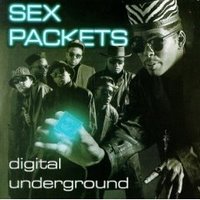 Atron Gregory, the group's first manager, introduced the young 2Pac to Humpty's alter-ego, D.U. leader and producer Shock-G, after the group completed Sex Packets (Tommy Boy, 1990) but before the album's release. As a result, Pac was on hand for the group's MTV-fueled explosion, making his recording debut on "Same Song," from their 1991 This Is an EP Release (Tommy Boy). Inevitably, once he blew up with the 1992 film Juice, 2Pac concentrated on his solo career, though he continued to appear on D.U. albums until 1996's Future Rhythm (Critique). Atron Gregory, the group's first manager, introduced the young 2Pac to Humpty's alter-ego, D.U. leader and producer Shock-G, after the group completed Sex Packets (Tommy Boy, 1990) but before the album's release. As a result, Pac was on hand for the group's MTV-fueled explosion, making his recording debut on "Same Song," from their 1991 This Is an EP Release (Tommy Boy). Inevitably, once he blew up with the 1992 film Juice, 2Pac concentrated on his solo career, though he continued to appear on D.U. albums until 1996's Future Rhythm (Critique).
"I couldn't have ever been 2Pac," Shock says now. "It's not my personality. By the same token, Pac probably couldn't have ever made it like I did as a producer-central figure in a collage of people. You gotta do you."
Though he moved out of the Bay Area – first to the Pocanos, then to Los Angeles – after the Oakland hills fire in late 1991, Shock has always turned to the Bay for new talent. Rap historians might note he was the first to tap Richmond, helping the duo Goldmoney score a deal with Tommy Boy and featuring them on Sons of the P (Tommy Boy, 1991). But Shock's most successful protégés after 2Pac are undoubtedly the Luniz, who appear on Future Rhythm and whose platinum debut, Operation Stackola (Noo Tribe, 1995), features production by Shock. That year Shock appeared on the remix of the Luniz' weed-smoking anthem "I Got 5 on It," alongside such local heavyweights as E-40 and Richie Rich. 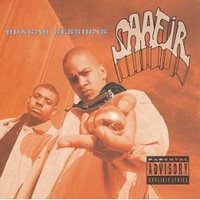 In the late '90s, Shock continued to influence the Bay through his associates. D.U. members DJ JZ and Saafir joined Hobo Junction for the critically acclaimed Box Car Sessions (Qwest, 1999) as well as three classic underground discs on their own Hobo Records. While D.U.'s 1998 album Who Got the Gravy? (Jake) failed to make a huge impression, it introduced Esinchill (see "Breaking Down the Battle Lines," page 43) as well as Mystic, whose debut, Cuts for Luck, Scars for Freedom (JCor), was nominated for a Grammy in 2002. Now, with the release of his first solo album, Fear of a Mixed Planet (33rd St), Shock has finally begun to receive his due as a pioneer. He's been producing tracks for Hunters Point MC Kev Kelly, even as he's transformed D.U.'s live show with the addition of an eight-piece funk band called Slapback. "I think people saw Humpty as a gimmick," Numskull of the Luniz says, "but Humpty is just a part of Shock. Shock is our driving force. For real. He's a genius." 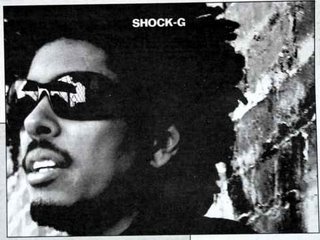 | ||||
| | ||||

Breaking Down the Battle Lines: Frontline's Locksmith and DU's Esinchill
By Garrett Caples
San Francisco Bay Guardian March 16, 2005
ESINCHILL FIRST DROPPED on Digital Underground's Who Got the Gravy? (see "You Ain't Knowin'," page 44), honing his skills with the group for the next five years on the road, and he has the support of fellow D.U. members like Numskull, also of the Luniz. "Esinchill is one of the best artists coming out of the Bay right now," he says. "He's book smart, and that comes out in his rhymes."
He's also a ferocious freestyler, so I was impressed to learn the Frontline's Locksmith beat him in a battle on KMEL, 106 FM, a few months ago. "We went one round, and they was like, 'It's a tie,' " Esinchill recalls. "Then we went a second round, and I fumbled. I couldn't bring it back."
But E remains philosophical. "I think what the Frontline do best is battle. That's where Locksmith shines. But there's a difference between being able to rap and being able to make songs. I think I make better songs."
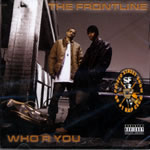 He raises an interesting point, insofar as the majority of the Frontline's verses are battle rhymes. The "realness" of the battle rhymer is almost inevitably gauged by "hardness," which we might provisionally define here as experience with, and stoicism in the face of, street life. As much as I dig their refusal to adopt the usual gangsta pose, the Frontline's emphasis on hardness limits their lyrics.
Take four bars of Locksmith on "I Gotcha," from the Richie Rich comp Grabs, Snatches, and Takes (Ten-Six, 2004):
You might see Lock on the block in some Tims and Nikes
Making motherfuckers duck when I extend my right
I'm an mc; I fight with pens and mics
You're a bitch; you fight for women's rights
Like many of rap's memorable moments, the third and fourth lines are at once clever and offensive. The repeated grammatical structure creates the expectation of a similar parallel in logic, which is then violated by the second half of the fourth line. (Remember your SATs: "MC" is to "bitch" as "pens and mics" are to "women's rights" is not the correct answer.) Though he might have shored it up with a better rhyme than "right" and "rights," the structure is complex and compelling, even if – for a UC Berkeley grad like Lock – the sentiment isn't very nice.
Here are four bars from the "Intro" to Esinchill's Everything to Lose! (Rceason, 2002):
Born sick and with seizures, massive head trauma
Bitch-ass doctors woulda killed me if it wasn't for mama
Took me off the medicine, didn't have no more falls
No more emergency phone calls and hospital halls
Though the difference in subject matter makes it absurd to compare these examples, each is representative of the rappers' respective concerns. With the notable exception of "Hennessy," Esinchill doesn't really stunt on brand names, and where Locksmith raps about being hard, Esinchill is introspective at the top of his lungs, eliding pronouns and breaking up syntax to pack a few years into four lines. On paper, "hospital halls" seems like a throwaway, yet on disc it leaps out, neatly condensing a kid's perspective on hospitals: boredom and waiting.
Here's the conclusion of both verses – Locksmith's, then Esinchill's:
Lock: Nigga, me no singer
I'm from the Rich where them boys like to keep those things
And they stay with their ring on bling
And they wear more gold than a Chinese ping pong team
I rap instead; I notice I'm at peace when I rhyme
I think with my dick so let me give you a piece of my mind –
Suck it; me in a nutshell, forever passionate
I'm through with this control; I gotta go, I got some ass to get
We've already heard Lock "stretch metaphors like a Chinese jump rope" on Who R You, so the use of "Chinese" for mere verbal flashiness begins to pall this time around. E's ending crushes it. To hear "passionate" rhymed with "ass to get" is exactly what I turn to rap for. The other rhyme is nearly as pleasing, and the second line's combination of two shopworn phrases leads so inevitably to "suck it," you can admire its formal invention even while declining its invitation.
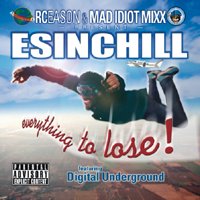 Esinchill's versatility in style and subject matter is what makes Everything to Lose! so accomplished a debut. And just as the Frontline's run of luck began with Locksmith's questionable 2003 battle loss on MTV, so Esinchill's buzz has picked up since losing to Locksmith. He's in talks with Hiero Imperium to release his next album, a duo record with partner King Beef called Choice Cuts, while the advance single – the Touré-produced "Hip Hop" – has been bubbling up in Funkmaster Flex's record pool. Maybe losing is everything.