A few weeks ago while writing a story about Fillmore rap, I called JT the Bigga Figga, only to be greeted by a long outgoing message informing callers he was in Nigeria on his Mandatory Hyphy tour with Snoop Dogg "for the next 48 to 72 hours." Though the message was largely a public self-congratulation delivered in the veteran rapper-producer's bigger-than-thou banter, even JT sounded surprised, as if the content of his boast for once exceeded his formidable powers of expression. And in truth, it was big: as recently as last year, such a feat would have seemed impossible. But JT's association with Snoop — forged by the pair's recent DVD, Mandatory Business (Get Low) — and the idea of so ambitious a tour under the rubric of hyphy indicate just how far Bay Area rap has come over the course of 2006. Perhaps encouraged by Lil Jon's example, big names have begun to stick their toes in the Bay, though whether Diddy found any rappers during his largely restaurant-based visit is unknown. MTV stirred the waters with video hits by the likes of E-40 ("Tell Me When to Go," "U and Dat"), Big Rich ("That's the Business"), and Bailey ("U-C-It"), while the Bay sent three Best West Coast DJ nominees to the Justo Mixtape Awards: Demolition Men, DJ Juice, and 40's DJ E-Rock. Upcoming major-label releases by Mistah FAB (Atlantic), the Team's Clyde Carson (Capitol), and the Pack (Jive) promise 2007 will continue to build on the momentum of the past couple years. The best thing about the past 12 months has been the sheer amount of world-class music released. The signal event of the first quarter was, of course, the March release of E-40's My Ghetto Report Card (BME/Reprise), which generated national curiosity about the hyphy movement and set the stage for much that ensued. April through June saw a flood of amazing discs that resumed in late August and hasn't abated since. These periods of activity were symbolically separated by the entrance of Mob Figaz's Husalah, who was given 53 months in federal prison for possession with intent to distribute more than five kilos of cocaine. The loss of this Mac Dre–level talent is a definite blow to local rap. But given six months of freedom after his sentencing to put his affairs in order, Hus recorded several albums' worth of material, two of which — Shower Posse, a duo album with the Jacka, and Explosive Mode III, a quartet with Jacka, San Quinn, and Messy Marv — have just appeared from FriscoStreetShow.com and rank with his finest work. This year's activity was set to culminate in the second annual Bay Area Rap Scene (BARS) Awards on Dec. 2 at the San Mateo Event Center. Every rapper I spoke to was excited about the event: those who had money bought suits, those who didn't rented, and even those who clung to white T's — or T's with massive airbrushed representations of themselves — approached the affair with respectful seriousness. "The idea was great," said Mistah FAB, who brought his mom to the event. "But the ordeal was a mess." Despite a stiff cover charge of $50 to $250, the attendance of national press and industry figures, and the promise of performances and presentations by many of the Bay's finest, the show was shut down after short sets by San Quinn and Messy Marv, two impromptu songs by E-40 and Keak Da Sneak, and roughly four awards. Fans were angry, the national press was unimpressed, and Bay Area rap was embarrassed at a delicate moment in its resurgence. Vibe, for example, posted its online coverage under the headline "BARS Awards Shut Down after Crowd Gets Too Hyphy," a misleading statement immediately contradicted by the story's first paragraph, which blames the event's premature end on "lack of security and poor planning on the part of promoters." The latter assessment is much more accurate. The allegedly "too hyphy" crowd consisted of the accumulated entourages of rappers who refused to leave the stage. Yet with the possible exception of Numskull and the Caliban (who briefly hijacked the show to perform one song), artists' behavior could hardly be called "hyphy" — it was more a sullen milling around brought on by boredom with the show's slack execution. "If there's a big pause in something that's supposed to be entertaining, of course there's going to be problems, because no one is paying attention," said the Jacka, whose much-deserved Underground Artist of the Year Award was announced to a near-empty hall. "It's like, 'Let's walk around. Fire up some weed. Let's get onstage. They're letting everyone else on.’” "Last year it was better," he concluded. "They had the kind of security people respected." It's difficult not to agree with this assessment. Google's cache of a Dec. 1 Craigslist ad page seeking security guards for the next-day event hardly inspires confidence, and the responsibility of securing the stage and choreographing a smooth sequence of events surely lies with the organizers, not the participants. Despite vigorous rebuttals posted by awards staff and promoters on Vibe.com and other sites, the overwhelming impression was that a lack of preparation to deal with what was admittedly stubborn but ultimately nonviolent behavior contributed to the blurry line between performers and spectators so typical of rap events. "If you're organizing a thousand personalities with a million egos, you've got to give yourself room to deal with things you didn't plan for," said FAB, whose scheduled appearance with Too Short was among the evening's casualties. This was particularly unfortunate as Short has done all he can for hyphy of late, including his single, "Keep Bouncin'," on which Snoop name-checks the movement. Now based in Atlanta, on a major label, and still highly successful, $hort doesn't need the hyphy movement but has taken it under his wing, seemingly out of love for the hip-hop scene of which he is universally acknowledged as the founder. "Short's a visionary," FAB said. "His sponsorship and persona allow us to get into certain spots. But it's up to us to be accountable for what we're doing." In any case, it would be a mistake to blame the artists for the collapse of the awards. There were no arrests and no incidents of parking-lot mayhem among cheated fans — just disappointment. The entire scene has worked hard to get to its present level of success and has conducted itself with infinitely less violence since Mac Dre's death. The rappers deserve a celebration, because whether or not the scene explodes in 2007 on the national level, the impressive collective output of Bay Area rap over the past two years already represents an extraordinary artistic achievement. The following is a strictly chronological list of personal favorites of 2006, culled from a huge stack of worthy contenders. TOP 10
Bay Area lays down the top 10 albums of 2006
Plus: What really happened at the BARS Awards?
Hyphy Holidays
by Garrett Caples
San Francisco Bay Guardian December 12, 2006 (1) Demolition Men, The Animal Planet Mixtape (starring Husalah and the Jacka of the Mob Figaz) (Mob Figaz)
 (2) E-40, My Ghetto Report Card (Reprise/WEA)
 (3) The Team, World Premiere (Rex)
 (4) Bullys Wit Fullys, The Infrastructure (SMC)
 (5) Husalah, Guns, Dope, and Religion (Sumo)
 (6) Beeda Weeda, Turfology (Hieroglyphics)
 (7) Traxamillion, The Slapp Addict (Slapp Addict)
 (8) Dem Hood Starz, Band-Aide and Scoot (SMC)
 (9) Big Rich, Block Tested Hood Approved (Koch)
 (10) J-Stalin, On Behalf of the Streets (Livewire)
20061220
Hyphy Holidays

20061108
Confessions of a Gofessional
Free mixtape by Team member Kaz Kyzah scores 7,000 downloads in first week Things move fast in rap. By the time their second album, World Premiere (Moedoe/Koch), dropped in April, the Team already had a new single, the "Hyphy Juice" remix, which now rivals "It's Getting Hot" as their biggest radio hit. Since then, Moedoe label head K.O.A.B. has inked a deal for Hyphy Juice, the energy drink he co-owns with the group, to be sold at 7-11 stores nationwide, while Team member Clyde Carson just signed as a solo act to Capitol Records. Carson’s ambitious project, Theater Music — consisting of one multisong, album-length track à la Prince's Lovesexy (Warner, 1988) — will appear next year, cobranded by Moedoe as well as the Game's Black Wall Street. Yet my appearance at the Team's condo concerns none of these matters. Instead, I've been summoned by Kaz Kyzah to discuss The Gofessional, his new mixtape with KMEL managing director DJ Big Von Johnson. Consisting of 19 tracks of mostly original material, The Gofessional is part of a growing trend in the Bay Area mix scene — like Husalah and Jacka's Animal Planet and Beeda Weeda's Homework — of blurring the distinction between the carefully crafted album and the "anything goes" approach of mixtapes. What makes The Gofessional unique, however, is its method of distribution: it's available for free at bigvon.com. In the first week alone, the mixtape was downloaded 7,000 times on the strength of two singles currently spinning on KMEL: "Cocaine," a soulful love-as-addiction metaphor over a 9th Wonder beat, and the LT-produced original "Love" (featuring Jimmie Reign), an R&B-infused investigation of more serious subjects often neglected by the Bay's current "go dumb" ethos. Before beginning, however, Kaz clears up the lingering mystery around World Premiere's release, not, as anticipated, through major label Universal but rather through independent powerhouse Koch. "We were on a label of a Mexican artist, Lil Rob, and it wasn't the place for us," Kaz says, referring to the Universal-distributed Upstairs imprint, which caters primarily to Latino rap. "When we got over there, it wasn't what we wanted. But it worked out where we could use it to get the album done and move on. We didn't have to pay any bread. We actually came out winning." "At the same time, I was going through legal trouble," he continues, describing continuing fallout from a robbery charge he caught at age 18. "I was worried about going to jail and house arrest. I did end up spending a couple of months in jail, so it was a real hectic time." While the delays of label jumping and legal woes may have muted World Premiere's impact, the period of house arrest last year proved productive for Kaz, who with West Oakland rapper J-Stalin and East Oakland producers Tha Mekanix formed a side group called the Go Boyz and recorded an album at the condo. These late-night sessions featuring an ankle-braceleted Kaz were the genesis of the current Go Movement, which already constitutes a third front in the Bay's hyphy and thizz campaigns. "What I want people to understand about the Go Movement," the Hyphy Juice shareholder stresses, "is it's not not about getting hyphy, going dumb. But it encompasses a whole lot more and that's what makes it so powerful. Like when I talk to Dotrix [of Tha Mekanix], we'll use go 1,500 times and have an in-depth conversation. "It was Dot who said, 'You the Gofessional, man.' And that was one of my favorite movies, The Professional, so I used it for my mixtape. I didn't want to come out with the Go Boyz, and nobody know what Go is all about. I was talking to some people from Marin, they never even heard of the Go Movement. To us it's old, but a lot of people are still catching on." The free download format of The Gofessional is proving to be an effective means of spreading the word. (Another 5,000 hard copies have already been distributed for the benefit of those not online, and more are on the way.) For Johnson, who apart from Kaz is the author of this largess, the free mixtape is designed to boost record sales as well as keep the Bay's current buzz alive. "I got 7,000 downloads in a week, when I know artists who put out records that took seven months to reach that in sales," Johnson says later that day at KMEL. "There are a lot of big artists, a lot of songs on the radio, but sales aren't adding up. So I feel like, give some away. Instead of trying to break a song, I'm trying to break an artist in the streets. I definitely think this will stimulate album sales." It's refreshing to hear such a statement these days, when the "free download" has been blamed for bringing the recording industry to its knees. To me, Johnson's logic is irrefutable; I'm more likely to check out something for free than for $15, and I'm way more likely to buy a $15 album from someone whose previous work I have and like. As The Gofessional is easily better than dozens of albums I've actually purchased, the odds of me buying an eventual Kaz Kyzah solo album are extremely high. Given the current excitement in Bay rap and Carson's deal with Capitol, the interest in Kaz's mixtape hasn't failed to attract the attention of majors as well.
Things move fast in rap. ...I've been summoned by Kaz Kyzah to discuss The Gofessional...
by Garrett Caples
San Francisco Bay Guardian August 16, 2006STALLED PREMIERE?
GOING FOR THE STREETS
20061104
The Team -- World Premiere (Moedoe/Rex/Koch)
Album Review by Garrett Caples
San Francisco Bay Guardian June 21, 2006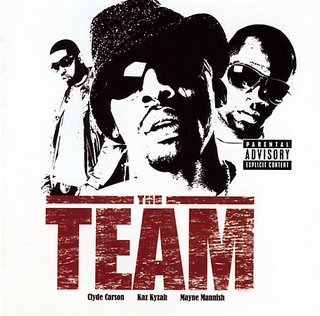 After months of delay, the Team's World Premiere has dropped, not on Universal as expected, but rather on large independent Koch. Whether this label jockeying had anything to do with the disc's belated appearance is unclear, yet the finished product is unquestionably one of the best, if most curiously assembled, albums to emerge under the banner of the hyphy movement.
While not a redo of the Bay Area group's 2004 debut, The Negro League (Moedoe), Premiere nonetheless lifts a pair of tracks, including the ShoNuff-produced hit "It's Getting Hot." The album also raids last year's Team mixtape, Go Music (Siccness.net), for the single "Patron," as well as the star-studded remix of "It's Getting Hot," which amusingly resuscitates MC Hammer. Two other singles from last year, "Just Go" and "Hyphy Juice," round out the familiar material, whereas their current single, the "Hyphy Juice" remix, is nowhere to be found.
All this sounds like a recipe for disaster, the same combination of ill timing and hit recycling that blunted the impact of Keak da Sneak's Kunta Kinte (Moedoe, 2006). Yet amazingly enough, Premiere overcomes its checkered origins and bangs from start to finish. The older material sounds fresh and is even heightened in the context of new tunes like "Top of the World" and "Good Girl," which add an almost psychedelic R&B dimension to the hyphy tonal palette. The innovative qualities of the music make any protest against its lyrical limitations — geared almost exclusively toward the club — beside the point, and the group's lack of gangsta posturing is refreshing in itself.
20061029
Ruling party -- Rising hip-hop star J-Stalin morphs from d-boy to Go Boy
by Garrett Caples
San Francisco Bay Guardian April 26, 2006
J-Stalin knows how to make an entrance.
The first time we meet, in November 2004 at the Mekanix's recording studio in East Oakland, he enters nonchalantly, sporting an embroidered eye mask as though it were everyday wear. He walks up to me and shakes my hand. "I'm J-Stalin. I write and record two songs a day," he says with boyish pride.
I had a hard time retaining the notion the rapper wasn't a boy, for though he'd recently turned 21, his five-foot frame and preternatural baby face gave the impression of a raspy-voiced, blunt-puffing, Henny-swilling 14-year-old.
Yet he already had a storied past. A teen crack dealer, or "d-boy," from West Oakland's Cypress Village, Stalin was busted at age 17, spending the next 11 months on parole with weekends in juvenile hall. During this period, to both stave off boredom and possibly escape the multigenerational cycle of dope-dealing in his family, the young Jovan Smith began writing raps, finding out about the other Stalin in 11th-grade history class, and soaking up game at the Grill in Emeryville, where family friend DJ Daryl had a recording studio.
After letting him watch for a year, Daryl put Stalin on a track — the result so impressed Daryl's frequent collaborator, Bay Area legend Richie Rich, he immediately commissioned a hook. Stalin would end up on three cuts on Rich's Nixon Pryor Roundtree (Ten-Six, 2002) and on two as a member of the Replacement Killers, a group that included Rich and Crestside Vallejo's PSD. Several more songs from this period had just surfaced on Rich's 2004 compilation, Snatches, Grabs, and Takes (Ten-Six), though Stalin had since defected to the Mekanix's production company, Zoo Entertainment. By the time we met, the highly productive crew had recorded most of Stalin's upcoming debut, On Behalf of Tha Streets.He's next
During the next 18 months, J-Stalin would generate no small amount of buzz, thanks in part to high-profile guest shots on projects like the Jacka's The Jack Artist (Artist, 2005) and the Delinquents' Have Money Have Heart (Dank or Die, 2005). Three advance tracks from On Behalf — "Party Jumpin’," featuring Jacka; a clean version of "Fuck You"; and an homage to the classic drum machine, "My 808" — have accumulated spins on KMEL, while the video for "My 808" has more than 20,000 plays on Youtube.com. Too $hort says he's "next," E-40's dubbed him "the future," and major labels like Capitol and Universal are checking him hard.
To crown these achievements, Stalin's copped a coveted spot hosting an upcoming project for the Bay Area's mix-tape kings, DJ Devro and Impereal, alias the Demolition Men (see sidebar).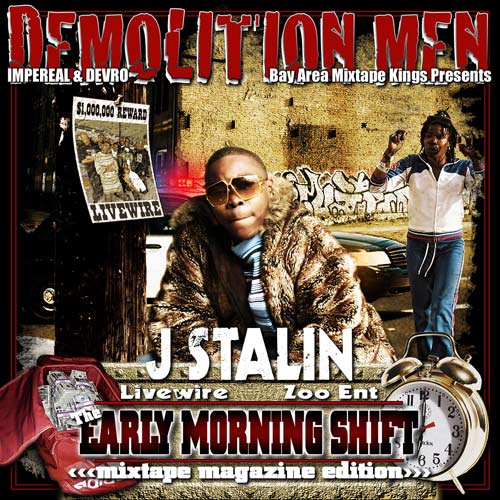 Named after Stalin's penchant for calling the DJs at 7 a.m., ready to lay verses, The Early Morning Shift is a potent fusion of mix tape beats and Mekanix originals, laced with Stalin's melodic raps and distinctively raw, R&B-style vocals. Taking advantage of the industry's current structure, whereby you can drop a mix tape or two without compromising your "debut" album marketability, The Early Morning Shift will be most listeners' first chance to hear the prolific J-Stalin at length, in the company of stars like Keak, F.A.B., and the Team, as well as Stalin's Cypress Village crew, Livewire. Having generated some 60 tracks in the scant two weeks devoted to recording the disc, Stalin has literally given the Demolition Men more than they can handle: Talk of a "part two" is already in the air, though the DJs are still rushing to finish the first for an early-May release.
 The Early Morning Shift comes at a pivotal time in J-Stalin's career. At the very least, the mix tape will warm up the Bay for On Behalf, which Zoo Entertainment plans to release independently in the next few months. With everywhere from Rolling Stone to USA Today catching on to the Bay's hyphy/thizz culture, and major labels lurking in the wings, it's probably only a matter of time before Stalin gets a deal. But the rapper is adamant on signing only as part of the Mekanix's Zoo.
"We don't want an artist deal," he says. "If they give us a label deal, it'll work, because I ain't fittin' to sign no artist deal."
If this sounds a tad dictatorial in the mouth of so young a playa, consider that Stalin left a famous rapper's camp to work with a then-unknown production duo, a decision fraught with risk. But Stalin's instincts regarding his own artistic strengths are sound. He thrives on quantity, and the Mekanix's intense productivity suits Stalin's seemingly endless supply of rhymes and hooks. The duo's ominous, minor-key soundscapes provide perfect vehicles for the rapper's exuberant tales of West Oakland street hustle and melancholy, often poignant reflections on d-boy life.
"I used to listen to their beats," Stalin recalls, "and be like, 'Damn, them niggas got heat!' Plus they ain't no haters. I mean, I'm a leader; I ain't no follower. They allow me to still be me and fuck with them at the same time."
A few months ago I had a chance to watch this process in action, dropping by the studio as Dot and Tweed were putting the finishing touches on a hot new beat, one in tune with current hyphy trends yet retaining the dark urgency characteristic of the Mekanix sound.
"Let me get on it," Stalin says, as he usually does when he hears something he likes.
Sometimes Dot says yes, sometimes no, depending on their plans for a particular session. With a beat this fresh and radio-ready, one they could easily sell, Dot is noncommittal: "What you got for it?"
Without a pause Stalin breaks into a melody, accompanied by an impromptu dance: "That's my name / Don't wear it out, wear it out, wear it out ..." Simple, catchy, the phrase totally works, and in less time than it takes to tell, he's in the booth laying down what promises to be the main single from On Behalf: "That's My Name."
Sitting behind the mixing board, Dot shoots me a smile, as if to say, "See why we work with this guy?"On the Go Movement
With The Early Morning Shift about to drop, and On Behalf on the way, the only thing Stalin needs is his own catchword, à la hyphy or thizz. Enter the Go movement. Among recent innovations in Bay Area hip-hop slang is a certain use of the word go to indicate a kind of dynamic state of being, widely attributed to Stalin.
"I ain't sayin' I made it up, but somebody from West Oakland did," Stalin says. "Even before there was hella songs talkin' about Go and shit, that shit came from ecstasy pills. We used to say, 'Goddamn, you motherfuckers go.' And then you refer to a female like, 'She go.' I swear it used to just be me and my niggas in the hood. I started fuckin' with the Mekanix and sayin' it at they place. Then, before I knew it, everybody was talking about Go."
Like thizz, Go quickly expanded beyond its drug-related origins, partly because it epitomizes so well the fast-paced environment of rappers' lifestyles. Among the early cosigners of the Go movement is the Team, whose album World Premiere (Moedoe) dropped at the beginning of April. Not only did the group release a between-album mix tape and DVD called Go Music (Siccness.net, 2005), but Team member Kaz Kyzah has hooked up with Stalin and the Mekanix for a side project called the Go Boyz. First previewed on Go Music, on a track also featuring Mistah F.A.B., the Go Boyz have already recorded their self-titled debut, and Zoo is in talks with Moedoe about an eventual corelease.
"Where I'm from, we don't say, 'Go stupid.' 'Go dumb.' We just go," Kaz Kyzah says, explaining the term's appeal.
"Really, it's a way of life for us," he continues. "Me, Stalin, Dot, and Tweed, we'd be up all night just goin'. Every song was recorded at like four in the morning. Listening to some of the stuff now, you can feel it in the music."Getting in early
Since I began this piece, Stalin, it seems, has gotten even bigger, as word of The Early Morning Shift and the Go Boyz has spread through the scene. People are suddenly lining up to work with him, and he's already committed to new projects with DJ Fresh, Beeda Weeda, the Gorilla Pits, and J-Nash, an R&B singer featured on Mistah F.A.B.'s upcoming Yellow Bus Driver. In a late-breaking development, E-40 confirms he intends to sign the Stalin/Beeda Weeda duo project to Sick Wid It Records.
During our interview, Stalin and I run by DJ Fresh's studio so J can lay a rhyme for an upcoming installment of Fresh's mix tape series, The Tonite Show. Another rapper, watching Stalin pull a verse out of thin air four bars at a time, is clearly awed: "He's amazing. I mean, he's on the records I buy."
Stalin takes it all in stride, though; aside from when I've watched him perform live, this is the first time I've ever seen someone react to him like he was a star. I get the feeling, however, it's far from the last.
J-Stalin
Fri/28, 10 p.m. doors
Club Rawhide
280 Seventh St., SF
$20
(415) 621-1197
myspace.com/jstalinofficialpage
Bring on the Demolition Men
by Garrett Caples
San Francisco Bay Guardian April 26, 2006
The Demolition Men, Impereal and DJ Devro, definitely didn't earn their reputation as the Bay Area's mix-tape kings by staying at home. As DJs the duo has performed together and separately at clubs all over the world, from China and Japan to South America and Europe. Native Spanish speakers — Impereal hails from the Colombian community in Queens, NY, while Devro is Southern California Creole — the pair also hosts Demolition Men Radio, broadcast Thursdays from 6 to 7 p.m. on Azul 1063, a hip-hop station in Colombia's Medellin. Yet if you live in the Bay, you're most liable to see them on the street, selling mix tapes out of their backpacks.
"We're like a walking promotional retail machine," Impereal jokes. "If you don't buy a mix tape, you going home with a flyer."
Such determination, coupled with the DJs' high output (more than 30 releases since late 2003, including three volumes each of R&B and reggaeton) and elaborate graphics, has finally kick-started the Bay's once lackadaisical mix tape scene.
An integral component of hip-hop in New York and the South, enabling new talents to be heard alongside vets and vets to issue bulletins with an immediacy unavailable to corporate labels, DJ-assembled mix tapes at their best are the ultimate in no-holds-barred hip-hop. Considered "promotional material" and usually printed in limited quantities, the discs are generally unencumbered by legal requirements like sample clearance.
Until recently, however, mix tapes weren't much of a factor here. While the Demolition Men are quick to pay homage to their local predecessors — like Mad Idiot, DJ Natural, and DJ Supreme — Natural acknowledges the mix tape scene was a bit dead before the Demolition Men began shaking it up.
"Out here DJs were concentrating on clubs," Natural says. "Then they started putting stuff out constantly." Now there's sufficient trade in mix tapes for Natural to move his formerly virtual business, Urban Era, to brick-and-mortar digs at 5088 Mission, making it the Bay's only all–mix tape music store. Yet even with increased competition, he notes, the Demolition Men still routinely sell out.
In addition to their up-tempo release schedule, the success of the Demolition Men's mixes might be attributed to the conceptual coherence they bring to their projects. While they do put together general mixes featuring more mainstream fare — such as the Out the Trunk series, which boasts exclusives from Ludacris — the duo's hottest projects tend to tap into the Bay's reservoir of talent. Aside from their multifaceted Best of the Bay series, the Demolition Men have released mix tapes hosted by Bay Area artists like Balance, Cellski, El Dorado Red, and the Team.
Currently the Demolition Men's most successful disc has been their most ambitious: Animal Planet, not so much a mix tape as music cinema, starring the Mob Figaz' Husalah and Jacka. A mighty 34 tracks — featuring production by Rob Lo, Traxamillion, and the Mekanix, and appearances by F.A.B., Keak, and Pretty Black — Animal Planet is an incredible collection of almost entirely exclusive, original material, seriously blurring the boundary between mix tape and album. Its success has encouraged bold undertakings, like The Early Morning Shift with J-Stalin and Block Tested, Hood Approved, a mix tape/DVD starring Fillmore rapper Big Rich. "I guess we're taking the mix tape to the next level," Devro says.
Demolition Men DJ
Thurs/27 and the last Thursday of every month, 9 p.m. doors
Vault
81 W. Santa Clara, San Jose
$10
(408) 298-1112
myspace.com/demolitionmenmusic
20061019
Rick Rock Changes the Game
by Garrett Caples
July 2005
After a prolonged eclipse following its mid-’90s commercial peak, Bay Area hip hop is once again starting to shine. Major labels long leery of the Bay’s reputation for violence off wax as well as on have begun to sign acts, from new groups like The Team (Universal) and The Frontline (Penalty/Ryko) to veterans like Sean T (Interscope) and E-A-Ski (Penalty/Ryko). Anticipation of E-40’s new album for Lil Jon’s Warner-distributed BME has only added fuel to the fire. But the man who perhaps sparked this major label flame is, appropriately enough, a Rock: Rick Rock, the innovative producer who laid the foundation for the Bay Area sound known as “hyphy.”
If the word “hyphy” means anything to you then you’re probably familiar with the Bay’s homegrown alternative to crunk: aggressively uptempo beats serving as vehicles for frenetic flows whose contrast to the more leisurely enunciations of the Dirty South’s chief export could hardly be more apparent. In the amount of time an Eastside Boy will spend stretching a single phoneme beyond recognition, a Bay rapper like Keak Da Sneak will deliver a brief dissertation on the fine art of ballin’. While the influence of crunk had been creeping into Bay Area club music for quite some time, it was the single “Hyphy” by the Fairfield, CA-based trio Federation, featuring a guest spot by 40 himself, that formalized the tendency. Produced by Rock and released on his own Southwest Federation label, “Hyphy” generated sufficient noise both in the club and on the radio to attract the attention of Virgin/EMI, who signed Rock’s label in time to release Federation’s 2004 debut, The Album. Emboldened by this example, or for fear of being left behind, other companies began to follow suit, leading to the present flurry of Bay Area deals.
Tucked away in a semi-rural corner of Sacramento, in a housing tract of relatively recent vintage, the home Rick Rock shares with his wife and baby daughter is a picture of domestic bliss, albeit one decorated with gold and platinum plaques. In person, Rock presents a marked contrast to the behavior suggested by Federation songs like “Go Dumb” and “Mayhem.” Laid back, soft spoken, able to disarm his toddler of a deafening musical Elmo toy without spoiling her sunny disposition, Rock displays throughout our interview an unfailing politeness more evocative of southern hospitality than elbow-throwing in the club.
“I was born in Montgomary, Alabama,” Rock says, “but raised in Suisun and Fairfield, California. Doonie Baby [of Federation] I met in Alabama. He was born in Mississippi. That’s how we came with the name Southwest Federation, because we’re a combination of both. I moved here when I was 15, then I moved back to Alabama until I was 25. Goldie Gold, he’s from Vallejo. And Stres is from Fairfield.”
“When I came here from Alabama,” he continues, “I was really doing East Coast music. SB-1200. I went into a store down there called the Fonkey Chicken, and my friend there said, ‘The type of music you’re doing, they’re not gonna feel it here;. you gotta switch up.’ And I was like, ‘I’m going to do me and have the game switch to me.’ And it’s weird because he brings that up, after what’s happened, and I listen to the radio, and now everyone’s trying to do me.”
Naturally such a change didn’t occur overnight, but rather resulted from patient toil and sacrifice; at this point, Rock has put a solid 10 years into the game.
“I began producing in 1995 with Conscious Daughters, a female group Paris had. Then I did one for 2pac. Most of these records were under the radar and I was just lucky to be on them at the time. I actually got on E-40’s Hall of Game (Jive, 1996). I did ‘Record Haters’ and ‘Circumstances.’ I didn’t charge money because at the time I didn’t have nowhere to live. I was sleeping on the floor, just trying to get my name out. That was two songs; his last three albums I did something like 9 songs on each.”
Though working with E-40 definitely put Rock in radar range, the Bay itself was just entering its lengthy turn-of-the-century drought, a time when many deserving artists languished without major label support or access to the airwaves. What saved Rock from a similar fate was a summons from Jay-Z to produce 4 songs for his Roc-A-Fella family album The Dynasty (2000), including the hit single “Change the Game.”
“When I did Jay-Z, things started heating up for me. Calls start coming in, ‘Who’s this guy? He’s got a different sound. West Coast-type of beat but not your typical West Coast beat, with East Coast rhyming on it.’ That’s when Fabolous came around.” Unlike Jay-Z, a proven star who could score a hit over polka, Fabolous was an unknown quantity, but the resulting single, “Can’t Deny It,” had no small role in making the rookie rapper a mispelled household word in 2001. “It just snowballed from there,” Rock says, continuing his winning streak over the next couple of years with hits like “Make it Clap” (Busta Rhymes), “Automatic” (E-40 and Fabolous), and “I Know What You Want” (Busta Rhymes and Mariah Carey), for which he won an ASCAP pop award.
While extensive collaborations with East Coast artists gave him a level of exposure he couldn’t have achieved in the Bay Area—including airplay on the region’s main hip hop station, Clear Channel-owned 106.1FM KMEL—Rock never abandoned his base in Sacramento. Indeed, his nationwide status as an A-list producer became a source of pride for the local hip hop community at a time when it desperately needed one.
“I love what I’m doing for the Bay Area,” Rock confirms, “for Northern Cali period, because there’s been a drought out here and I’ve been able to work with a lot of people and still represent Northern Cali. It gives people a hope, and me too. Working with different people from different places, like New York, or Atlanta, gives you another perspective and it translates into your music when you come home.” Nonetheless, he admits, being classed among elite hitmakers like Dre, Timbaland, and the Neptunes is “a different type of stress.”
“When you’re not on the radar, it’s cool; you’re getting a few dollars, you’re on the grind. The minute you got a couple of hits, you’re on the clock. Because then it’s like, when’s the next one? Right now, I got 2 or 3 singles in the pipe, and I can’t wait for them to come because my last record was ‘Breathe Stretch Shake’ [Mase featuring P.Diddy] and that’s like 6 months old now. If not longer. You get kinda nervous. And it’s something that new producers, they never feel that pressure.”
In the meantime, Rock hasn’t stood idle, throwing his energies into his own roster of artists. In addition to producing an album by Oakland group Kinsmoke, Rock has accumulated 18 tracks towards the next Federation album. “I’ve already started mixing the record,” he says with evident enthusiasm. What remains in question, however, is whether either album will be released through Virgin. In a textbook case of industry irony, the man who began the Bay’s new round of major label deals can’t wait to get out of his. For Rock was dissatisfied with Virgin’s handling of Federation’s The Album.
“It didn’t do well,” he sighs, like the ace pitcher whose team can’t score any runs for him. “It’s a classic Bay Area album. But what we did I can do independent and make way more.” Among his particular frustrations was Virgin’s decision not to make a video for “Hyphy,” cutting off one of the most likely routes for a regional hit to go national. “I really wanted to make these dudes stars, not just independent, around here stars. There was nothing out here and I wanted to make everything seem bigger than it is.”
“When I signed with Virgin, I was at Mister Chow’s in LA,” he continues, conjuring an image of the elite environment in which superproducers dwell. “Pharrell was there. He was complaining about how Virgin did N.E.R.D. and how they did Lenny Kravitz. And I’m sitting there listening, and it was just crazy that I ended up signing with Virgin.”
“I have to do a few more records for them unless they say we’re cool. They decide. We can’t drop them. I’m supposed to know what they want to do in a minute; hopefully they’ll be like, ‘We should sever ties,” because I’d really like to open another door.”
Fortunately, while Virgin makes up its mind, Rock is by no means in limbo; as a producer, he’s still a free agent. “I knew I couldn’t cross my production with Virgin because more than likely, we’d be off the label soon. I understood going into this that more times than not it doesn’t work.” Among his latest projects: splitting production chores with Lil Jon for the new E-40 album, proving that crunk and hyphy aren’t rivals but more like family.
“That’s gonna be a trip,” Rock says. “Lil Jon’s having the best 2-3 year run. I talk to 40, ‘What’s Lil Jon like in the studio?’ and 40 says, ‘Just like you. He comes from the ground up.’ Like some people, they don’t do nothing. Somebody else might do it and they put their name on it. So I always wonder, does he really turn knobs and hit keys and everything, and 40’s like, ‘Yeah, man. He’s doing it for real.’”