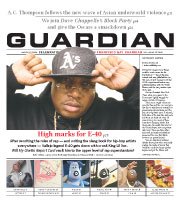
Showing posts with label Droop-E. Show all posts

20061202

The 'Moe Show -- San Quinn, Messy Marv, Big Rich, Will Hen leading out from the Fillmore

by Garrett Caples
San Franciso Bay Guardian November 22, 2006


If you don't know about the Filthy ’Moe

It's time I let real game unfold....

Messy Marv, "True to the Game"

I meet Big Rich on the corner of Laguna and Grove streets, near the heart of the Fillmore District according to its traditional boundaries of Van Ness and Fillmore, although the hood actually extends as far west as Divisadero. "Me personally," the 24-year-old rapper and lifelong ’Moe resident confesses, "I don't be sticking my head out too much. But I make sure I bring every photo session or interview right here."

At the moment he's taping a segment for an upcoming DVD by the Demolition Men, who released his mixtape Block Tested Hood Approved in April. Since then, the former member of the San Quinn–affiliated group Fully Loaded has created a major buzz thanks in part to the snazzy video for "That's the Business," his E-A-Ski- and CMT-produced single. It was the Jam of the Week in August on MTV2 and added to straight-up MTV in time for the Oct. 3 release of the Koch full-length Block Tested Hood Approved. (Originally titled Fillmore Rich, the album was renamed to capitalize on the mixtape-generated hype.)

Presented by E-40 and featuring Rich's dope in-house producer Mal Amazin in addition to heavyweights such as Sean-T, Rick Rock, and Droop-E, BTHA is a deep contribution to the rising tide of Bay Area hip-hop. While Big Rich's gruff baritone delivery and gritty street tales make his music more mobster than hyphy, the album is not unaffected by the latter style's up-tempo bounce, helping the movement hold national attention during this season of anticipation before Mistah FAB's major-label debut on Atlantic. "I don't necessarily make hyphy music," Rich says. "But I definitely condone it. As long as the spotlight is on the Bay, I'm cool with it." Coming near the end of a year that has seen landmark albums from San Quinn, Messy Marv, Will Hen, and fellow Fully Loaded member Bailey — not to mention JT the Bigga Figga's high-profile tour with Snoop Dogg, which has taken hyphy all the way to Africa — Rich's solo debut is one more indication of the historic district's importance to the vitality of local hip-hop and Bay Area culture in general.

THE EDGE OF PACIFIC HEIGHTS

The Fillmore is a community under siege, facing external and internal pressures. On the one hand, gentrification — in the form of high-end shops and restaurants serving tourists, Pacific Heights residents, and an increasingly affluent demographic creeping into the area — continues to erode the neighborhood's edges. "If you grew up in the Fillmore, you can see Pacific Heights has crept down the hill, closer to the ghetto," says Hen, who as a member of multiregional group the Product (assembled by Houston legend Scarface) moved more than 60,000 copies of its recent "thug conscious" debut, One Hunid (Koch). "Ten years ago there were more boundaries. But the Fillmore's prime location, and I'm not asleep to this fact. We're five minutes away from everything in the city. That has to play a role in the way the district is represented in a city that makes so much off tourism. You might not want your city portrayed as gangsta, even though it is."

Hen has a point. The notion of San Francisco as gangsta is somewhat at odds with the way the city perceives itself. As an Oakland writer, I can attest to this, for even in San Francisco's progressive artistic and intellectual circles, Oakland is usually understood to be beyond the pale in terms of danger and violence. Yet none of the Oakland rappers I've met talk about their hoods in quite the same way Fillmore rappers do, at least when it comes to their personal safety. As Big Rich films his section of the DVD, for example, he remarks on the continual stream of police cruisers circling the block.

"They slowed it down," he says. "Now they only come every 90 seconds. Right around here is murder central — people be shooting each other every night. By 7 o'clock, we all gotta disperse, unless you want to get caught in the cross fire." He waves his hands in mock terror. "I ain't trying to die tonight!"

“BUSTING HEADS”

Though Rich is clowning, his statement is perfectly serious — indiscriminate gunfire among gang members, often in their early teens, makes nocturnal loitering a risky proposition at best. As of September, according to the San Francisco Police Department's Web site, the Northern Police District, which includes the Fillmore, had the city's second highest number of murders this year, 11, ceding first place only to the much larger Bayview's 22. For overall criminal incidents, the Northern District led the city, at more than 10,000 so far.

Though Fillmore rappers might be given to stressing the danger of their hood, insofar as such themes constitute much of hip-hop's subject matter and they feel the need to refute the city's nongangsta image, no one I spoke to seemed to be boasting. They sounded sad. Hen, for example, reported that he'd been to three funerals in October, saying, "You hardly have time to mourn for one person before you have to mourn for the next person." While the SFPD's Public Affairs Office didn't return phone calls seeking corroboration, both Rich and Hen indicate the neighborhood is suffering from an alarming amount of black-on-black violence.

"Basically, it's genocide. We're going to destroy each other," Hen says. "It used to be crosstown rivalries rather than in your backyard. Now there's more of that going on. If you get into it at age 15, the funk is already there. Whoever your crew is funking with, you're in on it." The ongoing cycle of drug-related violence — the Fillmore's chief internal pressure — has only ramped up under the Bush administration's regressive economic policies. It's a fact not lost on these rappers: as Rich puts it succinctly on BTHA, "Bush don't give a fuck about a nigga from the hood."

"Everybody's broke. That's why everybody's busting each other's heads," explains Rich, who lost his older brother to gun violence several years ago. "If you don't know where your next dollar's coming from ..."

To be sure, the rappers give back to the Fillmore. They support large crews of often otherwise unemployable youth, and Messy Marv, for example, has been known to hand out turkeys for Thanksgiving and bikes for Christmas. But Bay Area rap is only just getting back on its feet, and while the rappers can ameliorate life in the Fillmore's housing projects, they don't have the means to dispel the climate of desperation in a hood surrounded by one of the most expensive cities on earth. Moreover, they are acutely aware of the disconnect between their community and the rest of the city, which trades on its cultural cachet.

"It's like two different worlds," Hen muses. "You have people sitting outside drinking coffee right in the middle of the killing fields. They're totally safe, but if I walk over there, I might get shot at. But the neighborhood is too proud for us to be dying at the hands of each other."

HOOD PRIDE

The neighborhood pride Will Hen invokes is palpable among Fillmore rappers. "I get a warm feeling when I'm here," Messy Marv says. "The killing, you can't just say that's Fillmore. That's everywhere. When you talk about Fillmore, you got to go back to the roots. Fillmore was a warm, jazzy African American place where you could come and dance, drink, have fun, and be you."

Mess is right on all counts. Lest anyone think I misrepresent Oaktown: the citywide number of murders in Oakland has already topped 120 this year. But my concern here is with the perceived lack of continuity Mess suggests between the culture of the Fillmore then and now. By the early 1940s, the Fillmore had developed into a multicultural neighborhood including the then-largest Japanese population in the United States. In 1942, when FDR sent West Coast citizens of Japanese origin to internment camps, their vacated homes were largely filled by African Americans from the South, attracted by work in the shipyards. While the district had its first black nightclub by 1933, the wartime boom transformed the Fillmore into a major music center.

"In less than a decade, San Francisco's African American population went from under 5,000 to almost 50,000," according to Elizabeth Pepin, coauthor of the recent history of Fillmore jazz Harlem of the West (Chronicle). "The sheer increase in number of African Americans in the neighborhood made the music scene explode."

Though known as a black neighborhood, Pepin says, the Fillmore "was still pretty diverse" and even now retains vestiges of its multicultural history. Japantown persists, though much diminished, and Big Rich himself is half Chinese, making him the second Chinese American rapper of note. "My mother's parents couldn't speak a lick of English," he says. "But she was real urban, real street. I wasn't brought up in a traditional Chinese family, but I embrace it and I get along with my other side." Nonetheless, Pepin notes, the massive urban renewal project that destroyed the Fillmore's iconic jazz scene by the late ’60s effectively curtailed its diversity, as did the introduction of barrackslike public housing projects.

The postwar jazz scene, of course, is the main source of nostalgia tapped by the Fillmore Merchants Association (FMA). Talk of a musical revival refers solely to the establishment of upscale clubs — Yoshi's, for example, is scheduled to open next year at Fillmore and Eddy — offering music that arguably is no longer organically connected to the neighborhood. In a brief phone interview, Gus Harput, president of the FMA's Jazz Preservation District, insisted the organization would "love" to open a hip-hop venue, although he sidestepped further inquiries. (Known for its hip-hop shows, Justice League at 628 Divisadero closed around 2003 following a 2001 shooting death at a San Quinn performance and was later replaced by the Independent, which occasionally books rap.) The hood's hip-hop activity might be too recent and fall outside the bounds of jazz, yet nowhere in the organization's online Fillmore history (fillmorestreetsf.com) is there an acknowledgement of the MTV-level rap scene down the street.

Yet the raucous 1949 Fillmore that Jack Kerouac depicts in his 1957 book, On the Road — replete with protohyphy blues shouters like Lampshade bellowing such advice as “Don’t die to go to heaven, start in on Doctor Pepper and end up on whisky!” — sounds less like the area's simulated jazz revival and more like the community’s present-day hip-hop descendants.

How could it be otherwise? The aesthetics have changed, but the Fillmore’s musical genius has clearly resided in rap since Rappin’ 4Tay debuted on Too $hort’s Life Is ... Too $hort (Jive, 1989), producer-MC JT the Bigga Figga brought out the Get Low Playaz, and a teenage San Quinn dropped his classic debut, Don’t Cross Me (Get Low, 1993). While there may not be one definitive Fillmore hip-hop style, given that successful rappers tend to work with successful producers across the Bay regardless of hood, Messy Marv asserts the ’Moe was crucial to the development of the hyphy movement: “JT the Bigga Figga was the first dude who came with the high-energy sound. He was ahead of his time. I’m not taking nothing away from Oakland, Vallejo, or Richmond. I’m just letting you know what I know.”

In many ways the don of the ’Moe, San Quinn — reaffirming his status earlier this year with The Rock (SMC), featuring his own Ski- and CMT-produced smash, “Hell Ya” — could be said to typify a specifically Fillmore rap style, in which the flow is disguised as a strident holler reminiscent of blues shouting. While both Messy Marv and Big Rich share affinities with this delivery, Will Hen, for instance, and Quinn’s brother Bailey — whose Champ Bailey (City Boyz, 2006) yielded the MTV and radio success “U C It” — favor a smoother, more rapid-fire patter.

What is most striking here is that, with the exception of fellow traveler Messy Marv (see sidebar), all of these artists, as well as recent signee to the Game’s Black Wall Street label, Ya Boy, came up in the ’90s on San Quinn’s influential Done Deal Entertainment. Until roughly two years ago, they were all one crew. While working on his upcoming eighth solo album, From a Boy to a Man, for his revamped imprint, Done Deal, Quinn paused for a moment to take justifiable pride in his protégés, who now constitute the Fillmore’s hottest acts.

“I create monsters, know what I’m saying?” Quinn says. “Done Deal feeds off each other; that’s why I’m so proud of Bailey and Rich. We all come out the same house. There’s a real level of excellence, and the world has yet to see it. Right now it seems like we’re separate, but we’re not. We’re just pulling from different angles for the same common goal.”

“We all one,” Quinn concludes, in a statement that could serve as a motto for neighborhood unity. “Fillmoe business is Fillmoe business.”

myspace.com/bigrich

myspace.com/williehen

myspace.com/sanquinn


Making Messy Marv

One of the most extraordinary products of recent Fillmore history is Messy Marv, a rapper whose life reflects the neighborhood's struggle with a half century of urban renewal and the ’80s-era introduction of crack into America's ghettos. In 1996, when he was still in 10th grade, he released his first album, Messy Situations (Ammo). Though it sold around 15,000 units, Mess admits he didn't take music seriously at first.

"I dropped out of high school due to family issues," he says. "I had to grow up real fast and do the man thing, but I started doin' the street thing."

Nonetheless, Mess's rap reputation grew, and in 1997 he hooked up with San Quinn to record Explosive Mode (Presidential, 1998), which has sold more than 50,000 copies. "There was a lot of hype around the hood about how he was better than me or I was better than him," Mess says. "We decided to come together, and we made a classic."

"At that time, I was really on the street, living outta cars, doing real bad things," he recalls. "So Quinn and his mom took me in."

Despite his success when few in the Bay were moving many units, Mess was unable to leave the dope game, partly due to his own addiction. "I inherited a cocaine habit," the rapper says. "I been clean for a while, but I had a really bad habit. All I can say is 'Say no to drugs.’” Though he won't go into details, Mess confirms his triple life as rapper, dealer, and user came to a head one night at an out-of-state show in 2001, when he was forced to jump out a fourth-floor window. "I broke both of my legs, crushed my left foot, lost a lot of blood," Mess says. "I was in a wheelchair for six months. The doctors said I'd never walk again."

"It gave me a whole new respect for handicapped people. I was doing shows in my wheelchair, and I rocked the whole crowd. It was a hell of a feeling that they still accepted me," he says. "That gave me the strength to get up and walk. I learned how to walk all over again, by myself, in four months. After that I decided it was time to go somewhere else with my life."

As if to atone for time lost, Messy Marv has since pursued his talent with a vengeance, recording a slew of projects for his own label, Scalen LLC, and labels such as Frisco Street Show, which released a reunion with Quinn, Explosive Mode 2: "Back in Business" (2006), and just dropped Explosive Mode 3 with Husalah and Jacka. In 2004, Mess inked a distribution deal for Scalen through Universal/Fontana, helping him move more than 20,000 copies each of Disobayish (2004) and Bandannas, Tattoos and Tongue Rings (2005). While he spent much of 2005 in county jail on a weapons violation, he still managed to score one of the big radio hits of the hyphy movement, "Get on My Hype," produced by Droop-E. Most recently, he's been on MTV and other airwaves with the E-A-Ski- and CMT-produced "So Hood," from The Infrastructure (SMC), his album with Hunters Point rapper Guce, released under the name Bullys Wit Fullys. A self-conscious bid to end hood rivalry between the ’Moe and HP, the Infrastructure project shows Mess's awareness of the power of his position as a role model even as he continues to spit with the most defiant swagger of any rapper in the Bay.

While Mess admits he has major deals on the table and plans to release the first of a two-volume opus titled What You Know about Me? in December, he also intends to retire thereafter in a nonbinding Jay-Z sort of way in order to concentrate on the younger acts on his label. This intention seems characteristic of the true spirit of the Fillmore as well as an acknowledgment that despite his youth, Messy Marv has already written a chapter in the district's history.

myspace.com/messymarvonline


Read More...

20061108

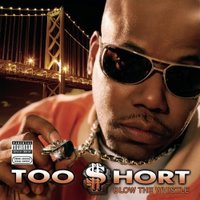
Too Short -- Blow the Whistle (Short/Jive)

Album Review by Garrett Caples
San Francisco Bay Guardian October 11, 2006

Although largely recorded in Atlanta with production by Jazze Pha and coexecutive producer Lil Jon, Blow the Whistle is Too Short's most Bay-sounding album in years and certainly his best disc since 2000's You Nasty (Jive). Having rapped professionally since 1983, Short might not bring his utmost to every recording, but Whistle sounds as hungry as the most hyphy debut imaginable. His subject matter has not changed significantly — shouts of “beeyatch!” still abound — but he brings a fresh intensity to his raps, as though reenergized by the youthful Bay Area movement.

Songs like the title track and the Droop-E-produced "I Want Your Girl" (featuring E-40 and Mistah FAB) find Short Dogg perfectly at home with the latest Bay sound, while on "Keep Bouncing" he even gets Snoop Dogg "ghostridin’ the whip." While it may be true that Short's wordplay tends toward the misogynistic, it's equally the case that he receives no credit for his gestures in the opposite direction. Witness his support rap on Kelis's girl-power anthem "Bossy" and the following lines from Whistle's "Sophisticated":
Y'all thought Too Short was all about pimpin'
Foul-mouthed mack just talkin’ bad about women
You heard bitch and cut it off
You ain't even listenin’
All I said was, if the shoe fits wear it
And if it don't apply, act like you didn't hear it.
No one has the right to take away from Short the word that made him famous. And nobody is obliged to take it seriously either.

Read More...

20061029

Super size me -- E-40's Ghetto Report Card

By Garrett Caples
San Francisco Bay Guardian March 1, 2006


The suburban sprawl of Pleasant Hill is so generic it looks like it was squeezed from a tube — an unlikely setting for anything more exciting than an ATM transaction. Yet here at the Bay Area's first Fatburger franchise, at four p.m. on a Thursday, there's a throb of expectation beneath the din of its middle-school patrons and its digital jukebox that anticipates the arrival of the restaurant's owner. Reporters and photographers have begun to pile up due to a delay in his schedule, as the owner in question, Vallejo rap legend E-40, is in the midst of a full-blown press junket in preparation for the March 14 release of My Ghetto Report Card, the first album under his new deal with Lil Jon's BME imprint, on Warner Bros.

Following a prolific decade on Jive Records, with whom he released nine solo discs in addition to three with his family-based crew, the Click, and one retrospective, Best of E-40: Yesterday, Today and Tomorrow (2004), 40's move to the ultrahot king of crunk's label is both a testament to his enduring preeminence in a notoriously fickle industry and an opportunity to reach that upper echelon of rap superstardom inhabited by the likes of Jay-Z and Snoop, Puffy and Eminem.

Not that he isn't already a star, as is immediately apparent from his entrance with a small entourage, which includes his 18-year-old rapper-producer son, Droop-E, his longtime manager, Chaz Hayes, a bodyguard, and a documentary film crew. Visibly exhausted after a two-week promotional blitz of New York City and Los Angeles, not to mention a morning of radio interviews, 40 still radiates charisma, transforming his immediate surroundings through his larger-than-life presence. Unfailingly polite, patient with the steady stream of fans, and acquainted with his restaurant employees down to the busboys, the man born Earl Stevens provides a marked contrast to the crack-slinging, gun-toting, "let-you-have-it-in-the-bladder"-style exploits of his rap alter-ego.

He apologizes for the scheduling conflict. "Just let me knock out this other interview real quick," he says — and he does, with the brisk efficiency of Babe Ruth pointing out where he's about to hit a home run, combined with the Babe's air of infinite leisure in performing such feats.

"I ain't had time to eat a fortune cookie," he says, settling down to a bunless Fatburger with the works and, in an off-menu innovation, a small Gatorade bottle half-filled with burgundy. He touts its antioxidant properties. Newly health conscious after a dentist visit revealed he had dangerously high blood pressure, the inventor of exotic ghetto cocktails with names like "Num Num Juice" sticks to red wine and rarely touches weed these days. After shedding some 50 pounds, and gaining some back, the tall, burly MC looks positively svelte at his current 333. He even works out, though hectic road life can make it impossible.

"Out in New York I did Direct Effect, MTV radio, Music Choice, a bunch of local video shows. LA was all interviews like this. When I'm not doing regular interviews, I'm doing phoners from 10 a.m. to 7 at night. But I'm not pitching a bitch, because it's part of the game."

GAME RELATED

E-40 speaks of the "game" with authority, for he rewrote many of its rules. Judged "too eccentric" by early-'90s record executives for his high-pitched, high-speed delivery and his compulsive coinage of slang — the very qualities defining his appeal — 40 began his own label, Sick Wid It, selling albums from the trunk of his car; after the label's third release, an EP titled The Mailman (1993), debuted at number 13 on Billboard's R&B chart, deals came to him. Signed through Sick Wid It by Jive in 1994, 40 pioneered the rapper-as-independent-label-head methodology that's since become industry standard.

Clearly the arrangement netted him a lot more money than many a rapper who's moved more units under direct contract with a major label. 40's got the gouda — his current currency euphemism — to invest in things like the Fatburger franchise or the Ambassador Lounge in San Jose, yet he readily acknowledges that the relationship between independent and major labels lends itself to the familiar corporate vice of outsourcing work as a means of cutting costs.

"A lot of A and Rs don't go to the hood like they used to and look for talent," he says. "They know all the rappers is connected, so they don't mind giving a big-name rapper a label deal. It's the smart thing to do. They're watching their money more than ever. They're not shipping as much as they used to. You're not going gold out the box any more."

E-40 himself has felt the pinch. Including the Click's Game Related (1995), 40 scored four gold albums between 1995 and 1998, one of which, In a Major Way (1995), was eventually certified platinum in 2002 by the Recording Industry Association of America. While his numbers, like everyone's, took a hit with the proliferation of Internet file-sharing and the general economic downturn under Bush, his albums continued to debut in Billboard's top-20 R&B chart, and aside from his own childhood idol, Too $hort, who has long since relocated to Atlanta, E-40 was the only Bay Area rapper signed to a major for the duration of the region's turn-of-the-century commercial drought.

"For anybody from the early '90s to still be here, they're keeping in touch with the kids on the street," Oakland rapper-producer E-A-Ski says. "40 don't get caught up in what he's done. He reaches out to what's going on now."

JIVE DEAL


Yet 40 also feels Jive underpromoted his more recent work. "Jive was a good label when they wanted to be," he says. "The first three or four years of the deal, it was excellent. Later, when the pop music started kicking in — no disrespect to Britney, *NSYNC; they made Jive a lot of money — that took the focus away from rap, from people who helped build the label.

"Don't get it twisted: I made a lot of money with Jive," he concludes diplomatically. "But the last few years, I think they dropped the ball on a few hits, a few videos they shoulda did."

Case in point: One of Lil Jon's earliest hits outside the Dirty South was "Rep Yo City," from 40's 2002 album, Grit and Grind. "BET wanted a video, and Jive lagged on it. They said, 'You need to get up to 800,000 spins,' and we was there. It would've been smart because you got E-40, Bun B, Petey Pablo. All three of us were on Jive, so why not do a video? That's what made me think, they ain't even interested.

"Lil Jon used to be signed to Too $hort's label [the Jive-distributed $hort Records]," 40 recalls. "$hort and Jon had a group together, a whole album ready to go, and Jive didn't want to do it. Me and $hort had an album, The History Channel, ready to go. They didn't want to do it. We had someone ready to put money in our pockets. Jive coulda got points, put their logo on it. They just didn't see the big picture. So I turned in my greatest hits and left."

Granted, crunk was so startlingly new — immediately becoming its own subgenre — that Jive's failure to predict Lil Jon's immanent explosion in popularity is perhaps understandable. But the label's inability to capitalize on a collaboration between two popular artists on its own roster, or even to let someone else do it and simply make money without spending any, is incomprehensible. (At press time a publicist for Jive was still tracking down who made that particular call.) Judging from their already classic collaborations like 1996's "Rapper's Ball" and 1999's "Pervin'" (a 40ism for intoxication that's passed into wider usage), a whole album of E-40 and Too $hort would have been a signal artistic event and wouldn't have failed to turn a profit, even if sales were restricted to their own overlapping fan bases.

HISTORY IN THE MAKING: DROOP-E


Jive's decision not to put out the still unreleased The History Channel, if not an act of outright incompetence, at the very least doesn't reflect the best interests of either artist, and one can hardly blame 40 for leaving. Yet, in an undeniably cruel twist of fate, 40's voluntary abdication from his deal came at a time when Bay Area hip-hop began to recover its shine. The transition between labels meant that 2005, the hottest year in the Bay since the mid-'90s, was also the first year since '97 that 40 didn't release an album.

Still, he made his presence felt through guest appearances, most notably on Mistah F.A.B.'s hit "Super Sic Wid It," produced by Droop-E. E-40's oldest son, the young Earl Stevens Jr., made his recording debut, at age three, on his father's 1991 debut, Federal (Sick Wid It, reissued by Jive, 1995), before dropping his first rhyme, at age seven, on In a Major Way. "I didn't force him into none of this," 40 insists, though he does cop to making Earl Jr. take five years of piano lessons. "Just in case he did want to go into it, so he'd know where all the notes are."

Such precautions, coupled with Droop-E's own inclinations, have paid off, as these days he's better known for his production work behind F.A.B., Turf Talk, and Messy Marv. The all-Droop-E-produced Bay Bridges Compilation (Sick Wid It/Navarro, 2005) — one of the best hip-hop albums of last year, period — also yielded a hit by Oakland's BavGate, "On the Radio," which literally exhorted KMEL-FM to "play the Gate on the radio." Such gimmickry aside, Droop-E's success is no joke: Having grown up in rap, yet still a teen, he brings an astonishing freshness to the music that's difficult to summarize but whose unifying characteristic might be a greater emphasis on sounding fun than on sounding hard, beeping or whistling where others simply slam. Yet his beats have no shortage of knock, and the hardest street-rappers — Marv, Keak Da Sneak, Little Bruce — sound perfect over them. Being 40's son may have gotten Droop-E a hearing, but his own abilities have placed him in the front rank of Bay Area producers.

STILL BREADED


While 40 is clearly proud of his son's success and was otherwise occupied with his club and restaurant, an albumless year must nonetheless have been agonizing for a rapper who, on the 1999 track "Get Breaded," claimed to be "like a pregnant lady, [coming] wit a album every eight or nine months." It's not that 40 lacked offers to leave Jive but rather that he wanted to make the right move. "I kept recording, marinated around for about a year. I prayed on it," he explains. "Baby from Cash Money was ready to sign me. Puffy was on deck, wanting me to sign. But when I went with Lil Jon, they was like, whatever your situation is, it's all love.

"Lil Jon and I powwowed. We knew our chemistry was there. I was, like, 'This might be a good look.' He hollered at his folk, hollered at Warner. They were like, 'Let's go.' We put the paperwork in motion, and there we is right now."

BME was an inspired choice for 40 not simply because it entailed joining forces with Lil Jon, America's favorite rapper since Snoop, nor because the label obviously intends to give the Vallejo vet the major push Jive never quite managed to deliver. But of all of 40's options — significantly, from labels run by rappers rather than by executives — Lil Jon and BME are the most organically connected to his music. E-40 was probably the first Bay Area artist to try his hand at crunk. Having long enjoyed a Southern following, he was only too ready to tackle its homegrown variety of hip-hop.

But on a deeper level, crunk and the current Bay Area sound known as hyphy are intimately related: "cousins," as 40 puts it. The production style of crunk could be said to have evolved from the classic Bay Area mob sound — from producers like Studio Ton, Bosko, Mike Mosley, and Tone Capone — that powered E-40's earlier releases and was immensely popular in the pre–Dirty South. "Everyone in the South was influenced by E-40," Murder Dog editor Black Dog Bone affirms. Hyphy, exemplified by longtime 40 associate Rick Rock, not to mention Droop-E himself, evolved as a Bay Area response to the crunk dominating the airwaves earlier this decade, when KMEL wasn't playing local music. The most obvious stylistic distinction is, of course, vocal, as Bay Area producers stripped away the screaming chants of crunk and replaced them with raps more in tune with local mob music traditions.

E-40's ability to navigate between crunk and hyphy is well documented on My Ghetto Report Card. First conceived as a dozen tracks, half by crunk king Lil Jon, half by hyphy maestro Rick Rock, the project gradually expanded to include tracks by original mob-music makers Bosko and Studio Ton, as well as Droop-E, who has more than proved his ability to hold his own in such company. With the first single, the Lil Jon–produced "Tell Me When to Go," featuring Keak Da Sneak, already creating a buzz, My Ghetto Report Card seems poised to bring 40 to the wider audience his talents deserve. At the very least, as 40 is aware, the new album is sure to extend the present hot streak in Bay rap through 2006.

"I'm the quarterback," he concludes. "I'm the billboard of the Bay, and I'm here to let the world know that we back like hockey."


My Ghetto Report Card will be released March 14. Watch the video for "Tell Me When to Go" at myspace.com/e40.

Read More...

20061022

Nation of Thizzlam: The Rebirth of Thizz Entertainment

by Garrett Caples
San Francisco Bay Guardian November 16, 2005

The real legacy of Mac Dre is not his criminal record but rather the music he made and the label he started as Romp Records after his release from prison in 1996. In a characteristically generous move, Dre’s first project was a Rompalation featuring the new generation of Crestside rappers who’d begun to establish themselves in his absence. In 2001, continuing friction with the Vallejo Police convinced Dre to relocate to Sacramento and rename his company Thizz Entertainment, downplaying the association with “Romper Room Gang” (see main article). Originally slang for an ecstasy high, “thizzin’” grew to be an extremely elastic concept in Dre’s hands, encompassing a wide range of hedonistic associations.

While Thizz long boasted an impressive roster of largely Crestside-bred talent, the death of its charismatic leader and best-seller obviously threatened the company’s existence. But Thizz wouldn’t die. Dre’s business partners, Miami Tha Most and Kilo Curt, instead brought in Crestside native Mac Mall as co-owner, flagship artist, and public face of the organization. Though Mall and Dre had fallen out in the mid-’90s, they’d recently reunited to record Da U.S. Open (Thizz 2005), the last project Dre completed, down to its tennis-themed cover art.

“We started doing a lot of shows on the road and bonded our friendship first,” Mall recalls. “Then that record was the easiest I ever made in my life. It was so organic. Me and Dre was getting ready to take over the world, doing projects together and then solos, along with the rest of Thizz. So we already had this in mind.”

“When dude passed, I made a vow; I’m not gonna let this story end. I gotta step up and keep Crestside music alive.”

Thizz has done more than keep alive. The period since Dre passed has been one of the hottest times for Bay Area rap in years, and no label has brought more heat than Thizz. In addition to maintaining Dre’s own vast catalogue, Thizz has dropped one underground banger after another, releasing new albums from its established core of Crestside artists like PSD (The Guru), Little Bruce (Base Rocks & Pimp Socks), and J-Diggs (California Livin’, Part 2), as well as more recent affiliates like former Steady Mobbin’ member BavGate (The InstaGator) and North Oakland’s Mistah F.A.B. (Son of a Pimp), whose Droop-E-produced single, “Super Sic Wid It” featuring Turf Talk and E-40, cracked the top 5 on KMEL, making it the label’s biggest radio success. (Dre’s own Sean-T-produced “Fellin’ Myself,” from his 2004 album Ronald Dregan, continues to play in heavy rotation.) Mob Figaz member Rydah J. Klyde, a friend of Dre from his Sacramento days, already had two big albums on Thizz this year—The Best of the Mob Figaz and a duo album, as Money Gang, with Johnny Cash of Da Hoodfellas, called Bang Fo’ Bread—when he dropped two more: one solo, What’s Really Thizzin?, one duo, with Freako, El Pueblo Children. This doesn’t even exhaust the list, which also includes four Thizz Nation compilations. Taken as a whole, it’s an unprecedented single-year output for a Bay Area independent hip hop label.

Dreganomics

The sheer volume of Thizz releases over the past year has been made possible by an increased level of collaboration within Bay Area hip hop’s notoriously cutthroat business environment. Dre’s goodwill extended far beyond Crestside, and the tragic circumstances of his death provided a sudden common ground on which a divided scene could unite.

“Thizz Nation, that’s everybody all put together, because that’s what Dre always wanted,” PSD says. “The Bay Area didn’t know how to come together. But with Thizz it’s starting to happen. A lot of neighborhoods that had problems squashed those problems in the name of Mac Dre and Thizz.”

“We’re trying to carry on what Dre had going on, to put the shine back on the Bay,” he continues. “This is a fire he started. It’s up to us to keep it lit. It’d not only be disrespectful not to; we’d be idiots.”

“Thizz isn’t just a label; it’s a movement,” says Mistah F.A.B. “Of course we want to do ourselves as our artists but really we want to keep Mac Dre’s legacy alive. He started a lot of things that’s taking place right now. We want to put the Bay Area back out front.”

This new spirit of cooperation involves more than just pooling creative resources, though this helps; in F.A.B.’s case he recorded his entire album, including guest shots and producers, for free. More radically, however, has been Thizz’s adaptation of the co-branding principle to local hip hop on an unprecedented scale, teaming with rappers like F.A.B. or BavGate, who often have their own labels and put their own albums together. “We do albums and we bring them to Kilo, who is the C.E.O.,” F.A.B. explains. “Each artist has their own different ways of completing his album. But if it’s an album Thizz feels is worth putting out, putting their stamp on, they’re gonna put it out.” In exchange for a cut of the profits, Thizz lends logistical support and promotional dollars, as well as the “Mac Dre Presents” logo. Ultimately such independent dollars only go so far; as is increasingly the case even with major labels, it’s ultimately the artist’s responsibility to break the record. But Thizz lends the power, infrastructure, and name-recognition of a corporation to artists who otherwise might not be able to push a record without it; it also exposes them to potential new fans through association with other Thizz artists.

“There comes a point of saturation,” F.A.B. admits. “You don’t want people to burn out on the whole movement before it even gets a chance to expand.” What is striking, however, is the sheer quality of the Thizz releases thus far. Obviously Dre’s death has lent an incredible urgency to this music. The effect might best be gauged by comparing PSD’s current The Guru to his 2003 U Ain’t Heard of Me???, both co-released by Thizz and his own Gateway Entertainment. While the earlier disc is an impressive if overpacked collection of a top-notch rapper, The Guru is a true masterpiece of an album, bluesy and soulful, tinged throughout with PSD’s Mississippi roots.

With the addition of Keak Da Sneak, who confirmed his much awaited upcoming album will be a Thizz co-release with his own AllNDaDoe label, Thizz continues to gain momentum. The one hold out thus far is Dre’s fellow Cutthroat Committee member Dubee. While he willingly helped PSD finish the group’s second album, Money Iz Motive, among the final projects Dre worked on, Dubee doesn’t feel ready to drop another album yet. “I put my game on pause,” he says, “out of respect for the cuddie.” While he may not agree, PSD understands his friend’s position; no one wants to exploit Dre even as they want to further his work.

“We could have used more songs with Dre,” PSD says, “But we were like no, save it for his kids. We have to eventually let go; we can’t just keep giving you Dre songs like Dre alive.”

Read More...

20061017

Say 'Bay' -- Behind the New Bay sound of local hip-hop: NorCal producers

by Garrett Caples
San Francisco Bay Guardian July 6, 2005

'WHAT AM I – Old Bay?" a sardonic Tone Capone says, digging up some 3X Krazy tracks on his computer. One of the main architects of the Bay Area's classic midtempo mid-1990s mob music, the North Oakland native Anthony Gilmour, a.k.a. Tone Capone, is perhaps best known as the producer of the Luniz's 1995 weed anthem, "I Got Five on It," the second-most-requested track in KMEL history. Tone was instrumental in launching the solo career of the Geto Boys' Scarface and later put high-schoolers Keak da Sneak, BA, and Agerman together as 3X Krazy. But despite the enduring popularity of "Five on It," the classic sound Tone helped pioneer has lately been held responsible for the Bay's subsequent commercial drought.

It's an idea Black Dog Bone, editor of Vallejo's redoubtable Murder Dog Magazine, doesn't quite buy. "I do think things got stagnant in the Bay, with the same sound for a long time. But mob music was really popular. People loved it." As a longtime observer, Black Dog attributes the Bay's subsequent commercial decline more to a lack of radio support. "I think the only reason KMEL is playing Bay music now is because of [Power 92.7]," he says. "KMEL was losing its audience. It wasn't about tempo."

Nevertheless, Black Dog's excited about the new sounds coming out of the Bay: "It's hyphy. The beats are faster and crunk-influenced, but the rap is still more like mob." Ivan Heredia, a marketing manager for Penalty/Rykodisc who heard the buzz E-A-Ski and the Frontline were generating out in New York, is confident the label can break the Frontline's Now U Know nationally because its "aggressive, more accessible sound" will appeal in other regions, like the South and the East Coast. "Now's the time for the New Bay to shine," he insists.

Tone Capone is unimpressed: "It's more of a club sound, if there's any kind of vibe attached to it. The New Bay stuff I hear is all kick-clap. Techno sounds. I even did one like that because that's what they wanted. But I can't say that that defines the Bay."

As Tone's remark suggests, the variety of sounds presently flourishing in the Bay can't be reduced to any single category. These days, most Bay Area producers won't even admit to having a particular style, but one thing's for sure: From Federation to the Frontline, most of the recent major signings in the Bay have occurred through local labels, themselves often based around the work of a single producer. In an age of increasingly capable digital technology, the producer has achieved an unprecedented autonomy and importance in hip-hop. Often he wears many hats: arranger, songwriter, musician, label head, artist rep, talent scout, surrogate parent, and sometimes also rapper. The ultimate model, of course, is Dr. Dre, a star in his own right, with million-dollar budgets and a continually expanding roster of platinum artists. Here are a few of the major players in and around the Bay.

Rick Rock

Label: Southwest Federation

Reppin': Fairfield and Sacramento

Like E-A-Ski, Rick Rock has maintained a national reputation as a producer even during the driest days of the Bay's commercial drought, providing hits for the likes of Fabolous, Jay-Z, and Busta Rhymes. And like Ski, Rock has played a central role in the present resurgence. In 2003, on the strength of the radio and club success of "Hyphy," the Fairfield trio Federation were picked up by Virgin through Rock's own Southwest Federation imprint. But Rock was unhappy with Virgin's promotion of Federation's The Album last year. "The whole reason why I did the major-label thing was I wanted the visuals," Rick groans. "But they didn't have a video. It's depressing to know we had a great body of work, and it falls by the wayside."

Besides completing a new Federation album, Rock's splitting production chores with Lil Jon on E-40's album for the crunk king's new BME label, due in September. "When everything was the slow mob music, I came through with the up-tempo, hard-hitting, Rick Rock aggressive music," he says. "Now people are switching to that up-tempo, hard-hitting type of thing. And that's cool – just do it your way. Because next time I come around, I'm going to come around with something else."

Droop E

Production team: The Pharmaceuticals
Reppin': Vallejo

"As far as the Bay Area," Rick Rock says, "I think Droop E, E-40's son, is gonna blow up. A youngster – he's 17 now. He was raised in music, though." Indeed, Droop E's first appearance on wax was at the age of three on his father's 1993 album, Federal (Sick wid It), though his production debut, at 15, was a Turf Talk track on Mack 10's 2003 compilation, Ghetto, Gutter and Gangsta (Ark21). He's also laced tracks for Mistah F.A.B., Baby Jaymes, and, of course, his pops.

"Pharmaceuticals: We're basically prescriptions and antidotes for these rappers," Droop E explains. Yet he adheres to no one formula. Compare the slow, swelling R&B brass on his "Can't Nobody," from Messy Marv's Disobayish (Scalen, 2004), with the techno-influenced shuffle of "Get On My Hype," from Marv's Bandanas, Tattoos and Tongue Rings (Scalen, 2005). "I flip-flop," he says. "I don't want to stay in one category." His own group, the Cabinet, is currently working on their Sick Wid It debut.

Sean T


Production Team: Dallas Squad

Reppin': East Palo Alto

If you're feelin' Mac Dre's posthumous hit, "Feelin' Myself," then you're feelin' Sean T. With a career stretching back to 1989 with Murder One Records, Sean T has numerous solo albums, but he is more known these days as a producer of "slaps," those monster handclap beats that remain a staple of a Bay Area hip-hop diet. Still, his production is diverse: The multi-instrumentalist draws on exotic varieties of world music in his search for sounds, layering them into thick, piano-laced slabs of gangsta funk. "I don't really have a style, because I'm like a chameleon," he says.

Having produced much of JT the Bigga Figga's two proto-Game releases, 2004's The Untold Story and 2005's West Coast Resurrection (both Get Low), Sean maintained ties with the Aftermath signee, who helped the producer land a distribution deal with Interscope for his own Get Gone Records. His album, Long Time Comin', is due out this month.

Mekanix (Dotrix and K. Tweed)

Label: Zoo Entertainment

Reppin': East Oakland

The Mekanix were accidentally formed in 1999, when former Digital Underground DJ Dotrix hooked up with street producer Kenny Tweed to work on a couple of tracks. Six years later they're still working together on a daily basis, laying down darkly atmospheric, stridently synthetic grooves for Eddie Projex, Dru Down, the Delinquents, Keak da Sneak, and Yukmouth. "They're definitely coming with something new that's not your typical Bay sound," E-A-Ski partner CMT remarks. "Very innovative beats." Recent albums featuring mostly Mekanix music include former Cydal member T-Luni's The Autobiography and FM Blue's The World Is Blue (both FastLife, 2004) and female rapper Okolo's Diamond N tha Ruff (HereAfter, 2005).

Touré


Label: 101% Music

Reppin': East Oakland

Touré's been holding it down for years as chief DJ for the Hieroglyphics, as recently documented on their Full Circle Tour DVD-live album (Hiero). His career as a producer started gradually, beginning with a track on Casual's 1994 classic, Fear Itself (Jive). Currently in the process of establishing his own label, 101% Music, Touré is working with former TWDY member Dolla Will, Emaculate, and Rhythm & Green members Ray Royal and Crown Jewel. He's also formulating Touré's Theory with the 101% roster.

Touré attributes the club sounds circulating throughout Bay music at present to the current software packages. "Hip-hop comes bundled with techno," he says. "And a lot of these keyboards now, you can manipulate and change the sound waveforms and create your whole sound."

Mike D

Label: Mo Slap Beats

Reppin': Oakland

An accomplished organist who enlivens the services at both Abyssian Baptist Church and Millenium Ministries in Oakland, Mike D has served as a musical director and performer on tours with TLC, Faith Evans, and Tony! Toni! Tone! But he is best known for laying down dark slices of funk behind OGs like Too $hort and the Delinquents. With his former partner, Sonny B, Mike laced $hort's coming-out-of-retirement albums, 1999's Can't Stay Away and 2000's You Nasty (Short), with four tracks each. His experience with the Delinquents' 1999 smash, "That Man!" confirms Ski's remarks on making music for the radio (see " 'Pressure' Drop"): "They really wasn't feelin' it, but I told them, 'You gotta give the radio something that moves.' " More recently Mike's been talking with Def Jam about his new label, Mo Slap Beats, and helping to promote Yella Paidgez (DoWhatchaDo), by his brother Yella Yezz.

One Drop Scott


Reppin': Berkeley

The son of Thalmus Rasulala (who appeared in such films as 1975's Friday Foster) and born in LA, Scott moved to the Bay as a kid in the early '70s. The accomplished percussionist helped form Salsa de Berkeley, played drums for jazz giants like Bill Summers, and replaced then-girlfriend Sheila E in Confunkshun.

While a member of the Freaky Executives, Scott wrote and produced a novelty rap song "Surf or Die" – a 1987 full-length of that name, credited to the Surf MC's on Profile Records, just edges out Life Is...Too Short (Jive, 1988) as the first big-label Bay Area rap album. One Drop worked with Tone Capone on Scarface and 3X Krazy projects, but it was his work on C-Bo's Til My Casket Drops (AWOL, 1998) that earned him his reputation for densely layered, musically sophisticated tracks that still bring the boom. One Drop recently contributed to BavGate's The InstaGator (Thizz, 2005).

Tone Capone


Reppin': North Oakland

"Straight mob," Tone says, his gravely voiced, staccato pronouncements betraying the world-weariness of one who's been to the platinum mountain yet found it wanting. "Just want to make some good music before I die, do my part." Yet despite Tone's seeming lack of ambition, his utter refusal to get excited about the latest round of major-label courtship, the ongoing intensity of his music is evident. In addition to recent work with San Quinn, Tone is preparing a conscious thug project called The Product, due on Koch in a few months, with Scarface, SF's Will Hen, and Mississippi's Young Malice. "It's a group with different flavors from different regions," he says, playing me cuts of awesomely revamped mob music, bouncing and slapping a little bit faster, more spaciously.

A track comes on that's a little slower, with the huge whomp bass of classic Bay mob. It's totally Tone, and I start to describe why this track reminds me of the old mob music in a way the other ones didn't, though I'm aware of an amusement dawning behind his impassive features. He waits for me to finish my explanation, then savors his mirth a moment longer. "Scarface produced that one."


part 1

Read More...