by Garrett Caples
Luniz 10th Anniversary Special exclusive to hyphythizzgo.com
Numskull is a hard man to pin down. When I first interviewed him in March, he was staying in Sacramento, shuttling back and forth to Reno to work on Caliban—his long-awaited first solo album—with producer C-Dash. Since then, we’ve periodically touched base by phone, at Digital Underground shows, or at the Garage in East Oakland, where former Luniz dj Dotrix and partner Kenny Tweed produce tracks as Tha Mekanix. One night in September in San Francisco, I bump into Num after a DU show, during which he brought down the house with a 3-song set from Caliban, backed by his group of the same name. Thizzing on a pill as well as on the crowd’s enthusiastic response, he gives me hug and tells me the album is done. Then he pulls me aside.
“This is important; you have to put this in the interview,” he says. “I was actually born in Mississippi; my mom moved to Oakland when I was a baby. And on my birth certificate, under race, its says ‘Negro.’”
He doesn’t elaborate further, but, only about a month after Hurricane Katrina, it was easy to catch his drift. Num was born in the ’70s, well after the peak of the civil rights movement when the term fell into disuse, but his birth certificate is evidence of the kind Katrina provided in abundance, that very little in fact had changed for certain black populations in America. If this seems like an atypical concern for the rapper who sometimes records under the name Drank-A-Lot, it does give a foretaste of what Caliban has in store for listeners.
“It’s gonna be Numskull’s solo album,” he says, “but I’m introducing the group so I got ‘em on a lot of songs. The Caliban is basically artists who don’t see the world like everybody else see it. We’re not worried about this club shit. Caliban—we took it from the Taliban, so we bitter about hella shit that’s going on. In the United States and overseas, all the shit. We hate Bush. It’s a Num album. And Num don’t really give a fuck about shit.”
The logistical details behind Caliban are still in flux. One minute Num is in talks with basketball players starting labels, next it’s supposed to be Koch, next he’s releasing it himself on the internet. Even the line-up of the Caliban seems to periodically undergo reassessment, though the core seems to be former No Limit soldier Don P; former Dangerous Crew member F.M. Blue, whose own long-delayed first album, The World Is Blue (FastLife 2004), is largely produced by the Mekanix; Blue’s younger brother Cheese Whosain; and DU member Esinchill, who just dropped his own C-Dash-produced project, a duo disc with King Beef called Choice Cuts (RCeason).
One thing, however, I can say for sure: the music Num played for me during our interview in Sacramento was some of the most advanced hip hop I’ve ever heard. Both Numskull and Esinchill hooked up with the newly-thriving Reno scene through Element, a trio who spent 5 years on the road as DU’s support crew and appear on Shock-G’s solo album, Fear of a Mixed Planet (33rd Street 2004). The beats coming out of Reno these days are wildly futuristic blends of the synthetic and the organic that sound truly like nothing else in rap. Clearly they inspired Num to take his own experimental approach to the vocals; the group tracks feature incredibly tight interplay between the rappers, as opposed to the usual structure of simply trading verses. As half of one of the greatest hip hop duos of all time, Num appreciates the power of group dynamics.
“I don’t like to be alone,” he confesses. “On stage, at home, anything. So I always bring people with me wherever I go. And these cats have talent, so why not put ‘em on?”
Such an attitude goes a long way towards explaining Num’s career in the years since Lunitik Muzik, for while Yukmouth has remained highly visible and productive—preparing to release his fourth solo album, Million Dollar Mouthpiece, in 2006—Num has kept a much lower profile. This has been partly due to circumstance; though he recorded a solo album in the late ’90s for NY-based K-Tel Records, the company folded before releasing it. Yet he also freely admits, “I didn’t think I was ready to do a solo album, at all. I was still into that Luniz shit. When I came out with my own album, I wanted it to be me, not people thinking he gotta make shit like the Luniz.”
Instead of pursuing a solo career, Num spent much of the period between Muzik and 2002’s Silver & Black on the road with the steadily-touring DU. “I was the animal on tour,” he admits. “I’m talking about drugs everywhere every night, drinking. And Shock was kinda coming along with me. But then he was like, we’re not going to take you and Clee on the next one. We understood. We were wild, acting a fool. I was still living out my Luniz fantasies. But Shock told me the reason we wasn’t making good music anymore was that we were partying too much. And I appreciated him for that.”
While the rest of DU embarked on tour, Num and Clee began hanging out in LA with producer Poli Pol, prior to his association with the Black-Eyed Peas. “The guy had a studio,” Num recalls. “We were just kicking it really cause we’d brought some other cats over to work with him. We were making songs that we wanted to hear. Shit that we were going through at that time. Like, you don’t have no pussy, so we made a jack off song. Shit like that. We weren’t even thinking about doing an album together at all. But then he’s like, fuck it; let’s do a whole album.” The result of these sessions was the brilliant but hard-to-find, label-less disc Good Laaawd That’s a Lot of Drank (1999), credited to Clee and Drank-A-Lot.
“That’s a classic album,” Num says proudly. “But we tried to put it out ourselves, and we didn’t know nothing about going independent. We pressed up 5,000 units and sold all 5,000 in stores. We would get the money back from the first sales, and we would try to put it into promotion. Then we’d have no money to press it up again when everybody’s asking for it. But I’ve never heard one person say that they didn’t like that album. I actually want to rerelease it.”
The duo eventually parted on friendly terms, but not before teaming with Money B for his Poli Pol-produced single “Putcha Thang on Me,” a Bay Area hit in 1999. Based on the chops displayed on his video for Good Laaawd’s single, “Knockdiesel,” Clee, now known as Cleetis Mack, went on to direct the successful Sex in the Studio adult hip hop dvd series (Metro Entertainment). Num, meanwhile, used Good Laaawd to help launch his proteges, Hittaz on tha Payroll, whose Mekanix-produced Ghetto Storm (Hitta) was one of the hottest albums in the Bay in 2003. The association continues, as Num co-hosts Sex in the Studio’s second episode (2004) and also features in the soundtrack single, “Drank-A-Lot,” with Money B and Eddi Projex of the Hittaz. Produced by the same Fifth who portrays “The Lame” on Yukmouth’s Regime mixtape, “Drank-A-Lot” generated a buzz earlier this year from numerous spins on BET’s late-night video show Uncut.
After years of crew-oriented endeavors, Num feels he’s finally “ready” to do a solo album, especially as he’s put together a powerful new crew to do it. The quality of the music on Caliban reveals the hidden perfectionism behind Num’s slow development into a solo artist
“Before I was just doing songs just to do them, and I don’t think that that’s my best work. A lot of those songs came from like me dealing with people and they’re like, ‘Num you should put this on your album.’ And I do hella songs by myself. None of it was worthy to me. That’s why I took so long. Out of 60 songs that I have, I’ll probably pick like 7 that I like.”
“I’m trying to make a classic album,” he concludes. “I don’t want an album with 2 good songs and 16 ok songs. I want an album that’s a classic all the way through, that you can just sit down and listen to. And I got something for everybody too. I have a song for this group, but other groups’ll want to listen to that song too. That’s the type of album I want to do.”
(part one: The Luniz: 10 On It!
part two: Yukmouth: The Regime Declares War)
20061022
The Mystery of Numskull

20061018
Make them party -- T.M.F., a.k.a. Tha Muthafuckaz, return to the Yay
by Garrett Caples
San Francisco Bay Guardian October 26, 2005
GIVEN THE TURN -of-the-century commercial drought in Bay Area hip-hop, a whole generation of rappers disappeared under the radar. Among the crews to reemerge now that the scene is flourishing again is T.M.F. (Tha Muthafuckaz), a trio whose members include Cool Ass Cris, Smoke G Ryda, and Chilli D.O.G. Best known for the anthem "Planet 62nd," referring to their home street in East Oakland's "Avenues," T.M.F. were a live threat in the mid- to late-'90s, headlining their own small club dates as well as opening for artists like E-40, C-BO, and Digital Underground. Their upcoming appearance with DU, Oct. 28 at the Red Devil Lounge, in fact marks a reunion with a group who played an important role in T.M.F.'s past.
"Digital Underground brought us into this game," Chilli recalls. "They gave us shows at Geoffrey's Inner Circle, in Reno, LA, San Jose. Now we're on our own. The parents have raised the kids, and it's time for us to become the parents."
The history of T.M.F. begins in 1994, when then-DU DJ and current Mekanix producer Dotrix was seeking acts to develop. While Chilli and Cool Ass Cris had each separately worked with Smoke G, "Dot basically put us together," Chilli says. "He helped us format hooks, a lot of stuff for our first project."
Smoke G also remembers the discipline of this formative period under Dotrix's tutelage. "We constantly practiced," he says. "Before we got the music, we had the lyrics down. We don't just sit down separately and write verses – we write together. We'll come up with a concept, every time."
Indeed, though it may seem straightforward enough, the name T.M.F. is conceptual. Smoke G drew the initial inspiration from the tag of a San Francisco graffiti group. "T.M.F. can be whatever – 'The Most Famous,' "The Most Fantastic' – but we are 'Tha Muthafuckaz.' It's a fitting name for three brothas." DU frontman Humpty Hump adds, "T.M.F. decided to represent us, like 2Pac did with Thug Life. 'I didn't create Thug Life,' Pac said, 'I just organized it.' To different degrees, we're all muthafuckas, right?"
Cris, for one, concurs. "We're not putting ourselves on another level from average, everyday people," he explains. "If we come into a spot to perform, we're not going to be hid backstage where can't nobody talk to us. You're liable to see us on the dance floor. We might be passing a blunt to you. That's part of the name. We're real muthafuckas."
In an age when 50 Cent needs to mobilize a small army before engaging in the most trivial pursuits, such an attitude is rare, if not outright unfashionable, but it conveys the peculiar essence of T.M.F.'s aesthetic. "We try to keep our music where it starts from," Cris says. "It's always had that real grimy, street touch, but it's not the same as what everybody else is talking about. It's not about getting hyphy or stupid, or shooting someone. We just bring it strictly from reality."
"They were like the Luniz, on some real hood shit," says former mentor Dotrix, who brought the group to DU's Money-B in 1995. As the first signees to his Bobby Beats Records, T.M.F. earned a spot on the compilation Folk Music, Volume One (1996). But despite the impressiveness of their Dotrix-produced theme song, "The Motherfuckas," and the string of successful gigs that followed, the trio had difficulty settling down to the business of making their album.
"We had our days," Cris recalls, "going to the studio, drunk and loaded. We needed to learn the work ethic – it's a job." By the end of decade, when Money-B wound up the label and moved to Los Angeles, the trio found itself without a deal or the crucial access to industry connections DU's presence afforded.
"We had problems that were greater than the group could handle," Chilli confesses, alluding to "vacations at Club County." Frustrated by a lack of progress at a time when Bay Area rap was tightening its belt, the group temporarily split. "I chose to do other things," Chilli says, "like go to work, but music was still in there." Cris began a solo career, while Smoke G, under the name Vulcangundalero, recorded two discs of Oakland Raiders-themed rap as a member of Stadiumkings. Gradually, however, the three realized they missed the tight vocal interplay that characterized T.M.F. Reuniting with penitent zeal, the group banged out a long-overdue debut, Chill wit Us, released this year on Cris's label, Contagiouz Entertainment. While distribution is largely "out the trunk," these days that trunk is also virtual – you can sample Chill on T.M.F.'s Web site (www.myspace.com/contagiouzentertainment) or download it from Artistgigs.com for $6. A stripped-down, street-style party album mingling the pimp talk and social consciousness that traditionally, if paradoxically, undergird Oakland hip-hop, Chill wit Us is hardcore rap unencumbered by the jewels, guns, and Gucci-obsessing of the average MC. While they're still a far grimier act than generally comes to the Red Devil – or to Blake's in Berkeley (Nov. 25) – T.M.F. are confident they can please any crowd.
"Even if they're not the type that would normally hear our music," Cris says, "people aren't intimidated by our group. I guess it's the vibe and energy that we bring. Even though it's on a street level, they feel comfortable with it. And once we on stage, we make the muthafuckas party."
T.M.F. play with Digital Underground (with Esinchill and King Beef) Fri/28, Red Devil Lounge, 1695 Polk, SF. Call for time and price. (415) 921-1695, www.ticketweb.com. They also play Nov. 25, Blakes, 2367 Telegraph, Berk. Call for time and price. (510) 848-0886.
20061016
Money-B: Porn on the Job
by Garrett Caples
January 2005
The original “Freak of the Industry,” Money-B has long been known for Talkin’ Dirty, as the title of his 1999 solo disc put it. And it’s not just talk; along with cousin and fellow Digital Underground member Cleetis Mack, Mon is the mastermind behind Sex in the Studio, an adult dvd series featuring some of the biggest names in hip hop. Chingy, Xzibit, and Ludacris headline Episode Two, which includes a 17-song cd by the likes of Planet Asia, the Outlawz, Numskull, Yukmouth, and Bun B. For our opinions issue, we caught up with the Larry Flint of rap at a recent DU gig, to get his take on porn, from the other side of the camera.
We envisioned Sex in the Studio as a celebrity-based adult music video magazine. What we do, our lifestyle, our experiences, the wild parties we go to, the wild shows—we have a lot of outrageous happenings going on. So we just felt like, man, we should share this with the world. Who wouldn’t want to see it? Even though I did it I still want to see it again.
We go out and interview celebrities. The fact that they’re our peers makes them comfortable being candid about themselves; they know we’re going to put shit on there they like. So you’ll probably hear them say things that you’d never hear on Clear Channel or Rap City or any other video show.
We have interview segments, then between each segment we have XXX hardcore scenes. And we have your favorite adult stars. Getting involved with porn stars, for us, it’s a natural progression. We hang out, keep the same hours, hang out at the same clubs. So we know each other. And so I tell them I’m doing this thing; do you want to interview Redman? And they already know Redman. So it’s like that.
Working with Ron Jeremy [on Episode One] was cool. We’ve known Ron for a long time; we’ve done a lot of shows with him, at the porn convention and whatnot. And it just so happened when we got our deal at Metro, he’s actually signed to Metro, so we’re almost like labelmates. Company colleagues. He’s real open and he enjoys what we do, and we definitely enjoy him. He’s always got something funny or nice to say. He’s a real good person to hang out with. Sometimes too much so.
What are the ingredients of good porn? I think you gotta do things that people want to see. A lot of people who watch porn, or a lot of companies, they think, the nastier you are the better. But there’s some things that are just too nasty; I don’t think people are going to want to see it. I don’t think you have to do the most outrageous thing.
But you definitely want beautiful women; that’s the most important. The other thing that’s important is that the women either be into it, or act like they’re into it and be convincing. And a lotta times, more times than not, you want to have a dude with a big dick. And to get really tight, clean shots without a lot of shadows. You definitely have to light it well. That’ll tell you that somebody’s really putting in the time and shooting it well. You know, you get shadows, you can’t see the hole.
The thing I learned, I always thought rappers were late for places. You know how they say, “colored people time”? There’s definitely a porno time. If you want to start at 2, you tell a porno chick it starts at 10.
And you know a porn scene is about 12-15 minutes. But you have to shoot for like three hours. And you know, a lot times you see the same guys in all the porno films; it’s because they can do it. You gotta be able to keep it up for 3 hours. I can’t do that shit, especially with people watching you, and then, “Cut!”—change positions. You have to have it in you. So I would say, it’s definitely a talent.
You treat them like artists. You have to. And it’s wild because, I don’t give a fuck if you’re a man or a woman, you watch pornos for the women. And so the women get paid the most, but it’s the men who really do the most work. It is what it is.
Sex and the Studio climaxes with a -- video hit?
This summary is not available. Please click here to view the post.
Drunken Master
by Garrett Caples
San Francisco Bay Guardian April 6, 2005
When I'm drunk I don't think a lot
Wave your cups in the air if you drink a lot.
Eddie Projex, "Drank-A-Lot"
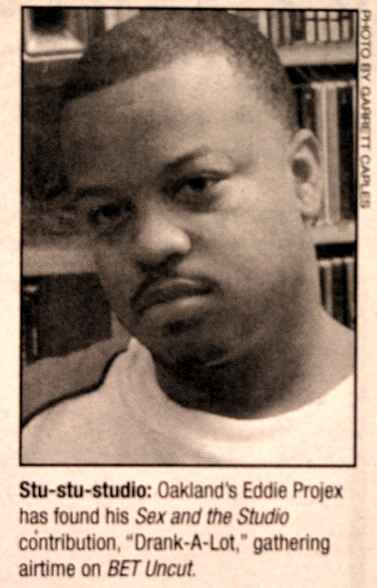
IF YOU SEE the video for "Drank-A-Lot" and aren't too distracted by the clubful of ass cheeks jiggling, you might notice the guy who spits the hook and first verse. He's Eddie Projex, from Oakland's Hittaz on tha Payroll, and the huge grin that never leaves his face throughout the clip is inspired by more than booty and booze. As the lead single from the soundtrack to episode two of the Sex and the Studio series, with verses by better-known buddies Numskull and Money B, "Drank-A-Lot" puts Eddie out front. The video has raised his profile, garnering nationwide "cable play" on BET Uncut, the station's adult-oriented music show (Wednesdays through Fridays, 3 to 4 a.m.). Now, after years of grinding away underground, Eddie's ready to shine.
"I like Hittaz on tha Payroll anyway, and Eddie's voice stands out," says Money B, recalling the "Drank-A-Lot" session. "I said, 'You pick the beat. Tell me which one you dig.' I went out the room, came back, and he'd already laid the hook. I was like, 'Yeeeaaahhhh.' "
Eddie's eagerness and efficiency reflect his persistence over the course of a decade in which Bay Area hip-hop got little mainstream love or major-label support. Along with MCs Polo, Curcinado, and Fletchberg Slim, Eddie formed Hittaz on tha Payroll in 1996.
"When 'I Got 5 on It' came out," Eddie says, referring to the Luniz' 1995 platinum hit, "we was in different groups. Everybody started fallin' off, and we were the only ones left standing. While the Luniz were making their mark, Num was busy doin' him. But we knew each other from back in the day, and when he came back, and sees we were still at it, he couldn't do nothing but accept it." Indeed, Num soon moved beyond acceptance. "He took me off the turf and flew me to L.A. Took care of me, gave me money, bought me clothes. He was like, 'Y'all gotta be my niggas.' "
Numskull premiered his new crew in 1999 on Good Laaawd, That's a Lot of Drank. In 2001, with no distribution deal, the Hittaz sold their debut disc, Underground Like Dead People, straight out the trunk, but it was with the release of Ghetto Storm (2003), on their own City Hall-distributed Hitta Records, that the Payroll began to attract attention. Produced entirely by the Mekanix, save for one banger by Sean T, Ghetto Storm was an instant East Oakland classic, due in no small part to Eddie's hook-writing ability on tracks like the atmospheric gangsta drama "Tha Game" and the sideshow anthem "Rims." Clearly Money B hadn't overlooked this elusive talent when he picked the Fifth-produced "Drank-A-Lot" as the single for Sex and the Studio's episode two.
Currently Eddie is shopping for a deal for his debut solo disc, Now or Never, even as he finishes two others: Ghetto Celebrity, for Hitta Records, and The Eddie Projex Project, for the Mekanix' Zoo Entertainment. In the meantime, taking advantage of the BET buzz, he's about to drop a street-only compilation, Eddie Projex Presents Oakland Street Music, Volume 1, which he hopes to turn into an annual showcase for emerging talent. Volume 1, which will also be sold at East Bay record stores like Rasputin's in Berkeley and Moses Music in East Oakland, features some of Oakland's hottest young artists – like Stevie Jo, E-Maculate, and R&B singer Naté – with production by the Mekanix, Sean T, and Harm and LT. Those unable to wait can check out the Hittaz' 2004 releases: Underground Like Dead People II, a recent Hitta Records mix tape, and Acid, a Polo and Curcinado duo project from FastLife Entertainment.
Fresh for the Underground
by Garrett Caples
San Diego Reader August 25, 2005
Chicago-born Fifth (a.k.a. Derrick Stanton) moved to San Diego with his family a decade ago, settling in El Cajon and then Spring Valley. The 19-year-old rapper/producer is the latest addition to rap crew Digital Underground. Fifth met original members Shock-G and Money B three years ago at "Gutfest," a barbecue thrown by local Digital Underground fan club Da Noses (which refers to Shock's plastic-nosed alter-ego, Humpty Hump).
"We played football," Fifth recalls, "then I let them hear my music. They let me get onstage that night. It was a surreal experience. My first professional recording was with Shock-G on 'Cherry Flava'd Email' [from last year's Fear of a Mixed Planet]. I was still 16."
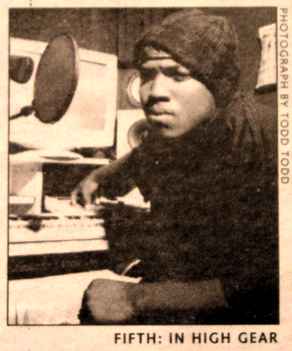 Since then, the Mount Miguel High School grad has produced 11 songs for Money B's Sex and the Studio DVD series. "Drank-A-Lot," a Fifth-produced single, has been playing on BET's late-night video show Uncut. Fifth recently showed for the third annual Gutfest, which climaxed with DU's August 12 performance at 'Canes. That night, Fifth delivered his own three-song set.
"[Money B] introduced me, 'This guy's from San Diego, you gotta love him.' I came up and did 'Down 'n Diego,' my big banger for San Diego, and everyone loved it. That was the song I originally played for Shock and Mon, so it was only right I started with that."
Fifth and DU are working on And Tomorrow, an upcoming 2pac album. Fifth, now living in L.A., plans to return to the area later this year to promote his as-yet-unreleased debut, Treason.
"We're still shopping for a deal, but we're going to release a single in San Diego, getting some airtime, giving it a buzz."
20061014
Behind the Nose -- Shock G steps out
by Garrett Caples
September 2005
Kev Kelley is excited. The Hunters Point emcee has been taken on as a protege by Shock-G, legendary leader of Digital Underground, who produces two tracks on the 23-year-old’s upcoming debut. It’s 3 a.m. Shock’s exhausted, having just wrapped a two-hour jam between DU and a funk band called Slapback, in celebration of his own “solo debut,” Fear Of A Mixed Planet. As we roll to the hotel for the interview, Kev insists on carrying Shock’s bag, despite its owner’s modest protests. “Fuck that!” Kev yells, zooming ahead with his treasure. “I’m doing what 2Pac did!” Shock accepts this with the habitual calm that contrasts so strikingly with his on-stage presence, whether as Shock-G or as his plastic-nosed alter ego, Humpty Hump. And Kev has a point. While never just a roadie — “We were producing and grooming and trying to get him a deal the whole time,” Shock says — 2Pac definitely lugged his share of equipment on the first DU tour in 1989. Shock’s ear for talent, moreover, is undeniable; through DU over the years he’s also boosted the careers of Saafir, the Luniz, and Mystic, among many others. As a producer Shock profoundly influenced rap’s development in the early ’90s. Two years before The Chronic had everyone jumping on the Mothership, Shock drew the blueprints for a hip-hop built on P-Funk principles. Tracks like “Rhymin’ on the Funk” (Sex Packets, 1990), “Same Song” (This Is An EP Release, 1991), and “The D-Flo Shuttle” (Sons Of The P, 1991) — all on Tommy Boy Records — laid the groundwork for much that followed. According to Digital Underground: Raw Uncut, a new DVD documenting the group’s entire history, “Freaks Of The Industry” remains, after 14 years, the #1 requested song on the Bay Area’s main hip-hop station KMEL despite never being a single. (#2? The Bay Area Ballers mix of the Luniz’s “I Got 5 On It,” also featuring Shock.) Such achievements and innovations have been obscured, however, by the huge pop success of “The Humpty Dance,” which led many to see the group as a bubblegum novelty. The beautifully eclectic, meticulously detailed, and deeply felt Fear Of A Mixed Planet is Shock’s ambitious attempt to finally step out of the shadow of Humpty Hump.
You ain't knowin' -- DU and 2Pac
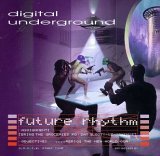
| All roads lead back to the Digital Underground and 2Pac By Garrett Caples San Francisco Bay Guardian March 16, 2005 I CAN'T COUNT how many surprised responses I've elicited with the information that 2Pac started out in Digital Underground. To anyone first exposed to him through the movies or during his final phase on Death Row Records, the idea of Pac coming up under the plastic-nosed guidance of Humpty Hump is scandalous. Such skeptics are referred to the 2004 documentary DVD Digital Underground: Raw Uncut, which features footage of the future Makaveli rocking "The Humpty Dance" for all he's worth. 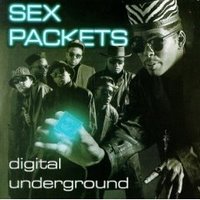 Atron Gregory, the group's first manager, introduced the young 2Pac to Humpty's alter-ego, D.U. leader and producer Shock-G, after the group completed Sex Packets (Tommy Boy, 1990) but before the album's release. As a result, Pac was on hand for the group's MTV-fueled explosion, making his recording debut on "Same Song," from their 1991 This Is an EP Release (Tommy Boy). Inevitably, once he blew up with the 1992 film Juice, 2Pac concentrated on his solo career, though he continued to appear on D.U. albums until 1996's Future Rhythm (Critique). Atron Gregory, the group's first manager, introduced the young 2Pac to Humpty's alter-ego, D.U. leader and producer Shock-G, after the group completed Sex Packets (Tommy Boy, 1990) but before the album's release. As a result, Pac was on hand for the group's MTV-fueled explosion, making his recording debut on "Same Song," from their 1991 This Is an EP Release (Tommy Boy). Inevitably, once he blew up with the 1992 film Juice, 2Pac concentrated on his solo career, though he continued to appear on D.U. albums until 1996's Future Rhythm (Critique).
"I couldn't have ever been 2Pac," Shock says now. "It's not my personality. By the same token, Pac probably couldn't have ever made it like I did as a producer-central figure in a collage of people. You gotta do you."
Though he moved out of the Bay Area – first to the Pocanos, then to Los Angeles – after the Oakland hills fire in late 1991, Shock has always turned to the Bay for new talent. Rap historians might note he was the first to tap Richmond, helping the duo Goldmoney score a deal with Tommy Boy and featuring them on Sons of the P (Tommy Boy, 1991). But Shock's most successful protégés after 2Pac are undoubtedly the Luniz, who appear on Future Rhythm and whose platinum debut, Operation Stackola (Noo Tribe, 1995), features production by Shock. That year Shock appeared on the remix of the Luniz' weed-smoking anthem "I Got 5 on It," alongside such local heavyweights as E-40 and Richie Rich. 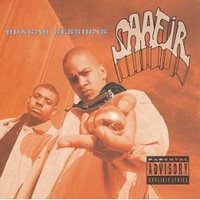 In the late '90s, Shock continued to influence the Bay through his associates. D.U. members DJ JZ and Saafir joined Hobo Junction for the critically acclaimed Box Car Sessions (Qwest, 1999) as well as three classic underground discs on their own Hobo Records. While D.U.'s 1998 album Who Got the Gravy? (Jake) failed to make a huge impression, it introduced Esinchill (see "Breaking Down the Battle Lines," page 43) as well as Mystic, whose debut, Cuts for Luck, Scars for Freedom (JCor), was nominated for a Grammy in 2002. Now, with the release of his first solo album, Fear of a Mixed Planet (33rd St), Shock has finally begun to receive his due as a pioneer. He's been producing tracks for Hunters Point MC Kev Kelly, even as he's transformed D.U.'s live show with the addition of an eight-piece funk band called Slapback. "I think people saw Humpty as a gimmick," Numskull of the Luniz says, "but Humpty is just a part of Shock. Shock is our driving force. For real. He's a genius." 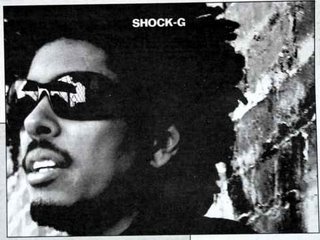 | ||||
| | ||||