A few weeks ago while writing a story about Fillmore rap, I called JT the Bigga Figga, only to be greeted by a long outgoing message informing callers he was in Nigeria on his Mandatory Hyphy tour with Snoop Dogg "for the next 48 to 72 hours." Though the message was largely a public self-congratulation delivered in the veteran rapper-producer's bigger-than-thou banter, even JT sounded surprised, as if the content of his boast for once exceeded his formidable powers of expression. And in truth, it was big: as recently as last year, such a feat would have seemed impossible. But JT's association with Snoop — forged by the pair's recent DVD, Mandatory Business (Get Low) — and the idea of so ambitious a tour under the rubric of hyphy indicate just how far Bay Area rap has come over the course of 2006. Perhaps encouraged by Lil Jon's example, big names have begun to stick their toes in the Bay, though whether Diddy found any rappers during his largely restaurant-based visit is unknown. MTV stirred the waters with video hits by the likes of E-40 ("Tell Me When to Go," "U and Dat"), Big Rich ("That's the Business"), and Bailey ("U-C-It"), while the Bay sent three Best West Coast DJ nominees to the Justo Mixtape Awards: Demolition Men, DJ Juice, and 40's DJ E-Rock. Upcoming major-label releases by Mistah FAB (Atlantic), the Team's Clyde Carson (Capitol), and the Pack (Jive) promise 2007 will continue to build on the momentum of the past couple years. The best thing about the past 12 months has been the sheer amount of world-class music released. The signal event of the first quarter was, of course, the March release of E-40's My Ghetto Report Card (BME/Reprise), which generated national curiosity about the hyphy movement and set the stage for much that ensued. April through June saw a flood of amazing discs that resumed in late August and hasn't abated since. These periods of activity were symbolically separated by the entrance of Mob Figaz's Husalah, who was given 53 months in federal prison for possession with intent to distribute more than five kilos of cocaine. The loss of this Mac Dre–level talent is a definite blow to local rap. But given six months of freedom after his sentencing to put his affairs in order, Hus recorded several albums' worth of material, two of which — Shower Posse, a duo album with the Jacka, and Explosive Mode III, a quartet with Jacka, San Quinn, and Messy Marv — have just appeared from FriscoStreetShow.com and rank with his finest work. This year's activity was set to culminate in the second annual Bay Area Rap Scene (BARS) Awards on Dec. 2 at the San Mateo Event Center. Every rapper I spoke to was excited about the event: those who had money bought suits, those who didn't rented, and even those who clung to white T's — or T's with massive airbrushed representations of themselves — approached the affair with respectful seriousness. "The idea was great," said Mistah FAB, who brought his mom to the event. "But the ordeal was a mess." Despite a stiff cover charge of $50 to $250, the attendance of national press and industry figures, and the promise of performances and presentations by many of the Bay's finest, the show was shut down after short sets by San Quinn and Messy Marv, two impromptu songs by E-40 and Keak Da Sneak, and roughly four awards. Fans were angry, the national press was unimpressed, and Bay Area rap was embarrassed at a delicate moment in its resurgence. Vibe, for example, posted its online coverage under the headline "BARS Awards Shut Down after Crowd Gets Too Hyphy," a misleading statement immediately contradicted by the story's first paragraph, which blames the event's premature end on "lack of security and poor planning on the part of promoters." The latter assessment is much more accurate. The allegedly "too hyphy" crowd consisted of the accumulated entourages of rappers who refused to leave the stage. Yet with the possible exception of Numskull and the Caliban (who briefly hijacked the show to perform one song), artists' behavior could hardly be called "hyphy" — it was more a sullen milling around brought on by boredom with the show's slack execution. "If there's a big pause in something that's supposed to be entertaining, of course there's going to be problems, because no one is paying attention," said the Jacka, whose much-deserved Underground Artist of the Year Award was announced to a near-empty hall. "It's like, 'Let's walk around. Fire up some weed. Let's get onstage. They're letting everyone else on.’” "Last year it was better," he concluded. "They had the kind of security people respected." It's difficult not to agree with this assessment. Google's cache of a Dec. 1 Craigslist ad page seeking security guards for the next-day event hardly inspires confidence, and the responsibility of securing the stage and choreographing a smooth sequence of events surely lies with the organizers, not the participants. Despite vigorous rebuttals posted by awards staff and promoters on Vibe.com and other sites, the overwhelming impression was that a lack of preparation to deal with what was admittedly stubborn but ultimately nonviolent behavior contributed to the blurry line between performers and spectators so typical of rap events. "If you're organizing a thousand personalities with a million egos, you've got to give yourself room to deal with things you didn't plan for," said FAB, whose scheduled appearance with Too Short was among the evening's casualties. This was particularly unfortunate as Short has done all he can for hyphy of late, including his single, "Keep Bouncin'," on which Snoop name-checks the movement. Now based in Atlanta, on a major label, and still highly successful, $hort doesn't need the hyphy movement but has taken it under his wing, seemingly out of love for the hip-hop scene of which he is universally acknowledged as the founder. "Short's a visionary," FAB said. "His sponsorship and persona allow us to get into certain spots. But it's up to us to be accountable for what we're doing." In any case, it would be a mistake to blame the artists for the collapse of the awards. There were no arrests and no incidents of parking-lot mayhem among cheated fans — just disappointment. The entire scene has worked hard to get to its present level of success and has conducted itself with infinitely less violence since Mac Dre's death. The rappers deserve a celebration, because whether or not the scene explodes in 2007 on the national level, the impressive collective output of Bay Area rap over the past two years already represents an extraordinary artistic achievement. The following is a strictly chronological list of personal favorites of 2006, culled from a huge stack of worthy contenders. TOP 10
Bay Area lays down the top 10 albums of 2006
Plus: What really happened at the BARS Awards?
Hyphy Holidays
by Garrett Caples
San Francisco Bay Guardian December 12, 2006 (1) Demolition Men, The Animal Planet Mixtape (starring Husalah and the Jacka of the Mob Figaz) (Mob Figaz)
 (2) E-40, My Ghetto Report Card (Reprise/WEA)
 (3) The Team, World Premiere (Rex)
 (4) Bullys Wit Fullys, The Infrastructure (SMC)
 (5) Husalah, Guns, Dope, and Religion (Sumo)
 (6) Beeda Weeda, Turfology (Hieroglyphics)
 (7) Traxamillion, The Slapp Addict (Slapp Addict)
 (8) Dem Hood Starz, Band-Aide and Scoot (SMC)
 (9) Big Rich, Block Tested Hood Approved (Koch)
 (10) J-Stalin, On Behalf of the Streets (Livewire)
20061220
Hyphy Holidays

20061202
The 'Moe Show -- San Quinn, Messy Marv, Big Rich, Will Hen leading out from the Fillmore
by Garrett Caples
San Franciso Bay Guardian November 22, 2006
If you don't know about the Filthy ’Moe
It's time I let real game unfold....
At the moment he's taping a segment for an upcoming DVD by the Demolition Men, who released his mixtape Block Tested Hood Approved in April. Since then, the former member of the San Quinn–affiliated group Fully Loaded has created a major buzz thanks in part to the snazzy video for "That's the Business," his E-A-Ski- and CMT-produced single. It was the Jam of the Week in August on MTV2 and added to straight-up MTV in time for the Oct. 3 release of the Koch full-length Block Tested Hood Approved. (Originally titled Fillmore Rich, the album was renamed to capitalize on the mixtape-generated hype.)
Presented by E-40 and featuring Rich's dope in-house producer Mal Amazin in addition to heavyweights such as Sean-T, Rick Rock, and Droop-E, BTHA is a deep contribution to the rising tide of Bay Area hip-hop. While Big Rich's gruff baritone delivery and gritty street tales make his music more mobster than hyphy, the album is not unaffected by the latter style's up-tempo bounce, helping the movement hold national attention during this season of anticipation before Mistah FAB's major-label debut on Atlantic. "I don't necessarily make hyphy music," Rich says. "But I definitely condone it. As long as the spotlight is on the Bay, I'm cool with it." Coming near the end of a year that has seen landmark albums from San Quinn, Messy Marv, Will Hen, and fellow Fully Loaded member Bailey — not to mention JT the Bigga Figga's high-profile tour with Snoop Dogg, which has taken hyphy all the way to Africa — Rich's solo debut is one more indication of the historic district's importance to the vitality of local hip-hop and Bay Area culture in general.
THE EDGE OF PACIFIC HEIGHTS
The Fillmore is a community under siege, facing external and internal pressures. On the one hand, gentrification — in the form of high-end shops and restaurants serving tourists, Pacific Heights residents, and an increasingly affluent demographic creeping into the area — continues to erode the neighborhood's edges. "If you grew up in the Fillmore, you can see Pacific Heights has crept down the hill, closer to the ghetto," says Hen, who as a member of multiregional group the Product (assembled by Houston legend Scarface) moved more than 60,000 copies of its recent "thug conscious" debut, One Hunid (Koch). "Ten years ago there were more boundaries. But the Fillmore's prime location, and I'm not asleep to this fact. We're five minutes away from everything in the city. That has to play a role in the way the district is represented in a city that makes so much off tourism. You might not want your city portrayed as gangsta, even though it is."
Hen has a point. The notion of San Francisco as gangsta is somewhat at odds with the way the city perceives itself. As an Oakland writer, I can attest to this, for even in San Francisco's progressive artistic and intellectual circles, Oakland is usually understood to be beyond the pale in terms of danger and violence. Yet none of the Oakland rappers I've met talk about their hoods in quite the same way Fillmore rappers do, at least when it comes to their personal safety. As Big Rich films his section of the DVD, for example, he remarks on the continual stream of police cruisers circling the block.
"They slowed it down," he says. "Now they only come every 90 seconds. Right around here is murder central — people be shooting each other every night. By 7 o'clock, we all gotta disperse, unless you want to get caught in the cross fire." He waves his hands in mock terror. "I ain't trying to die tonight!"
“BUSTING HEADS”
Though Rich is clowning, his statement is perfectly serious — indiscriminate gunfire among gang members, often in their early teens, makes nocturnal loitering a risky proposition at best. As of September, according to the San Francisco Police Department's Web site, the Northern Police District, which includes the Fillmore, had the city's second highest number of murders this year, 11, ceding first place only to the much larger Bayview's 22. For overall criminal incidents, the Northern District led the city, at more than 10,000 so far.
Though Fillmore rappers might be given to stressing the danger of their hood, insofar as such themes constitute much of hip-hop's subject matter and they feel the need to refute the city's nongangsta image, no one I spoke to seemed to be boasting. They sounded sad. Hen, for example, reported that he'd been to three funerals in October, saying, "You hardly have time to mourn for one person before you have to mourn for the next person." While the SFPD's Public Affairs Office didn't return phone calls seeking corroboration, both Rich and Hen indicate the neighborhood is suffering from an alarming amount of black-on-black violence.
"Basically, it's genocide. We're going to destroy each other," Hen says. "It used to be crosstown rivalries rather than in your backyard. Now there's more of that going on. If you get into it at age 15, the funk is already there. Whoever your crew is funking with, you're in on it." The ongoing cycle of drug-related violence — the Fillmore's chief internal pressure — has only ramped up under the Bush administration's regressive economic policies. It's a fact not lost on these rappers: as Rich puts it succinctly on BTHA, "Bush don't give a fuck about a nigga from the hood."
"Everybody's broke. That's why everybody's busting each other's heads," explains Rich, who lost his older brother to gun violence several years ago. "If you don't know where your next dollar's coming from ..."
To be sure, the rappers give back to the Fillmore. They support large crews of often otherwise unemployable youth, and Messy Marv, for example, has been known to hand out turkeys for Thanksgiving and bikes for Christmas. But Bay Area rap is only just getting back on its feet, and while the rappers can ameliorate life in the Fillmore's housing projects, they don't have the means to dispel the climate of desperation in a hood surrounded by one of the most expensive cities on earth. Moreover, they are acutely aware of the disconnect between their community and the rest of the city, which trades on its cultural cachet.
"It's like two different worlds," Hen muses. "You have people sitting outside drinking coffee right in the middle of the killing fields. They're totally safe, but if I walk over there, I might get shot at. But the neighborhood is too proud for us to be dying at the hands of each other."

HOOD PRIDE
The neighborhood pride Will Hen invokes is palpable among Fillmore rappers. "I get a warm feeling when I'm here," Messy Marv says. "The killing, you can't just say that's Fillmore. That's everywhere. When you talk about Fillmore, you got to go back to the roots. Fillmore was a warm, jazzy African American place where you could come and dance, drink, have fun, and be you."
Mess is right on all counts. Lest anyone think I misrepresent Oaktown: the citywide number of murders in Oakland has already topped 120 this year. But my concern here is with the perceived lack of continuity Mess suggests between the culture of the Fillmore then and now. By the early 1940s, the Fillmore had developed into a multicultural neighborhood including the then-largest Japanese population in the United States. In 1942, when FDR sent West Coast citizens of Japanese origin to internment camps, their vacated homes were largely filled by African Americans from the South, attracted by work in the shipyards. While the district had its first black nightclub by 1933, the wartime boom transformed the Fillmore into a major music center.
"In less than a decade, San Francisco's African American population went from under 5,000 to almost 50,000," according to Elizabeth Pepin, coauthor of the recent history of Fillmore jazz Harlem of the West (Chronicle). "The sheer increase in number of African Americans in the neighborhood made the music scene explode."
Though known as a black neighborhood, Pepin says, the Fillmore "was still pretty diverse" and even now retains vestiges of its multicultural history. Japantown persists, though much diminished, and Big Rich himself is half Chinese, making him the second Chinese American rapper of note. "My mother's parents couldn't speak a lick of English," he says. "But she was real urban, real street. I wasn't brought up in a traditional Chinese family, but I embrace it and I get along with my other side." Nonetheless, Pepin notes, the massive urban renewal project that destroyed the Fillmore's iconic jazz scene by the late ’60s effectively curtailed its diversity, as did the introduction of barrackslike public housing projects.
The postwar jazz scene, of course, is the main source of nostalgia tapped by the Fillmore Merchants Association (FMA). Talk of a musical revival refers solely to the establishment of upscale clubs — Yoshi's, for example, is scheduled to open next year at Fillmore and Eddy — offering music that arguably is no longer organically connected to the neighborhood. In a brief phone interview, Gus Harput, president of the FMA's Jazz Preservation District, insisted the organization would "love" to open a hip-hop venue, although he sidestepped further inquiries. (Known for its hip-hop shows, Justice League at 628 Divisadero closed around 2003 following a 2001 shooting death at a San Quinn performance and was later replaced by the Independent, which occasionally books rap.) The hood's hip-hop activity might be too recent and fall outside the bounds of jazz, yet nowhere in the organization's online Fillmore history (fillmorestreetsf.com) is there an acknowledgement of the MTV-level rap scene down the street.
Yet the raucous 1949 Fillmore that Jack Kerouac depicts in his 1957 book, On the Road — replete with protohyphy blues shouters like Lampshade bellowing such advice as “Don’t die to go to heaven, start in on Doctor Pepper and end up on whisky!” — sounds less like the area's simulated jazz revival and more like the community’s present-day hip-hop descendants.
How could it be otherwise? The aesthetics have changed, but the Fillmore’s musical genius has clearly resided in rap since Rappin’ 4Tay debuted on Too $hort’s Life Is ... Too $hort (Jive, 1989), producer-MC JT the Bigga Figga brought out the Get Low Playaz, and a teenage San Quinn dropped his classic debut, Don’t Cross Me (Get Low, 1993). While there may not be one definitive Fillmore hip-hop style, given that successful rappers tend to work with successful producers across the Bay regardless of hood, Messy Marv asserts the ’Moe was crucial to the development of the hyphy movement: “JT the Bigga Figga was the first dude who came with the high-energy sound. He was ahead of his time. I’m not taking nothing away from Oakland, Vallejo, or Richmond. I’m just letting you know what I know.”
In many ways the don of the ’Moe, San Quinn — reaffirming his status earlier this year with The Rock (SMC), featuring his own Ski- and CMT-produced smash, “Hell Ya” — could be said to typify a specifically Fillmore rap style, in which the flow is disguised as a strident holler reminiscent of blues shouting. While both Messy Marv and Big Rich share affinities with this delivery, Will Hen, for instance, and Quinn’s brother Bailey — whose Champ Bailey (City Boyz, 2006) yielded the MTV and radio success “U C It” — favor a smoother, more rapid-fire patter.
What is most striking here is that, with the exception of fellow traveler Messy Marv (see sidebar), all of these artists, as well as recent signee to the Game’s Black Wall Street label, Ya Boy, came up in the ’90s on San Quinn’s influential Done Deal Entertainment. Until roughly two years ago, they were all one crew. While working on his upcoming eighth solo album, From a Boy to a Man, for his revamped imprint, Done Deal, Quinn paused for a moment to take justifiable pride in his protégés, who now constitute the Fillmore’s hottest acts.
“I create monsters, know what I’m saying?” Quinn says. “Done Deal feeds off each other; that’s why I’m so proud of Bailey and Rich. We all come out the same house. There’s a real level of excellence, and the world has yet to see it. Right now it seems like we’re separate, but we’re not. We’re just pulling from different angles for the same common goal.”
“We all one,” Quinn concludes, in a statement that could serve as a motto for neighborhood unity. “Fillmoe business is Fillmoe business.”
 Making Messy Marv
One of the most extraordinary products of recent Fillmore history is Messy Marv, a rapper whose life reflects the neighborhood's struggle with a half century of urban renewal and the ’80s-era introduction of crack into America's ghettos. In 1996, when he was still in 10th grade, he released his first album, Messy Situations (Ammo). Though it sold around 15,000 units, Mess admits he didn't take music seriously at first.
"I dropped out of high school due to family issues," he says. "I had to grow up real fast and do the man thing, but I started doin' the street thing."
Nonetheless, Mess's rap reputation grew, and in 1997 he hooked up with San Quinn to record Explosive Mode (Presidential, 1998), which has sold more than 50,000 copies. "There was a lot of hype around the hood about how he was better than me or I was better than him," Mess says. "We decided to come together, and we made a classic."
"At that time, I was really on the street, living outta cars, doing real bad things," he recalls. "So Quinn and his mom took me in."
Despite his success when few in the Bay were moving many units, Mess was unable to leave the dope game, partly due to his own addiction. "I inherited a cocaine habit," the rapper says. "I been clean for a while, but I had a really bad habit. All I can say is 'Say no to drugs.’” Though he won't go into details, Mess confirms his triple life as rapper, dealer, and user came to a head one night at an out-of-state show in 2001, when he was forced to jump out a fourth-floor window. "I broke both of my legs, crushed my left foot, lost a lot of blood," Mess says. "I was in a wheelchair for six months. The doctors said I'd never walk again."
"It gave me a whole new respect for handicapped people. I was doing shows in my wheelchair, and I rocked the whole crowd. It was a hell of a feeling that they still accepted me," he says. "That gave me the strength to get up and walk. I learned how to walk all over again, by myself, in four months. After that I decided it was time to go somewhere else with my life."
As if to atone for time lost, Messy Marv has since pursued his talent with a vengeance, recording a slew of projects for his own label, Scalen LLC, and labels such as Frisco Street Show, which released a reunion with Quinn, Explosive Mode 2: "Back in Business" (2006), and just dropped Explosive Mode 3 with Husalah and Jacka. In 2004, Mess inked a distribution deal for Scalen through Universal/Fontana, helping him move more than 20,000 copies each of Disobayish (2004) and Bandannas, Tattoos and Tongue Rings (2005). While he spent much of 2005 in county jail on a weapons violation, he still managed to score one of the big radio hits of the hyphy movement, "Get on My Hype," produced by Droop-E. Most recently, he's been on MTV and other airwaves with the E-A-Ski- and CMT-produced "So Hood," from The Infrastructure (SMC), his album with Hunters Point rapper Guce, released under the name Bullys Wit Fullys. A self-conscious bid to end hood rivalry between the ’Moe and HP, the Infrastructure project shows Mess's awareness of the power of his position as a role model even as he continues to spit with the most defiant swagger of any rapper in the Bay.
While Mess admits he has major deals on the table and plans to release the first of a two-volume opus titled What You Know about Me? in December, he also intends to retire thereafter in a nonbinding Jay-Z sort of way in order to concentrate on the younger acts on his label. This intention seems characteristic of the true spirit of the Fillmore as well as an acknowledgment that despite his youth, Messy Marv has already written a chapter in the district's history.
20061104
Dope, rap, and religion
With two hot collaborations, one new solo joint, and an upcoming reunion with Mob Figaz in the works, Husalah should be on top of the world. Instead, he's spending the next four and a half years behind bars I'm on the set of the video for "Never Blink," a song off Mob Figaz member the Jacka's 2005 solo disc, The Jack Artist (Artist), featuring Dubb 20 and J-Stalin. The "set" in West Oakland where 10th Street meets Mandela is not sanctioned by a film commission but monitored from a distance by a slowly circling caravan of three police cruisers. A Mercedes SL500 creeps through the crowd and parks in the middle of the road, retracting its hard top with the slow-motion elegance of a moon landing before a familiar 6-foot-3-inch frame unfolds from the low roadster and begins the usual round of hand slaps and hugs. Husalah is on the set. "I represent the Iraqi Space Program," he announces, then immediately reconsiders. "The Nigga Spaceship Association." He has the air of one whose wit is so fertile he must double-stack its results. Though Hus doesn't perform on "Never Blink," he has turned up on behalf of his fellow Mob Figa for some whoridin' — that art of dancing, lyric miming, and tough posturing behind the rapper — and for the next several takes nearly steals the show. He can't help it. Combined with his athletic build and strikingly handsome face, his height makes him conspicuous in any crowd, while his desire to "take it further," evident in his innovative, melodic flows and ever-evolving gangsta argot, also animates his appearance. Instead of imaginary bills, Husalah pulls out a stack of new hundreds, fans it to show it's all hundreds, shuts the fan, and begins to count, licking the bills instead of his thumb as he goes while bobbing to the mournful yet light-as-air RobLo production. Fielding an imaginary call, Hus shoulders his phone as he continues to count and dance, gazing off abstractedly as though processing information. It's a performance worthy of a Mac Dre or an André, though more thugged out and unmistakably Husalah's own. Husalah's been recording for eight years, debuting as a teen with the other Mob Figaz — Jacka, Fed-X, AP9, and Rydah J. Klyde — on "Ride til We Die," the opening cut on C-Bo's Til My Casket Drops (Awol, 1998). Now, at 25 he is hitting his creative stride just as Bay Area rap is making itself felt on a national level. Three hot Husalah projects are currently in stores: 3 da Hard Way (FriscoStreetShow, 2005), a trio with Jacka and hard-spitting MC Marvaless; Animal Planet (2006), a Demolition Men mixtape cohosted with Jacka; and Dope, Guns and Religion (Sumo, 2006), a solo debut drawing on new and unreleased material. With a Mob Figaz reunion on the horizon, the timing couldn't be better, except for one small catch. In February, Husalah was sentenced to four and a half years in federal prison for possession with intent to distribute "more than five kilos" of cocaine, a charge dating from 2001, when the rapper was 20. At press time, he was set to turn himself in July 10. "Where I come from," Husalah says several days before the video shoot, at the Mob Figaz's studio, hidden away in an upper-middle-class chunk of Antioch, "it's all about getting money, staying fly, being the coolest dude." Born in 1981 in nearby Pittsburg, the young Tito Alston grew up in el Pueblo Housing Project, notorious for its colorful "hood rich" hustlers, who made small fortunes dealing dope and pimping. It's exactly the sort of "subculture that glorifies swagger over work," according to a March 20 New York Times article and "causes the deepening ruin of black youth." Such preferences likely are also the effect of poor education and few opportunities for low-income inner-city families. Pittsburg may not be your classic inner city, but it's certainly no exurban paradise. An inland port first known as New York Landing, it was rechristened Black Diamond following the 1903 discovery of coal in the hills and received its present name in 1911 to honor the arrival of the steel industry. The low-paying jobs available to unskilled laborers (in chemical and power plants and oil refineries and distribution centers) are ones few would wish to take or even consider safe. As a teen Husalah rapped in talent shows, but his first love was sports. He played basketball and football and even boxed. His hoop dreams were quashed, however, when he was expelled from Pittsburg High in 10th grade after being caught with crack he intended to sell. Following a brief stint at the alternative Riverside High, where he was again busted with his stash, he was expelled for good and sentenced to a year of house arrest. "I used to sneak out at 10 every night, until 8 in the morning [to sell crack]," he recalls. "That was my shift." By 16, Hus was "heavy into the streets. I didn't care about music no more." "Then one day I was playing basketball in the gym," he continues. "Jacka, AP9, and RobLo came and got me. They was, like, 'C-Bo at the record store — he want to hear y'all rap.' I was, like, 'I don't care about this shit no more.' I got $4,000 in my pocket. To a young ’un that's big." Fortunately his friends managed to persuade the young Husalah to have his date with destiny. "We weren't even a group," he says. "We were just the tightest dudes in the area. But C-Bo was fresh off 2Pac's All Eyez on Me [Polygram, 1996], selling 300- or 400,000 units consistently. We went into the studio that day and did 'Ride til We Die.' After that, Bo's, like, 'We fittin' to do an album.' We went on tour, dropped the album [C-Bo's Mob Figaz (Git Paid, 1999)], and sold 140,000." If the number seems small to platinum-conscious readers, consider that this occurred in the middle of Bay Area rap's long commercial decline, when even an album with a radio hit — such as the Delinquents' Bosses Will Be Bosses (Dank or Die, 1999), featuring "That Man!" — only moved 50,000 units. Or that the stir caused two years ago by Frontline's Who R U? (IMG) was based on sales of 10,000. For an independent debut in the Bay, 140,000 would still be huge. The figure was more than sufficient to establish the Figaz as a force in Bay Area rap. For a couple of years, Husalah says, "I was, like, 'OK, this is money.' But then Bo went to jail and it got stagnated." The loss of C-Bo's leadership coupled with the Bay's commercial misfortunes slowed the group's momentum. "I fell back into [dope dealing] because it was lucrative," Hus confesses. "I've always been the nigga to wear the flyest kicks, the best fits, the best chick, so I gotta keep that standard going." Work on an attempted follow-up album, Mob Figaz, languished so long that the exasperated Warlock Records would eventually release it unfinished in 2003. As he returned to the streets, however, Husalah began to develop a spiritual consciousness. E-40's remark on In a Major Way (Jive, 1995) advising the listener to "read Proverbs" in times of stress got Husalah perusing the Bible, and from there he moved to the Koran. It was the Koran that spoke to his struggles and sensibility. "It's all about God first," he says. "It ain't about preaching. It's about knowing what's real." His conversion to Islam led him to wrestle seriously for the first time with the implications of selling crack to his community. "Allah says you can't be judged for what you weren't aware of," Hus comments. "I thought I was doing right as a youth. That's what all the older people I came up under did to make money. You get dope at hoop or be catching long bombs or sell dope. There's not a lot of opportunity here. But once you become a man, you get aware of what you doing. It's not an excuse now that you're aware of it." The ambivalence Hus developed toward his primary source of income is documented on Dope, Guns and Religion, which despite its celebration of the hustling lifestyle is threaded with contradictory feelings born of his spiritual awakening: "But at the same time I barely touch packages/ ’Cause I believe pushing poison is for savages/ But then again, this shit got advantages/ How could I live if my pockets is Somalian?" As these lines from "Rainman" illustrate, Husalah has tapped into Bay Area rap's 2Pac-inspired tradition of the "conscious thug," using the dope dealer or pimp persona to articulate the dilemmas faced by black high school dropouts — more of whom, by their late 20s, are incarcerated (34 percent) than employed (30 percent), according to the same New York Times article. But where 2Pac was a conscious rapper who adopted the thug persona, partly from his on-screen success in Juice, partly as a way to get his message across, Husalah is a thug rapper who achieved consciousness, seeking a way out of the dope game even as he remained ensnared by its financial rewards. Though he scaled back his activities, Husalah was unable to resist what seemed like a quick job for a big payoff in 2001 and arranged to help ferry "a large amount of cocaine" from Chicago to Cali. "That was a decision I made," he explains today. "It wasn't out of ignorance. It was out of a sense of desperation or hopelessness. I felt like I had no other choice." "Some dude ratted me out; we were being watched the whole time," he continues. "I caught a federal conspiracy charge in Chicago. There was another guy driving the car, but they said I was the one who coordinated, flew him out there to pick something up, to take something around. With the feds, you got to take the charge and do your time. You can't win." Nonetheless, after posting bail Hus returned to the Bay, hiding out for the next 18 months. "I wasn't really on the run because it was an out-of-state case and they didn't know where I was," he explains. "I'm, like, 'I'm not surrendering until they pick me up.' In the meantime, the grand jury indicted me, and I was snatched up by the task force in Pittsburg. "I didn't have no criminal record. I'd been to juvenile hall, but this was my first time going to jail and I'm looking at 10 years." Bailed out again, Hus would spend another three years fighting the case in court before eventually agreeing to plead guilty to possession and intent in exchange for the feds dropping the weightier conspiracy charge. Sentencing him to 53 months in February, the judge granted Husalah a six-month stay to get his musical affairs in order before entering the Federal Correctional Institute in Sheridan, Ore. "My whole thing now is making music," says Husalah, who, in addition to completing his parts for the upcoming Mob Figaz album, has been hard at work finishing a half dozen projects, including a rock album, The Unusual Suspects; a dancehall disc with Jacka as the Shower Posse; and Harsh Reality, the full-length he was making when his legal woes began. "Plus, I figure I'll still be able to work in there, because in the federal system it's a lot more open. I'm pretty sure I'll have a mini ADAT recorder. There'll be new product." With the group’s business partnership, MobFigaz, LLC, continuing in his absence, Husalah has no fear of losing his musical profits. “I know they’re gonna keep it rockin',” he says. “We gonna make sure our check is in the mail.” “Husalah is a phenomenal artist,” says Mistah F.A.B., who featured a farewell interview with Hus on the most recent installment of his new WILD 94 show. “He’s very intelligent and his character and charisma leave an impression on people. It’s unfortunate he has to go to jail for his past mistakes, but his stock will rise for doing his time and we’ll be waiting for him when he gets back. It’s going to be a learning experience.” Husalah, it seems, agrees. “If Allah made me go through what I had to go through, there's a reason. I'm a better person. I learned what not to do. The statistics show it's death or jail for a street nigga, so for me it happened to be jail. I feel like it's a blessing that I'm breathing, I'm healthy." "When you look at the whole situation, I had a lot of fun," he concludes philosophically. "I rocked a lot of models, rode a lot of rims, dropped a lot of tops, popped a lot of bottles, all that bullshit, so I'm trying to see what I'll evolve into now. I might be heavily religious. I might be into different types of music. Whatever it is, I'm gonna stay a real nigga, keeping this mob shit rocking. I'm gonna lay down and do my time. Then get right back and make money like I never left." www.myspace.com/husalahofthemobfigaz
by Garrett Caples
San Francisco Bay Guardian July 12, 2006BLACK DIAMOND
“THIS IS MONEY”
COKE ADDS LIFE?
20061029
Bring on the Demolition Men
by Garrett Caples
San Francisco Bay Guardian April 26, 2006
The Demolition Men, Impereal and DJ Devro, definitely didn't earn their reputation as the Bay Area's mix-tape kings by staying at home. As DJs the duo has performed together and separately at clubs all over the world, from China and Japan to South America and Europe. Native Spanish speakers — Impereal hails from the Colombian community in Queens, NY, while Devro is Southern California Creole — the pair also hosts Demolition Men Radio, broadcast Thursdays from 6 to 7 p.m. on Azul 1063, a hip-hop station in Colombia's Medellin. Yet if you live in the Bay, you're most liable to see them on the street, selling mix tapes out of their backpacks.
"We're like a walking promotional retail machine," Impereal jokes. "If you don't buy a mix tape, you going home with a flyer."
Such determination, coupled with the DJs' high output (more than 30 releases since late 2003, including three volumes each of R&B and reggaeton) and elaborate graphics, has finally kick-started the Bay's once lackadaisical mix tape scene.
An integral component of hip-hop in New York and the South, enabling new talents to be heard alongside vets and vets to issue bulletins with an immediacy unavailable to corporate labels, DJ-assembled mix tapes at their best are the ultimate in no-holds-barred hip-hop. Considered "promotional material" and usually printed in limited quantities, the discs are generally unencumbered by legal requirements like sample clearance.
Until recently, however, mix tapes weren't much of a factor here. While the Demolition Men are quick to pay homage to their local predecessors — like Mad Idiot, DJ Natural, and DJ Supreme — Natural acknowledges the mix tape scene was a bit dead before the Demolition Men began shaking it up.
"Out here DJs were concentrating on clubs," Natural says. "Then they started putting stuff out constantly." Now there's sufficient trade in mix tapes for Natural to move his formerly virtual business, Urban Era, to brick-and-mortar digs at 5088 Mission, making it the Bay's only all–mix tape music store. Yet even with increased competition, he notes, the Demolition Men still routinely sell out.
In addition to their up-tempo release schedule, the success of the Demolition Men's mixes might be attributed to the conceptual coherence they bring to their projects. While they do put together general mixes featuring more mainstream fare — such as the Out the Trunk series, which boasts exclusives from Ludacris — the duo's hottest projects tend to tap into the Bay's reservoir of talent. Aside from their multifaceted Best of the Bay series, the Demolition Men have released mix tapes hosted by Bay Area artists like Balance, Cellski, El Dorado Red, and the Team.
Currently the Demolition Men's most successful disc has been their most ambitious: Animal Planet, not so much a mix tape as music cinema, starring the Mob Figaz' Husalah and Jacka. A mighty 34 tracks — featuring production by Rob Lo, Traxamillion, and the Mekanix, and appearances by F.A.B., Keak, and Pretty Black — Animal Planet is an incredible collection of almost entirely exclusive, original material, seriously blurring the boundary between mix tape and album. Its success has encouraged bold undertakings, like The Early Morning Shift with J-Stalin and Block Tested, Hood Approved, a mix tape/DVD starring Fillmore rapper Big Rich. "I guess we're taking the mix tape to the next level," Devro says.
Demolition Men DJ
Thurs/27 and the last Thursday of every month, 9 p.m. doors
Vault
81 W. Santa Clara, San Jose
$10
(408) 298-1112
myspace.com/demolitionmenmusic
20061028
The Mob Figaz Meet Marvaless -- 3 Da Hard Way (FriscoStreetShow.com)
Album Review by Garrett Caples
San Francisco Bay Guardian January 25, 2006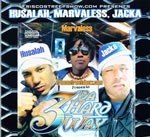
Except for a retrospective Best of (Thizz), Pittsburg's own Mob Figaz spent 2005 in divide-and-conquer mode. Particularly hot were Rydah J. Klyde – who dropped two duo discs (El Pueblo Children with Freako and Bang Fo Bread with Johnny Cash as Money Gang) and a solo What's Really Thizzin? (all on Thizz) – and Jacka, whose solo debut, The Jack Artist (Artist), generated a huge buzz in the early part of the year. The present disc, teaming Jacka and fellow Figa Husalah with tough-talkin' Sac Town female rapper Marvaless, is one of the tightest side-projects in hip-hop history. If this were a full-time trio, they'd be a hardcore Fugees. It doesn't hurt that most of the tracks are produced by Rob-Lo, who provides ample evidence of why people speak of him in the hushed tones reserved for Rick Rock or E-A-Ski. He cooks up tracks in every style, yet everything he does is his own.
With all eyes on Klyde and Jacka, picking Husalah as your favorite Mob Figa is a bit like claiming George as your favorite Beatle, but I'm convinced that, like George, whose interest in India added unexpected depth to the band's psychedelia, Husalah is the Mob's special ingredient, bringing a sublime ridiculousness to every track. Witness "Shower Posse," a faux-dancehall gem that Husalah handles in a patois of Jamaican slang and invented nonsense, or "Moblife," where he phones in some vocals from the freeway. This willingness to go the extra creative mile is what distinguishes the Mob from every other thugged-out crew out there.