by Garrett Caples
Luniz 10th Anniversary Special exclusive to hyphythizzgo.com
2005 marks the 10th anniversary of Operation Stackola (Noo Tribe/Virgin, 1995), the platinum debut of Oakland duo Jerold “Yukmouth” Ellis, Jr. and Garrick “Numskull” Husbands: the Luniz. Featuring fat tracks by the likes of Shock-G, DJ Fuze (both from Digital Underground), DJ Darryl, and E-A-Ski & CMT, Stackola is best known for the Tone Capone-produced “I Got 5 On It,” which a decade later remains the weed-smoking anthem of hip hop. The album also established the Luniz’s peculiar brand of outrageousness. At a time when the persona of the millionaire rapper became the norm, the Luniz portrayed themselves as small-time hustlers, usually broke, always on something. Their sense of humor, moreover, was bizarre and inimitable; who but the Luniz would begin their very first album depicting their own death, at the hands of a machine-gun-toting “playa hata” shouting “Fuck the Luniz!”? (About half-way through Stackola, on “5150,” the pair are killed again, floating up to heaven to encounter Jesus, Shock-G’zus, who promptly kicks them out, though in truth Shock would bring them into DU, both on stage and in the studio.)
But what defined the Luniz above all else was the chemistry between Yukmouth and Numskull. Friends since their early teens, the two forged a bond based on their determination to succeed in hip hop. “We was both sleeping on the park bench,” Num recalls, “because his grandma and my mom wanted us to get jobs, and we’re like ‘No, we want to be rappers.’” Such shared hardships infused the pair’s complementary vocal styles, for Yuk’s frenetic flow was a perfect match for Num’s almost talking style of rap. “In every great duo, one partner brings something the other lacks,” says Mekanix production team member Dotrix, who dj’ed for the Luniz on tour for their second album, Lunitik Muzik (1997). “Num’s flow sounds simple, though it’s actually complex, but with him it’s more what he says, rather than how. Yuk, on the other hand, is all style, like a NY rapper, more how he says it than what.” Such differences mirror the Luniz’s distinct personalities. Yukmouth, to invoke a song from his 2003 album Godzilla, is “stuntastic,” rocking jewels and platinum teeth, puffing high-grade weed, sipping Moet; Numskull, by contrast, is laid back and hood, sporting white tees with no ice, no longer smoking weed but still committed to Mickey’s malt liquor.
The history of the Luniz begins in the late ’80s when Yukmouth joined Numskull’s Brothaz Wit Potential as a non-rapping visual artist who quickly became one of the tightest rhymers in the crew. Forming a duo originally called Luni Tunz, their first break came in the early ’90s when they met Chris Hicks of C-Note Records, who was in the process of recording the debut of another Oakland sensation, Dru Down. Hicks put the Luniz in the studio with Dru, where they recorded “Rescue 911” and “Ice Cream Man,” a local underground hit. The Luniz also recorded “5 On It,” which was sufficient to land a deal with Noo Trybe, while Dru’s album, Explicit Game, was picked up by Relativity.
The international impact of “5 On It” should have paved the way for the Luniz’s future. Instead, as if presaged by their multiple deaths on Operation Stackola, the duo was dealt a series of setbacks of the career-killing kind. Hoping to replicate Stackola’s success, Noo Trybe chief Eric Brooks tried to steer the Luniz in a pop direction Yuk & Num stubbornly resisted. Lunitik Muzik thus ended up sounding like the biggest-budget street album ever recorded; lacking a pop hit, the album nonetheless went gold, though it fell short of the label’s expectations.
Industry pressures began to take their toll. Ensnared in bad deals with both Brooks and Hicks, as well as legal difficulties owing to wild behavior on tour, the Luniz began to grow apart, and when Yuk jumped at a solo offer from Rap-A-Lot, their days as a duo seemed over. Yet, though mostly leading seperate lives, the Luniz never really broke up, playing the occasional gig and making joint appearances on various projects, including each others’, as well as the West Coast Mix of P.Diddy’s “5 On It”-based “Satisfy You” (Bad Boy 2000). Gradually they renewed their bond and recorded what was to be their third album, Oakland Blaze. But new complications arose. Noo Trybe folded, leaving Hicks with the rights to the Luniz name, while Yukmouth remained under contract to Rap-A-Lot. Numskull, meanwhile, refused to do business with Rap-A-Lot, as he’d never been paid for his appearances on Yuk’s projects. As negotiations ensued, bootlegs of Blaze began selling all over Oakland, even spawning the underground hit “I’m a Raider.” After endless delays, the album was finally rushed out, with a slightly different track list, in the summer of 2002, as Silver & Black (Rap-A-Lot). Though previous bootlegging resulted in low sales, the buzz the project generated was undeniable proof fans were still hungry for the Luniz, and the Luniz could still deliver.
To celebrate the Luniz’s 10th anniversary in the industry, I touched down with both Yukmouth and Numskull. With 3 solo albums, 2 United Ghettos of America comps, and 1 duo disc with C-Bo as Thug Lordz already under his belt, Yuk is promoting All Out War, Vol. 2 (Smoke-A-Lot), the second mixtape by his crew the Regime. Num, meanwhile, is preparing his first “solo” release, Caliban, named after his own new group, who are featured on the album. While the music on each reflects their respective personalities, it’s hard not to notice that both the Regime and the Caliban have adopted camouflage and fatigues, as if, even at a distance, Yuk and Num are attuned to the same wavelength. Both are optimistic about an eventual 4th Luniz album, but only when the conditions are right. “I wanna do it for me,” Numskull says, “not because of the Luniz name.” Yukmouth agrees: “We gotta build that bond back because that bond ain’t there right now. Soon as we can vibe together as the Luniz, then we can do it.”
(part two: Yukmouth: The Regime Declares War
part three: The Mystery of Numskull)
20061022
The Luniz: 10 On It!

The Mystery of Numskull
by Garrett Caples
Luniz 10th Anniversary Special exclusive to hyphythizzgo.com
Numskull is a hard man to pin down. When I first interviewed him in March, he was staying in Sacramento, shuttling back and forth to Reno to work on Caliban—his long-awaited first solo album—with producer C-Dash. Since then, we’ve periodically touched base by phone, at Digital Underground shows, or at the Garage in East Oakland, where former Luniz dj Dotrix and partner Kenny Tweed produce tracks as Tha Mekanix. One night in September in San Francisco, I bump into Num after a DU show, during which he brought down the house with a 3-song set from Caliban, backed by his group of the same name. Thizzing on a pill as well as on the crowd’s enthusiastic response, he gives me hug and tells me the album is done. Then he pulls me aside.
“This is important; you have to put this in the interview,” he says. “I was actually born in Mississippi; my mom moved to Oakland when I was a baby. And on my birth certificate, under race, its says ‘Negro.’”
He doesn’t elaborate further, but, only about a month after Hurricane Katrina, it was easy to catch his drift. Num was born in the ’70s, well after the peak of the civil rights movement when the term fell into disuse, but his birth certificate is evidence of the kind Katrina provided in abundance, that very little in fact had changed for certain black populations in America. If this seems like an atypical concern for the rapper who sometimes records under the name Drank-A-Lot, it does give a foretaste of what Caliban has in store for listeners.
“It’s gonna be Numskull’s solo album,” he says, “but I’m introducing the group so I got ‘em on a lot of songs. The Caliban is basically artists who don’t see the world like everybody else see it. We’re not worried about this club shit. Caliban—we took it from the Taliban, so we bitter about hella shit that’s going on. In the United States and overseas, all the shit. We hate Bush. It’s a Num album. And Num don’t really give a fuck about shit.”
The logistical details behind Caliban are still in flux. One minute Num is in talks with basketball players starting labels, next it’s supposed to be Koch, next he’s releasing it himself on the internet. Even the line-up of the Caliban seems to periodically undergo reassessment, though the core seems to be former No Limit soldier Don P; former Dangerous Crew member F.M. Blue, whose own long-delayed first album, The World Is Blue (FastLife 2004), is largely produced by the Mekanix; Blue’s younger brother Cheese Whosain; and DU member Esinchill, who just dropped his own C-Dash-produced project, a duo disc with King Beef called Choice Cuts (RCeason).
One thing, however, I can say for sure: the music Num played for me during our interview in Sacramento was some of the most advanced hip hop I’ve ever heard. Both Numskull and Esinchill hooked up with the newly-thriving Reno scene through Element, a trio who spent 5 years on the road as DU’s support crew and appear on Shock-G’s solo album, Fear of a Mixed Planet (33rd Street 2004). The beats coming out of Reno these days are wildly futuristic blends of the synthetic and the organic that sound truly like nothing else in rap. Clearly they inspired Num to take his own experimental approach to the vocals; the group tracks feature incredibly tight interplay between the rappers, as opposed to the usual structure of simply trading verses. As half of one of the greatest hip hop duos of all time, Num appreciates the power of group dynamics.
“I don’t like to be alone,” he confesses. “On stage, at home, anything. So I always bring people with me wherever I go. And these cats have talent, so why not put ‘em on?”
Such an attitude goes a long way towards explaining Num’s career in the years since Lunitik Muzik, for while Yukmouth has remained highly visible and productive—preparing to release his fourth solo album, Million Dollar Mouthpiece, in 2006—Num has kept a much lower profile. This has been partly due to circumstance; though he recorded a solo album in the late ’90s for NY-based K-Tel Records, the company folded before releasing it. Yet he also freely admits, “I didn’t think I was ready to do a solo album, at all. I was still into that Luniz shit. When I came out with my own album, I wanted it to be me, not people thinking he gotta make shit like the Luniz.”
Instead of pursuing a solo career, Num spent much of the period between Muzik and 2002’s Silver & Black on the road with the steadily-touring DU. “I was the animal on tour,” he admits. “I’m talking about drugs everywhere every night, drinking. And Shock was kinda coming along with me. But then he was like, we’re not going to take you and Clee on the next one. We understood. We were wild, acting a fool. I was still living out my Luniz fantasies. But Shock told me the reason we wasn’t making good music anymore was that we were partying too much. And I appreciated him for that.”
While the rest of DU embarked on tour, Num and Clee began hanging out in LA with producer Poli Pol, prior to his association with the Black-Eyed Peas. “The guy had a studio,” Num recalls. “We were just kicking it really cause we’d brought some other cats over to work with him. We were making songs that we wanted to hear. Shit that we were going through at that time. Like, you don’t have no pussy, so we made a jack off song. Shit like that. We weren’t even thinking about doing an album together at all. But then he’s like, fuck it; let’s do a whole album.” The result of these sessions was the brilliant but hard-to-find, label-less disc Good Laaawd That’s a Lot of Drank (1999), credited to Clee and Drank-A-Lot.
“That’s a classic album,” Num says proudly. “But we tried to put it out ourselves, and we didn’t know nothing about going independent. We pressed up 5,000 units and sold all 5,000 in stores. We would get the money back from the first sales, and we would try to put it into promotion. Then we’d have no money to press it up again when everybody’s asking for it. But I’ve never heard one person say that they didn’t like that album. I actually want to rerelease it.”
The duo eventually parted on friendly terms, but not before teaming with Money B for his Poli Pol-produced single “Putcha Thang on Me,” a Bay Area hit in 1999. Based on the chops displayed on his video for Good Laaawd’s single, “Knockdiesel,” Clee, now known as Cleetis Mack, went on to direct the successful Sex in the Studio adult hip hop dvd series (Metro Entertainment). Num, meanwhile, used Good Laaawd to help launch his proteges, Hittaz on tha Payroll, whose Mekanix-produced Ghetto Storm (Hitta) was one of the hottest albums in the Bay in 2003. The association continues, as Num co-hosts Sex in the Studio’s second episode (2004) and also features in the soundtrack single, “Drank-A-Lot,” with Money B and Eddi Projex of the Hittaz. Produced by the same Fifth who portrays “The Lame” on Yukmouth’s Regime mixtape, “Drank-A-Lot” generated a buzz earlier this year from numerous spins on BET’s late-night video show Uncut.
After years of crew-oriented endeavors, Num feels he’s finally “ready” to do a solo album, especially as he’s put together a powerful new crew to do it. The quality of the music on Caliban reveals the hidden perfectionism behind Num’s slow development into a solo artist
“Before I was just doing songs just to do them, and I don’t think that that’s my best work. A lot of those songs came from like me dealing with people and they’re like, ‘Num you should put this on your album.’ And I do hella songs by myself. None of it was worthy to me. That’s why I took so long. Out of 60 songs that I have, I’ll probably pick like 7 that I like.”
“I’m trying to make a classic album,” he concludes. “I don’t want an album with 2 good songs and 16 ok songs. I want an album that’s a classic all the way through, that you can just sit down and listen to. And I got something for everybody too. I have a song for this group, but other groups’ll want to listen to that song too. That’s the type of album I want to do.”
(part one: The Luniz: 10 On It!
part two: Yukmouth: The Regime Declares War)
20061018
Esinchill cuts
by Garrett Caples
San Francisco Bay Guardian October 26, 2005
Also performing with Digital Underground Oct. 28 at the Red Devil are Esinchill and King Beef. A relentless freestyler, inventive writer, and habitual stage-diver, Esinchill has one of the tightest flows in the Bay, and if he remains Oakland's best-kept secret, it's due to lack of exposure. After a show-stealing debut on DU's Who Got the Gravy? (Jake, 1998) and extensive touring with the group, E only made a handful of guest appearances, on discs by DJ Quik, the Delinquents, and so forth, before dropping the hard-to-find Everything to Lose! (Rceason, 2002). Displaying an unexpected metaphysical streak, as well as harrowing tales of a mysterious childhood illness, Everything is an astonishingly assured album showcasing E's versatility and eagerness to expand his range.
Having secured distribution for his Rceason label, Esinchill teamed up with childhood pal King Beef for Choice Cuts, Volume One, whose advance single – the Touré-produced "Hip Hop" – began generating a buzz with East Coast radio play earlier this year. Self-designated "hip-hop mood music," Choice Cuts is a frank genre workout of club/party songs that is less ambitious than its predecessor yet in many ways more accomplished. Much credit goes to the duo's main collaborator, Reno's C-Dash, who produced 11 of its 15 tracks, providing a unity of mood absent from so many rap albums. Dash's music is a dense mixture of synthetic and organic sounds with heavy R&B leanings – so crucial is he to the project that he warrants the rare hip-hop instrumental, which fits seamlessly into the album's flow.
As performers, Esinchill and King Beef display the deep rapport of classic rap duos, egging each other on to further audacity. Smooth-voiced and heavyset, Beef makes a perfect verbal and visual foil for E's rapid-fire staccato flow and compact frame. Sharing a disdain for rap's overreliance on guns, crack, hos, and bling, E and Beef concoct distinctive songs that should give less-adventurous lyricists pause. Their material is also untainted by the misogyny endemic to rap – they might joke about the perils of hooking up with the unattractive on a song like "Wing Man," but for the most part they adopt the Romeo approach, if only out of romantic self-interest. "It's just my attitude and gratitude and respect to a queen, and when respect exudes, then great sex ensues," E raps on "Mojo."
With a second single, "If You Want It," on the way, Esinchill and Beef are busy promoting Choice Cuts, as well as working in the studio on E's next solo album, Vigilantism, and Beef's first, The Swing Party, both tentatively slated for release next year on Rceason. Also look for Esinchill to appear on several cuts off Caliban, the long-awaited solo album from Numskull of the Luniz.
20061016
Money-B: Porn on the Job
by Garrett Caples
January 2005
The original “Freak of the Industry,” Money-B has long been known for Talkin’ Dirty, as the title of his 1999 solo disc put it. And it’s not just talk; along with cousin and fellow Digital Underground member Cleetis Mack, Mon is the mastermind behind Sex in the Studio, an adult dvd series featuring some of the biggest names in hip hop. Chingy, Xzibit, and Ludacris headline Episode Two, which includes a 17-song cd by the likes of Planet Asia, the Outlawz, Numskull, Yukmouth, and Bun B. For our opinions issue, we caught up with the Larry Flint of rap at a recent DU gig, to get his take on porn, from the other side of the camera.
We envisioned Sex in the Studio as a celebrity-based adult music video magazine. What we do, our lifestyle, our experiences, the wild parties we go to, the wild shows—we have a lot of outrageous happenings going on. So we just felt like, man, we should share this with the world. Who wouldn’t want to see it? Even though I did it I still want to see it again.
We go out and interview celebrities. The fact that they’re our peers makes them comfortable being candid about themselves; they know we’re going to put shit on there they like. So you’ll probably hear them say things that you’d never hear on Clear Channel or Rap City or any other video show.
We have interview segments, then between each segment we have XXX hardcore scenes. And we have your favorite adult stars. Getting involved with porn stars, for us, it’s a natural progression. We hang out, keep the same hours, hang out at the same clubs. So we know each other. And so I tell them I’m doing this thing; do you want to interview Redman? And they already know Redman. So it’s like that.
Working with Ron Jeremy [on Episode One] was cool. We’ve known Ron for a long time; we’ve done a lot of shows with him, at the porn convention and whatnot. And it just so happened when we got our deal at Metro, he’s actually signed to Metro, so we’re almost like labelmates. Company colleagues. He’s real open and he enjoys what we do, and we definitely enjoy him. He’s always got something funny or nice to say. He’s a real good person to hang out with. Sometimes too much so.
What are the ingredients of good porn? I think you gotta do things that people want to see. A lot of people who watch porn, or a lot of companies, they think, the nastier you are the better. But there’s some things that are just too nasty; I don’t think people are going to want to see it. I don’t think you have to do the most outrageous thing.
But you definitely want beautiful women; that’s the most important. The other thing that’s important is that the women either be into it, or act like they’re into it and be convincing. And a lotta times, more times than not, you want to have a dude with a big dick. And to get really tight, clean shots without a lot of shadows. You definitely have to light it well. That’ll tell you that somebody’s really putting in the time and shooting it well. You know, you get shadows, you can’t see the hole.
The thing I learned, I always thought rappers were late for places. You know how they say, “colored people time”? There’s definitely a porno time. If you want to start at 2, you tell a porno chick it starts at 10.
And you know a porn scene is about 12-15 minutes. But you have to shoot for like three hours. And you know, a lot times you see the same guys in all the porno films; it’s because they can do it. You gotta be able to keep it up for 3 hours. I can’t do that shit, especially with people watching you, and then, “Cut!”—change positions. You have to have it in you. So I would say, it’s definitely a talent.
You treat them like artists. You have to. And it’s wild because, I don’t give a fuck if you’re a man or a woman, you watch pornos for the women. And so the women get paid the most, but it’s the men who really do the most work. It is what it is.
Sex and the Studio climaxes with a -- video hit?
This summary is not available. Please click here to view the post.
Drunken Master
by Garrett Caples
San Francisco Bay Guardian April 6, 2005
When I'm drunk I don't think a lot
Wave your cups in the air if you drink a lot.
Eddie Projex, "Drank-A-Lot"
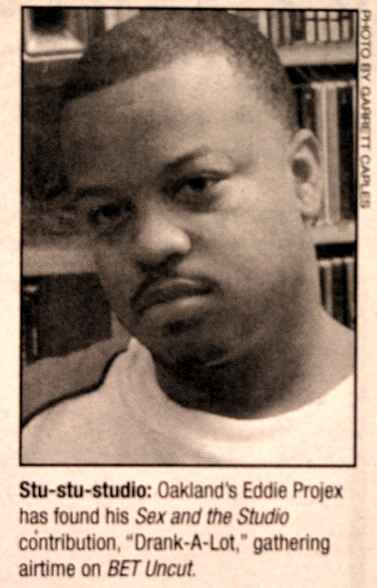
IF YOU SEE the video for "Drank-A-Lot" and aren't too distracted by the clubful of ass cheeks jiggling, you might notice the guy who spits the hook and first verse. He's Eddie Projex, from Oakland's Hittaz on tha Payroll, and the huge grin that never leaves his face throughout the clip is inspired by more than booty and booze. As the lead single from the soundtrack to episode two of the Sex and the Studio series, with verses by better-known buddies Numskull and Money B, "Drank-A-Lot" puts Eddie out front. The video has raised his profile, garnering nationwide "cable play" on BET Uncut, the station's adult-oriented music show (Wednesdays through Fridays, 3 to 4 a.m.). Now, after years of grinding away underground, Eddie's ready to shine.
"I like Hittaz on tha Payroll anyway, and Eddie's voice stands out," says Money B, recalling the "Drank-A-Lot" session. "I said, 'You pick the beat. Tell me which one you dig.' I went out the room, came back, and he'd already laid the hook. I was like, 'Yeeeaaahhhh.' "
Eddie's eagerness and efficiency reflect his persistence over the course of a decade in which Bay Area hip-hop got little mainstream love or major-label support. Along with MCs Polo, Curcinado, and Fletchberg Slim, Eddie formed Hittaz on tha Payroll in 1996.
"When 'I Got 5 on It' came out," Eddie says, referring to the Luniz' 1995 platinum hit, "we was in different groups. Everybody started fallin' off, and we were the only ones left standing. While the Luniz were making their mark, Num was busy doin' him. But we knew each other from back in the day, and when he came back, and sees we were still at it, he couldn't do nothing but accept it." Indeed, Num soon moved beyond acceptance. "He took me off the turf and flew me to L.A. Took care of me, gave me money, bought me clothes. He was like, 'Y'all gotta be my niggas.' "
Numskull premiered his new crew in 1999 on Good Laaawd, That's a Lot of Drank. In 2001, with no distribution deal, the Hittaz sold their debut disc, Underground Like Dead People, straight out the trunk, but it was with the release of Ghetto Storm (2003), on their own City Hall-distributed Hitta Records, that the Payroll began to attract attention. Produced entirely by the Mekanix, save for one banger by Sean T, Ghetto Storm was an instant East Oakland classic, due in no small part to Eddie's hook-writing ability on tracks like the atmospheric gangsta drama "Tha Game" and the sideshow anthem "Rims." Clearly Money B hadn't overlooked this elusive talent when he picked the Fifth-produced "Drank-A-Lot" as the single for Sex and the Studio's episode two.
Currently Eddie is shopping for a deal for his debut solo disc, Now or Never, even as he finishes two others: Ghetto Celebrity, for Hitta Records, and The Eddie Projex Project, for the Mekanix' Zoo Entertainment. In the meantime, taking advantage of the BET buzz, he's about to drop a street-only compilation, Eddie Projex Presents Oakland Street Music, Volume 1, which he hopes to turn into an annual showcase for emerging talent. Volume 1, which will also be sold at East Bay record stores like Rasputin's in Berkeley and Moses Music in East Oakland, features some of Oakland's hottest young artists – like Stevie Jo, E-Maculate, and R&B singer Naté – with production by the Mekanix, Sean T, and Harm and LT. Those unable to wait can check out the Hittaz' 2004 releases: Underground Like Dead People II, a recent Hitta Records mix tape, and Acid, a Polo and Curcinado duo project from FastLife Entertainment.
20061014
Breaking Down the Battle Lines: Frontline's Locksmith and DU's Esinchill
By Garrett Caples
San Francisco Bay Guardian March 16, 2005
ESINCHILL FIRST DROPPED on Digital Underground's Who Got the Gravy? (see "You Ain't Knowin'," page 44), honing his skills with the group for the next five years on the road, and he has the support of fellow D.U. members like Numskull, also of the Luniz. "Esinchill is one of the best artists coming out of the Bay right now," he says. "He's book smart, and that comes out in his rhymes."
He's also a ferocious freestyler, so I was impressed to learn the Frontline's Locksmith beat him in a battle on KMEL, 106 FM, a few months ago. "We went one round, and they was like, 'It's a tie,' " Esinchill recalls. "Then we went a second round, and I fumbled. I couldn't bring it back."
But E remains philosophical. "I think what the Frontline do best is battle. That's where Locksmith shines. But there's a difference between being able to rap and being able to make songs. I think I make better songs."
 He raises an interesting point, insofar as the majority of the Frontline's verses are battle rhymes. The "realness" of the battle rhymer is almost inevitably gauged by "hardness," which we might provisionally define here as experience with, and stoicism in the face of, street life. As much as I dig their refusal to adopt the usual gangsta pose, the Frontline's emphasis on hardness limits their lyrics.
Take four bars of Locksmith on "I Gotcha," from the Richie Rich comp Grabs, Snatches, and Takes (Ten-Six, 2004):
You might see Lock on the block in some Tims and Nikes
Making motherfuckers duck when I extend my right
I'm an mc; I fight with pens and mics
You're a bitch; you fight for women's rights
Like many of rap's memorable moments, the third and fourth lines are at once clever and offensive. The repeated grammatical structure creates the expectation of a similar parallel in logic, which is then violated by the second half of the fourth line. (Remember your SATs: "MC" is to "bitch" as "pens and mics" are to "women's rights" is not the correct answer.) Though he might have shored it up with a better rhyme than "right" and "rights," the structure is complex and compelling, even if – for a UC Berkeley grad like Lock – the sentiment isn't very nice.
Here are four bars from the "Intro" to Esinchill's Everything to Lose! (Rceason, 2002):
Born sick and with seizures, massive head trauma
Bitch-ass doctors woulda killed me if it wasn't for mama
Took me off the medicine, didn't have no more falls
No more emergency phone calls and hospital halls
Though the difference in subject matter makes it absurd to compare these examples, each is representative of the rappers' respective concerns. With the notable exception of "Hennessy," Esinchill doesn't really stunt on brand names, and where Locksmith raps about being hard, Esinchill is introspective at the top of his lungs, eliding pronouns and breaking up syntax to pack a few years into four lines. On paper, "hospital halls" seems like a throwaway, yet on disc it leaps out, neatly condensing a kid's perspective on hospitals: boredom and waiting.
Here's the conclusion of both verses – Locksmith's, then Esinchill's:
Lock: Nigga, me no singer
I'm from the Rich where them boys like to keep those things
And they stay with their ring on bling
And they wear more gold than a Chinese ping pong team
I rap instead; I notice I'm at peace when I rhyme
I think with my dick so let me give you a piece of my mind –
Suck it; me in a nutshell, forever passionate
I'm through with this control; I gotta go, I got some ass to get
We've already heard Lock "stretch metaphors like a Chinese jump rope" on Who R You, so the use of "Chinese" for mere verbal flashiness begins to pall this time around. E's ending crushes it. To hear "passionate" rhymed with "ass to get" is exactly what I turn to rap for. The other rhyme is nearly as pleasing, and the second line's combination of two shopworn phrases leads so inevitably to "suck it," you can admire its formal invention even while declining its invitation.
 Esinchill's versatility in style and subject matter is what makes Everything to Lose! so accomplished a debut. And just as the Frontline's run of luck began with Locksmith's questionable 2003 battle loss on MTV, so Esinchill's buzz has picked up since losing to Locksmith. He's in talks with Hiero Imperium to release his next album, a duo record with partner King Beef called Choice Cuts, while the advance single – the Touré-produced "Hip Hop" – has been bubbling up in Funkmaster Flex's record pool. Maybe losing is everything.